Quick answer: A battery fits only when its case, hold-down, terminal layout and vehicle-approved electrical specification all match. Equal amp-hour capacity or enough tray length does not establish a safe replacement.
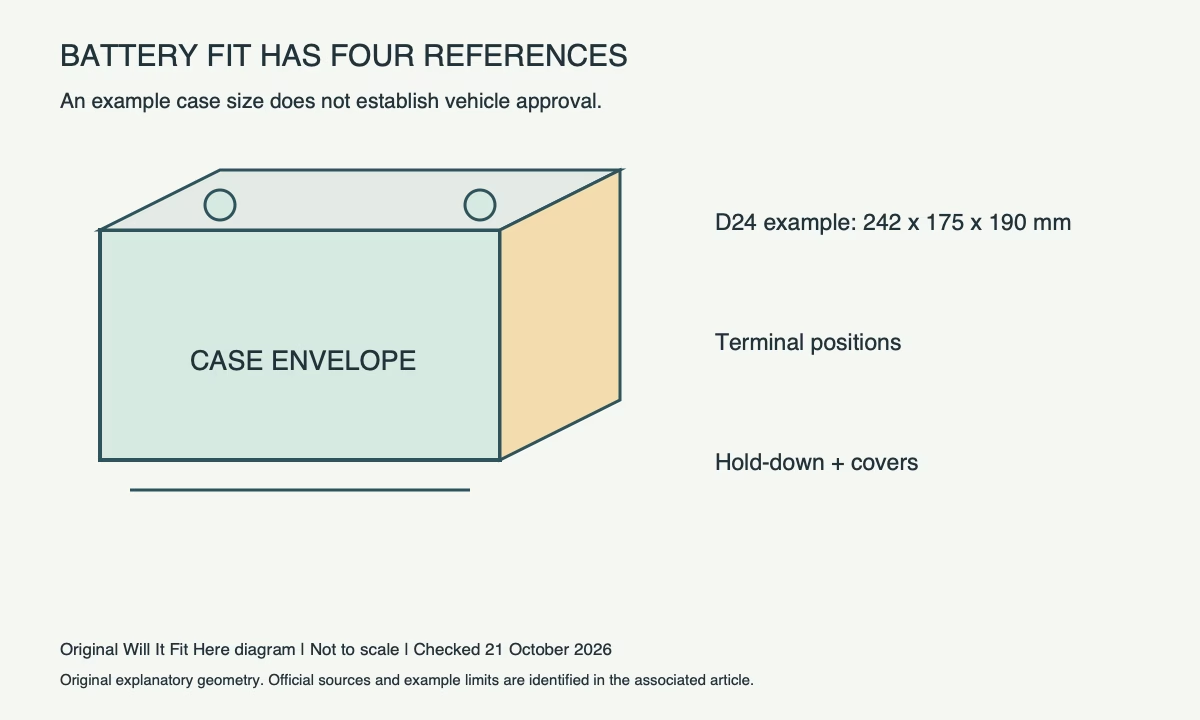
Start with the approved application
Use the vehicle’s exact year, engine and battery equipment in the manufacturer’s application guide. Record the required battery technology as well as the size. A conventional flooded battery, EFB and AGM are not automatically interchangeable because their cases look alike. Any registration or battery-management procedure is a separate vehicle requirement.
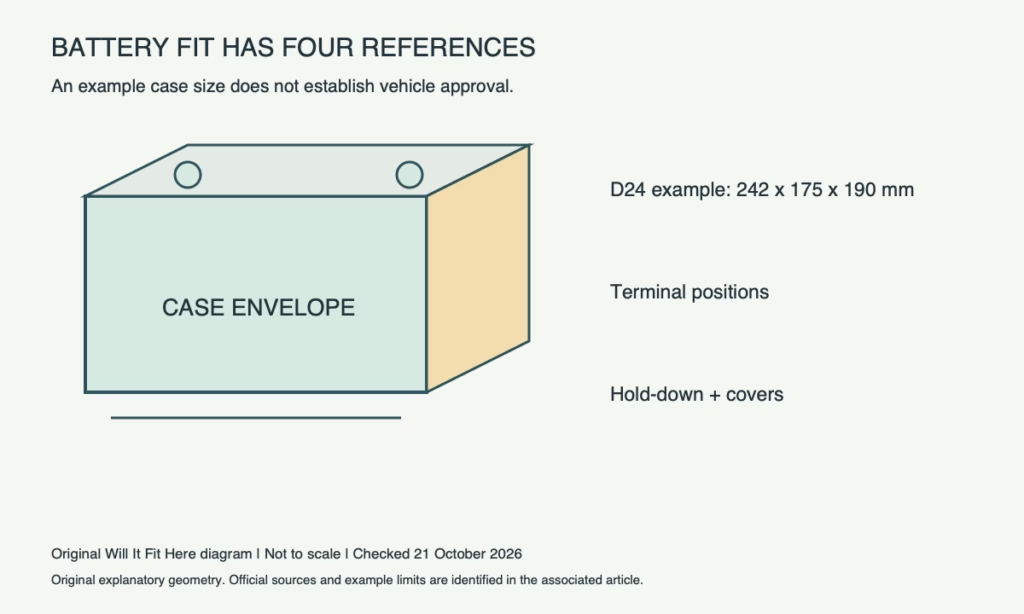
As a concrete dimensional reference, VARTA’s UK Dynamic SLI D24, product 560408054K262, lists a 242 × 175 × 190 mm case and H5/L2 case size. It is an example to identify, not a recommendation for an unspecified car.
Measure three axes and the hold-down
Compare the selected battery drawing with the permitted tray envelope. Include the base fixing profile, clamp position and the space above terminals and protective covers. The bonnet’s clearance is not simply the case height subtracted from a rough engine-bay measurement.
| Reference | What to record |
|---|---|
| Length × width × height | Full case and the drawing’s terminal-height reference |
| Hold-down | Base ledge or top clamp required by the vehicle |
| Terminal layout | Positive/negative positions and post type |
| Surroundings | Covers, vent connection and cable routing |
For a hypothetical tray with 240 mm usable length, a 242 mm case is already 2 mm too long. Do not remove a clamp, cut a tray or omit a cover to turn that mismatch into a “fit.” Even with adequate tray dimensions, reversed terminal positions can leave a cable unable to reach correctly.
Keep fit separate from installation
Do not stretch a cable across the battery or route it where it can rub or be trapped. Match any venting provision and protective parts using the vehicle instructions. Batteries can present short-circuit, chemical and lifting hazards; have a suitable battery installer resolve uncertain applications rather than treating this comparison as a replacement procedure.
Before you decide
- Vehicle-approved technology and electrical specification confirmed.
- Case drawing, terminal positions and hold-down match.
- Correct venting, covers and cable route retained.
- Required vehicle setup procedure identified before replacement.
Common questions
Is the same Ah rating enough? No. It does not describe case geometry, terminal positions, starting performance or technology compatibility.
Can a shorter battery be left unclamped? No. Use only the vehicle-approved mounting arrangement and a compatible battery.
Official sources and scope
Checked October 21, 2026: VARTA UK Dynamic SLI D24 specifications. Confirm the exact product, route or current policy before acting. No firsthand fit test is claimed.
Related guide: Rear Facing Car Seat Fit: 5 Useful Space Checks. This addresses a separate fit check; its measurements do not transfer to the products above.