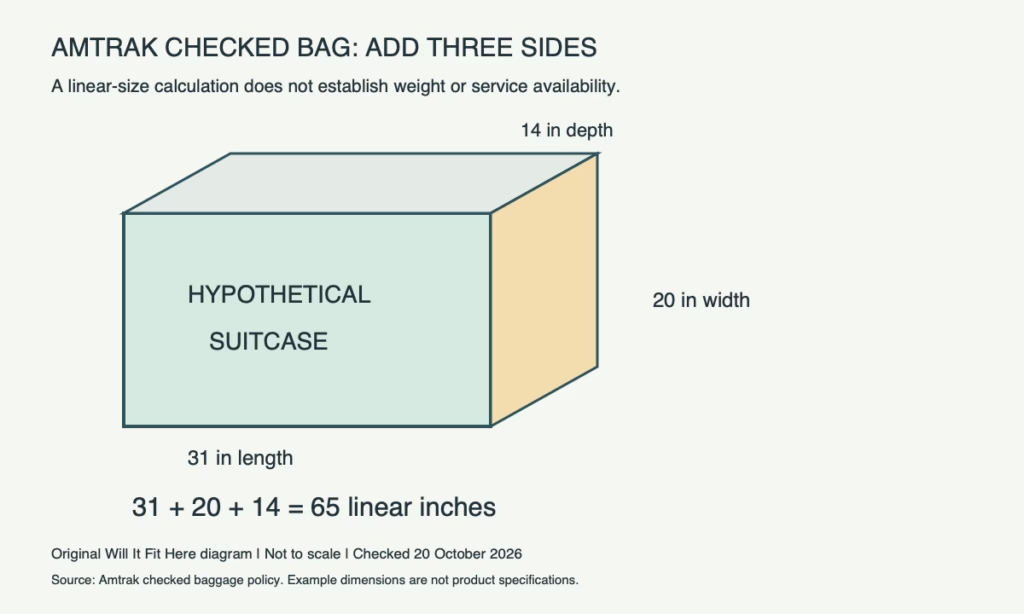
Quick answer: For Amtrak’s standard checked-bag allowance, assess both 50 lb per bag and 75 linear inches, meaning length plus width plus height. Passing that size calculation does not guarantee you can check the bag: your train and the relevant stations must offer checked baggage service. A carry-on allowance is a different test.
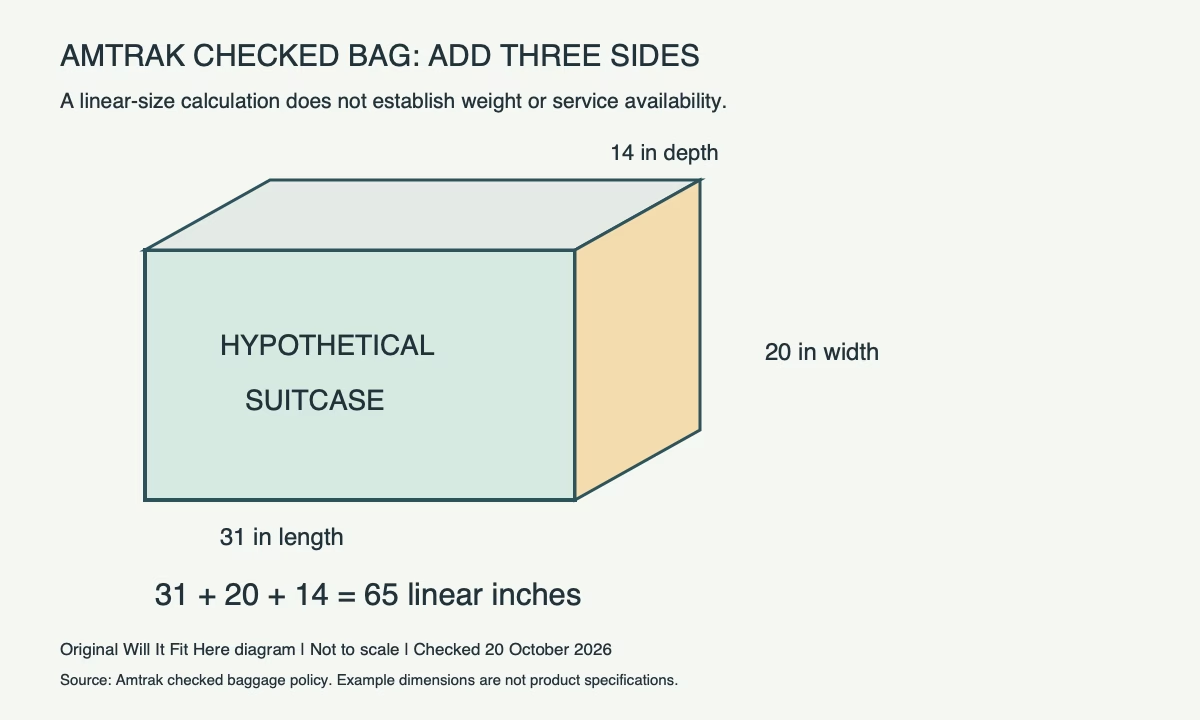
Measure three sides rather than the diagonal
Pack the suitcase fully, close its expansion zipper in the intended position and retract its handle. Use two straight edges to find the overall exterior in each direction. Include wheels and fixed handles in your packing worksheet; a soft pocket may become the deepest point after loading.
Write the readings as L, W and H, then add them. Do not measure around the entire bag with a tape, multiply the sides, or substitute the corner-to-corner diagonal. Those operations describe different quantities.
| Illustrative packed case | Calculation | Standard size comparison |
|---|---|---|
| 31 × 20 × 14 in | 31 + 20 + 14 = 65 linear in | 10 in below 75 |
| 35 × 24 × 18 in | 35 + 24 + 18 = 77 linear in | Exceeds 75; check oversized acceptance |
| 75 linear in expressed in centimetres | 75 × 2.54 = 190.5 cm total | A sum of sides, not one permitted side |
The first example passes only the dimensional calculation. If it weighs 54 lb, reducing its volume without reducing its weight will not solve the weight issue. Weigh each packed bag separately and leave enough practical margin for scale differences and last-minute additions.
Confirm a baggage service for the whole route
Amtrak’s checked-baggage page lists two standard bags free and a separate oversized category for 76–100 linear inches. Consult the current policy for charges, exceptions and acceptance. Do not arrive assuming any large bag can be checked by paying more.
Before packing, check the exact departure and arrival stations and the booked train. Ask Amtrak how transfers affect your checked bag. A staffed station name alone is not proof that every train calling there carries checked baggage.
- Record the booked train number and both station codes.
- Confirm checked-baggage availability and the station’s check-in deadline.
- Check ordinary luggage versus special-item packing rules.
- Keep items needed during the trip accessible in a permitted carry-on.
Plan the station route too
A suitcase can pass a linear-size rule yet remain awkward on stairs, a platform ramp or the route to the baggage counter. Measure your own car opening and leave room for the wheels to turn around the narrowest corner. If you need assistance, arrange it before travel rather than relying on a generous bag allowance.
For a folding bicycle, use our separate Amtrak folding-bike fit guide; bicycle handling and storage should not be inferred from this suitcase calculation.
Common questions
Is 75 linear inches the same as a 75-inch-long bag? No. It is the sum of three exterior dimensions.
Does a 65-linear-inch case qualify as carry-on? That sum alone cannot answer it. Carry-on rules specify separate side limits and can vary by service.
Can a slightly oversized bag be guaranteed acceptance? No. Check Amtrak’s oversized and special-item policies and confirm the service before travel.
Official sources and scope
Checked October 20, 2026: Amtrak checked baggage policy, carry-on baggage policy, and Amtrak travel FAQs. Examples are calculations, not firsthand loading tests or train storage specifications.