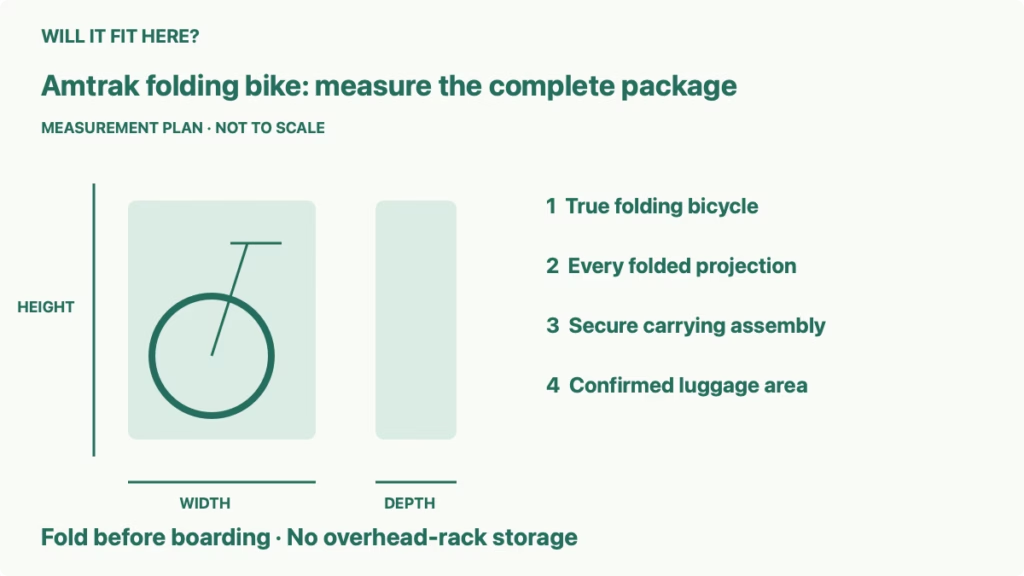
Quick answer: Amtrak folding bike fit requires a true folding bicycle, its complete folded exterior within the current policy and a confirmed storage arrangement for the train. The official page lists folding bikes under 34 × 15 × 48 inches in lieu of a baggage piece. It also says only certain passenger cars can accommodate them as carry-on; otherwise they must be checked.
You are deciding whether a folded bicycle can travel with your luggage rather than in the ordinary full-size bike service. The useful measurement is the compact assembly you will carry aboard, including anything still attached. This guide separates a folded-size comparison from the route, car and storage questions.
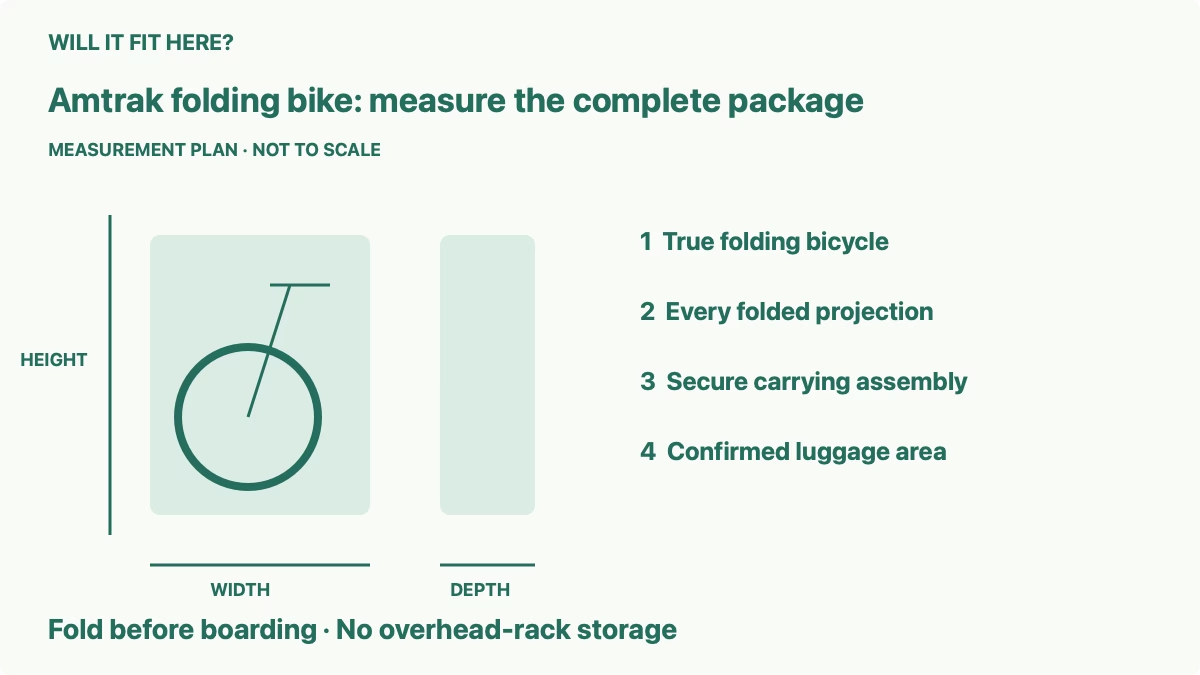
1. Confirm the bicycle category before Amtrak folding bike fit
Amtrak’s folding-bike description applies to bicycles designed to fold into a compact assembly. An ordinary bicycle with wheels removed does not become a folding bike under that description. Establish the product type before measuring a configuration that the policy does not cover.
Find the manufacturer’s folding instructions and the intended transport configuration. Identify which latches, bars or pedals normally fold, and which accessories remain attached. The transport worksheet should describe a repeatable configuration you can achieve without improvising at the platform.
Do not detach structural parts merely to label a regular bicycle as folded. If you own an ordinary full-size bike, investigate the appropriate Amtrak bicycle service for the route instead. The full-size service has its own reservation, handling and storage conditions.
Keep the bike model and intended folded configuration beside the dimensions. They make an inquiry with Amtrak more precise than asking whether an unspecified “small bike” is allowed.
2. Measure the complete folded exterior
Fold the bicycle according to its manufacturer before taking measurements. Use the farthest points of the resulting package, including folded handlebars, pedals, saddle, wheels, carry handle and any retained rack. A manufacturer’s bare-frame measurement may omit an accessory you intend to keep attached.
Compare all three exterior readings with the official 34 × 15 × 48 inch envelope. Do not rely on the bicycle’s unfolded length or wheel diameter. Label the readings clearly, use one unit throughout, and confirm any uncertain orientation with Amtrak.
The official page’s parenthetical metric figures do not form a consistent direct conversion of all three inch figures. This guide therefore uses the published inch envelope. Ask Amtrak to clarify a borderline metric-only specification rather than treating an inconsistent conversion as extra permission.
A hypothetical folded package with a 16-inch thickness fails a 15-inch side comparison even if the other dimensions are comfortably smaller. A spare inch on one side does not cancel an excess on another. This is a measurement example, not a tested bike or acceptance claim.
3. Include accessories and the carrying arrangement
Measure the state you will actually carry. A protruding light, bottle cage or packed side bag can change the result. Decide whether accessories remain on the folded bike or travel separately, then check the final assembly again.
If you use a manufacturer-approved transport bag, record the complete outside dimensions with the bike inside and the closure secured. Fabric can bulge around a pedal or handlebar. Do not assume the bag’s empty dimensions describe the filled package.
Plan how you will lift, hold and move the folded assembly. Protect exposed or dirty components with appropriate transport equipment where required by the operator or manufacturer. Avoid a configuration that opens unexpectedly while being carried.
Check that the configuration can be repeated after the return trip’s ride. A fit decision made with accessories missing at home may be inaccurate once a rack, lock or luggage is added for travel.
4. Confirm the train and permitted storage location
The current Amtrak page says the bike must be folded before boarding. Its permitted locations are luggage areas at the end of the car, or the lower level in Superliners. Folding bikes must not be stored in overhead racks.
That placement requirement is independent of the size comparison. A compact package cannot be approved for an overhead rack just because it looks lighter than another passenger’s suitcase. Confirm the arrangement for the train you booked.
Amtrak also qualifies folding-bike carry-on with passenger-car accommodation and possible checked handling. Contact Amtrak with the route, train, stations and folded dimensions. Ask what happens if the actual car cannot accommodate the package and whether the proposed alternative is available at both stations.
Keep every answer attached to the relevant departure. A successful arrangement on a previous trip does not establish the equipment or available space on the next one.
5. Check baggage allocation and connections
The official folding-bike rule describes carriage in lieu of a piece of baggage. Review your remaining luggage as a complete combination rather than counting the folded bike as an unlisted extra. Confirm current fees and any required arrangements with Amtrak.
List each train on a connecting itinerary. The storage and handling plan must work on every leg, including the transfer station. If the bike needs checked handling on one segment, resolve that segment before assuming you can carry it through the entire journey.
Allow for the practical sequence: fold in a suitable place, secure the compact assembly, carry it to boarding and place it only where directed. This guide does not promise a particular car’s opening size or a guaranteed available luggage space.
If one condition remains unresolved, make an alternative transport plan before departure. A smaller folded package can improve a measurement result, but it cannot create checked-baggage service or the correct passenger-car accommodation.
| Question | Result to record |
|---|---|
| True folding bicycle? | Manufacturer-designed folding assembly |
| Complete size? | Three folded exterior readings including projections |
| Carry configuration? | Accessories, secure closure and any transport bag |
| Storage? | Confirmed permitted luggage area on the train |
| Connection? | Every leg’s allocation and handling resolved |
Common questions
Can I remove a regular bike’s wheels and use this rule? Amtrak distinguishes true folding bikes from regular bicycles with or without wheels.
Can a tiny folded bicycle go overhead? The current folding-bike page prohibits overhead-rack storage.
Does passing the size envelope guarantee carry-on? Confirm the actual passenger-car accommodation and handling arrangement.
For transporting a bicycle by car, see hitch bike rack fit. Browse the Travel guides for separate packing checks.
Official source and limits
Checked October 7, 2026: Amtrak bringing bicycles onboard. Confirm current conditions for your train and stations. Examples are hypothetical; no firsthand train test, guaranteed luggage space or specific car opening is claimed.