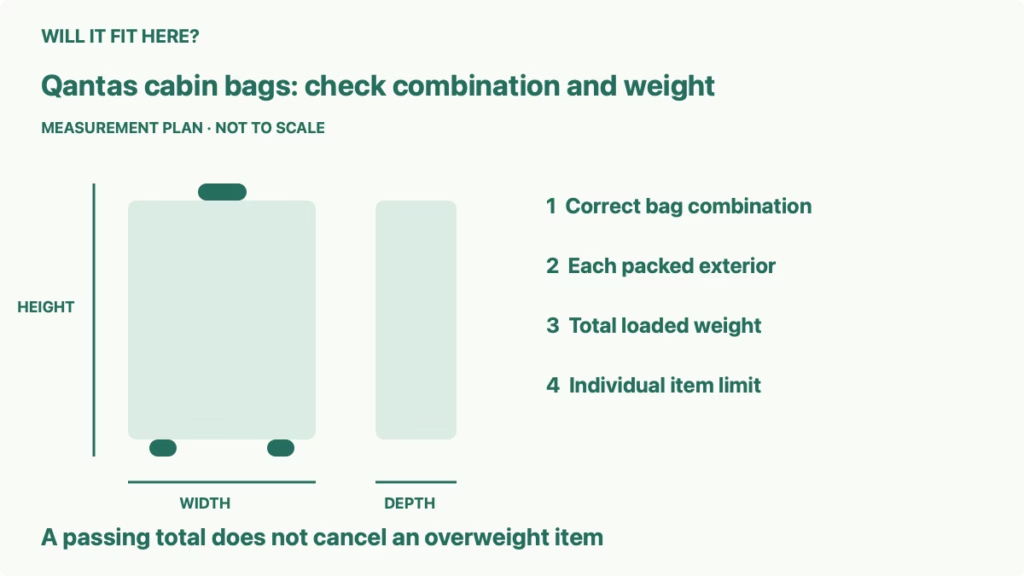
Quick answer: Qantas cabin bag fit depends on the allowed bag combination and weight limits for your route and aircraft, as well as the packed dimensions. Use the current policy for the complete itinerary. A permitted domestic combination may have both a total allowance and an individual-item cap, while an international or smaller-aircraft leg can impose different conditions.
You have a rolling case and a backpack that each look small enough, but that does not settle whether both can travel together. Before packing for a Qantas itinerary, make one worksheet for the complete combination. This guide helps distinguish bag type, exterior dimensions, total loaded weight and individual weight rather than treating “carry-on allowance” as one number.
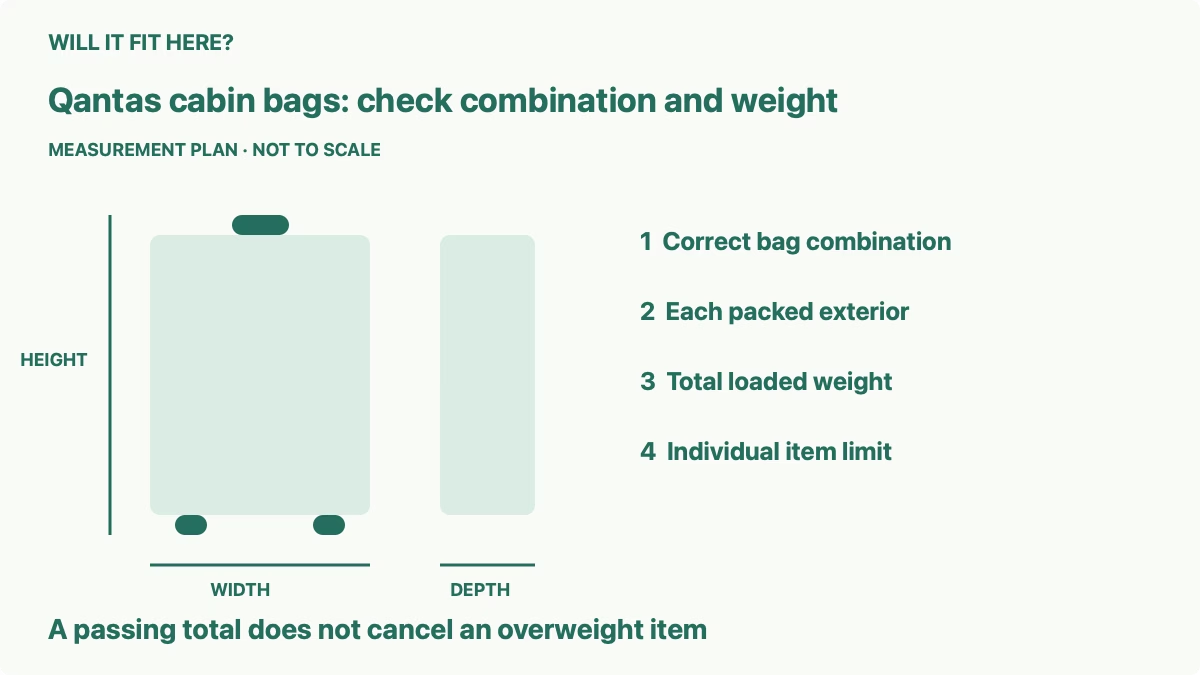
1. Match Qantas cabin bag fit to the route
Record every flight’s operating airline, route, cabin and aircraft where known. Domestic and international allowances differ, and a booking can also include Jetstar or another partner. Do not assume that a Qantas flight number makes a partner-operated flight follow the same cabin baggage rules.
For Domestic Economy and Business, the current page lists an overhead bag, an underseat bag and a personal item, with 14 kg total and a maximum 10 kg per item. International Economy is listed as one overhead bag and one small personal item, with a 7 kg maximum allowance. Its International First, Business and Premium Economy description allows an overhead bag, an underseat bag and a personal item, with 14 kg total and a maximum 10 kg per item.
Those are descriptions of permitted combinations, not an invitation to exchange a backpack for any equally weighted suitcase. Identify the bag type for each piece. An underseat bag is a specified luggage type; the additional small personal item has a separate description.
Recheck the policy after an upgrade, cabin change or itinerary alteration. Write the date of the check beside the flight details. If the flight’s operator or equipment is uncertain, obtain the applicable allowance before using a domestic rule to approve your entire journey.
2. Measure each packed bag in its own category
The current Qantas page describes an overhead bag as up to 56 cm high × 36 cm wide × 23 cm deep. It describes an underseat bag as up to 34 cm high × 48 cm wide × 23 cm deep. Match the complete packed outline to the relevant type rather than rotating the labels to make one convenient number disappear.
Qantas says size measurements include wheels and packed-away handles. Close the bag, retract the travel handle and measure the greatest outside projections. Include a bulging pocket, rigid corner or fixed handle even if the manufacturer’s main-shell drawing looks smaller.
Measure with the expansion zipper in its intended position. A case that matches the allowance when empty or unexpanded may exceed it when ready to leave home. If you depend on compressing a soft bag, check that its normal packed state still works without forcing the contents.
A hypothetical 55 × 35 × 25 cm rolling case exceeds a 23 cm depth limit even though its other two dimensions are smaller. A passing sum of dimensions cannot cancel a side limit. Record all three results independently and leave uncertain measurements unresolved.
3. Check total weight and each item separately
Weigh every bag with its actual contents and the bag itself. Then add the pieces covered by the applicable weight allowance. Keep the individual readings on the worksheet so that the total does not hide an overweight item.
Where the current allowance is 14 kg total with a 10 kg maximum per item, both conditions must be met. As an arithmetic example, 10.5 kg plus 3 kg totals only 13.5 kg but the first item exceeds 10 kg. Two 7.5 kg items each fall below 10 kg but their 15 kg total exceeds 14 kg.
The same calculation cannot approve International Economy, whose stated maximum is 7 kg. Use the rule attached to your own flight. A generous domestic allowance should not become the starting point for packing an international Economy connection.
Account for anything added after the first weighing, such as a charger, clothing or purchases. Reweigh after repacking. Shifting contents can solve a permitted combination’s individual-weight problem only when the final total, size and piece rules also pass.
| Question | Independent result needed |
|---|---|
| May these pieces travel together? | The route and cabin permit the bag combination |
| Does each bag meet its dimensions? | Three complete packed exterior readings |
| Is one bag too heavy? | The applicable individual-item limit |
| Is the combination too heavy? | The applicable total loaded allowance |
| Does every leg work? | Operating airline and aircraft conditions checked |
4. Treat the Dash 8 Q400 as a separate check
The current Qantas page lists Domestic QantasLink Dash 8 Q400 as one overhead bag and one personal item with a 7 kg maximum. It also notes that small wheelie bags do not fit overhead and will be collected at boarding and returned on arrival.
That aircraft note matters even if a rolling case meets the general overhead dimensions. A baggage size allowance does not describe every locker opening or available stowage volume. Plan the handling arrangement for the actual equipment rather than assuming a dimensional pass guarantees in-cabin storage.
Before travel, confirm which belongings must remain with you if the rolling case is collected. Follow Qantas’s current instructions for power banks, spare batteries and other restricted items. Those transport requirements are separate from the dimensions and weight comparison here.
Consider the connection and what you will need during the flight. Pack within the permitted item combination and ask the airline when the collection arrangement is unclear. Do not rely on photographs of another aircraft’s cabin to establish the available space on your departure.
5. Check connections and approved placement
Qantas advises packing for the lowest allowance when a journey combines domestic and international flights, Qantas and Jetstar, or partner flights. Build the worksheet around the most restrictive applicable combination instead of approving each outbound bag against only the first flight.
If more than one carry-on bag is permitted, the current page asks travelers to place the smaller bag under the seat in front. It notes that an exit row or bulkhead requires the underseat bag to go into an overhead locker. Seat location therefore changes placement even when the permitted baggage combination stays the same.
Do not equate the extra small personal item with a second full-size underseat bag. Read the current personal-item description for your flight. Write down which allowance covers the proposed item and obtain clarification for a borderline arrangement.
Finish with a record of bag models, packed dimensions, weights, permitted combination and the rule for every leg. If one condition fails, repack or arrange an appropriate checked-baggage option. A complete comparison gives you a practical decision without depending on a guess about gate enforcement.
Common questions
Does a 14 kg total mean one 14 kg suitcase? No. Where the rule also caps an item at 10 kg, the individual limit still applies.
Can a spare kilogram compensate for oversized depth? No. Size and weight are independent requirements.
Will a compliant wheelie case stay in the Q400 cabin? The current page says small wheelie bags are collected at boarding and returned on arrival.
For another airline’s route distinctions, see Emirates cabin bag fit. The Travel guides cover separate packing checks.
Official source and limits
Checked October 7, 2026: Qantas carry-on baggage allowances. Rules may change and differ for partners. The calculations are hypothetical; no firsthand boarding test, specific locker measurement or acceptance guarantee is claimed.