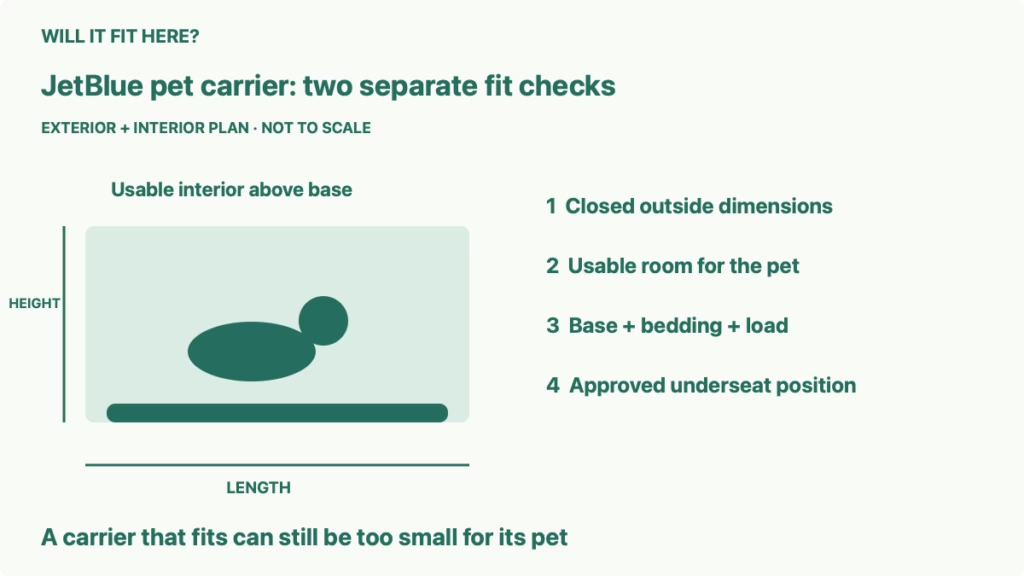
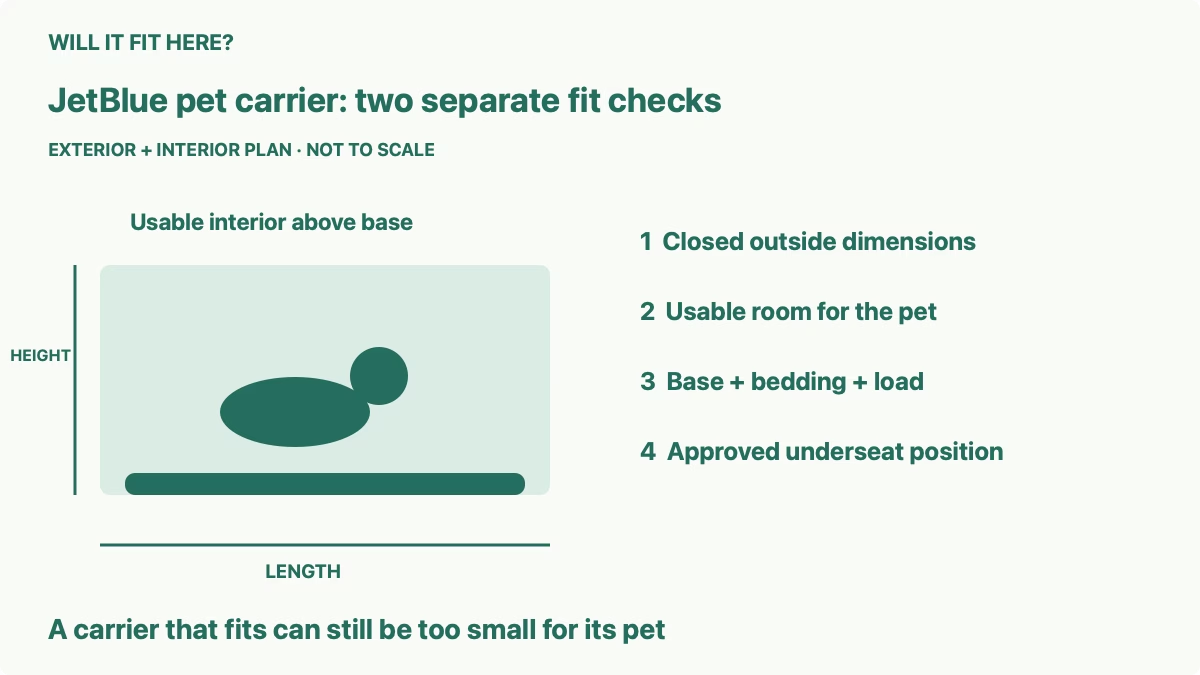
Quick answer: JetBlue pet carrier fit requires two separate results: the complete carrier must meet the airline’s exterior size and underseat requirements, and the pet must have enough usable interior room. The current official page lists a maximum of 17 inches long × 12.5 inches wide × 8.5 inches high. A bag that fits the size limit can still be unsuitable for the animal inside it.
You are comparing low soft-sided carriers for a small dog or cat and want to avoid buying one that is too tall for the airline or too cramped for your pet. Start with your actual animal, the closed carrier and the intended flight. This guide addresses ordinary cabin pets; service-animal requirements are a separate policy.
1. Check the flight before JetBlue pet carrier fit
Confirm that the itinerary accepts your pet before choosing a carrier. The JetBlue page checked October 7, 2026 says that only small dogs and cats may travel as ordinary pets, in Main, and that pets are not allowed in Mint. Interline and codeshare bookings have separate restrictions.
Check the operating flight, departure and destination rather than assuming that every ticket displaying the JetBlue name has the same pet arrangements. International entry requirements also need their own review. A physically suitable carrier cannot resolve a destination restriction, missing documentation or an unavailable pet place.
The official page describes limited pet capacity and asks travelers to book early. Confirm the pet reservation and current requirements with JetBlue. Do not interpret purchasing an appropriately sized bag as reserving a place for the animal on a particular departure.
Keep a simple trip record: flight numbers, cabin, destination requirements and the pet booking confirmation. Review it after an itinerary change. If a flight or cabin no longer accepts the pet, resolve that issue before continuing with a dimensional fit comparison.
2. Measure the carrier’s closed exterior
The maximum size shown on the current JetBlue page is 17 × 12.5 × 8.5 inches, given as 43.18 × 31.75 × 21.59 cm. Keep length, width and height in their stated orientations. A smaller reading on one side does not compensate for another side exceeding its limit.
Measure the carrier with its intended base, bedding and attachments installed. Close it in the configuration that will be used for travel, then identify the greatest exterior projections. Pockets, stiff seams, a shaped roof and a handle that does not lie flat can change the real outline.
Product dimensions may describe an empty carrier before it carries weight. Compare those figures with the actual item when possible and ask the manufacturer what the quoted measurements include. Do not substitute the pet’s length for the carrier’s length or use the base footprint as the entire envelope.
For a hypothetical comparison, a 16.5 × 12 × 9-inch carrier has two sides below the published maximum but exceeds the 8.5-inch height. That does not establish acceptance. A claim that its roof can bend needs clarification from the airline and must not reduce the animal’s necessary usable space.
3. Assess the pet’s usable interior room
The JetBlue page says that one pet is allowed per carrier and that it must be able to turn around comfortably while the carrier is closed. Its linked help page also requires the pet to stand up and move around with ease. This is a separate check from the outside dimensions. The animal cannot use the thickness occupied by the base, padding, seams or collapsed walls.
Measure your actual pet and compare it with the manufacturer’s usable interior dimensions. Body shape matters as well as nominal weight. Two animals with the same weight can need different room because of leg length, shoulder height and overall proportions.
Introduce the proposed carrier at home without forcing the animal into a restricted space. Assess the normal closed configuration and seek appropriate veterinary guidance if comfort or travel suitability is uncertain. Do not treat a still photograph of a pet lying down as proof of comfortable turning room.
Any compression that removes headroom or narrows the turning area needs reassessment. Airline allowance and pet suitability both need to pass at the same time. If no suitable carrier can satisfy both, discuss another travel arrangement rather than solving the height problem by crowding the pet.
| Exterior check | Separate interior check |
|---|---|
| Complete closed length | Usable space around the pet’s body |
| Greatest closed width | Comfortable turning room |
| Closed height in travel configuration | Room remaining with base and bedding |
| Underseat stowage | Ventilation and suitable enclosure |
4. Include the base, bedding and travel load
A removable base can make the bag more stable while taking up some internal height. Bedding has the same tradeoff. Compare the carrier in its final configuration rather than measuring an empty flexible shell and adding a thick pad after deciding it fits.
Check the manufacturer’s load rating, closure instructions and any applicable airline weight restrictions. Weigh the complete arrangement, including the pet and what will remain inside the carrier. A size comparison cannot approve a weight result.
The linked JetBlue help page requires a leak-proof bottom and good ventilation and accepts soft-sided and hard-sided carriers. Keep ventilation panels clear and use the intended carrier components. Do not cut a frame, remove a required support or modify a closure to meet an exterior number. An altered bag may behave differently under load and cannot be approved by the original specification alone.
Record the carrier model, measured exterior, usable interior and loaded weight together. Repeat the check if you change the base, liner or bedding. A growing pet also needs a fresh assessment even when the carrier’s outside measurements remain exactly the same.
5. Confirm underseat placement and everyday handling
JetBlue says that the pet and approved carrier count as a personal item and must fit under the seat in front. The published maximum is a baggage policy, not a guarantee that every seating position offers the same unobstructed space. Confirm seating restrictions and the specific arrangement with JetBlue.
The official page requires the pet to remain in the zipped carrier at the airport and aboard the aircraft, with its stated limited exception for feeding or assistance. Plan access to the zipper and ventilation without treating routine travel as an opportunity to remove the pet from the enclosure.
An additional seat does not remove underseat requirements during taxi, takeoff and landing. Follow the airline’s current placement instructions and crew direction. A pet cannot simply occupy an uncovered seat as a substitute for a compliant carrier.
Assess your ability to carry the loaded bag, move through the airport and lower it into the required position without deforming the pet’s usable space. Keep the fit worksheet with the booking details. If a placement or handling question remains unresolved, ask JetBlue before travel rather than relying on a generic “airline approved” label.
Common questions
Does “airline approved” guarantee JetBlue acceptance? No. Check JetBlue’s current requirements, your itinerary, the actual carrier and your pet.
Can a flexible top solve a height mismatch? Do not assume it does. Confirm acceptability and preserve suitable internal space and ventilation.
Is pet weight enough to choose a carrier? No. Exterior fit, usable interior, loaded weight and itinerary requirements are separate decisions.
For a separate road-trip comparison, see the vehicle fit guides. The Travel guides cover other baggage checks.
Official source and limits
Checked October 7, 2026: JetBlue traveling with pets and JetBlue linked booking policies. Airline and destination rules can change. The diagram and hypothetical measurement are planning aids; no animal travel test, specific seat measurement or acceptance guarantee is claimed.