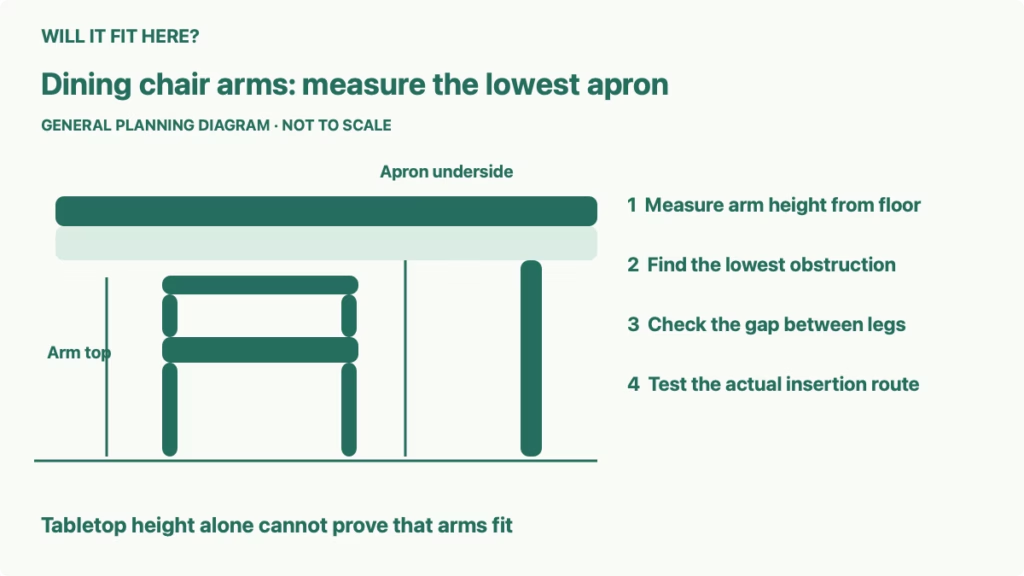
Quick answer: Dining chair arms fit under a table only when their highest point clears the lowest underside along the insertion route, and the chair fits between the table legs. Compare armrest height with the apron or support rail, not just the top of the dining table. Check the chair in its complete, assembled condition on the floor or rug where it will stand.
This guide helps you choose an upholstered dining armchair for a table you already own. The decision is whether the chair can tuck in far enough to leave your room usable, while still working when someone sits down. A comfortable chair and a suitable table can be an awkward combination when their dimensions are checked separately.
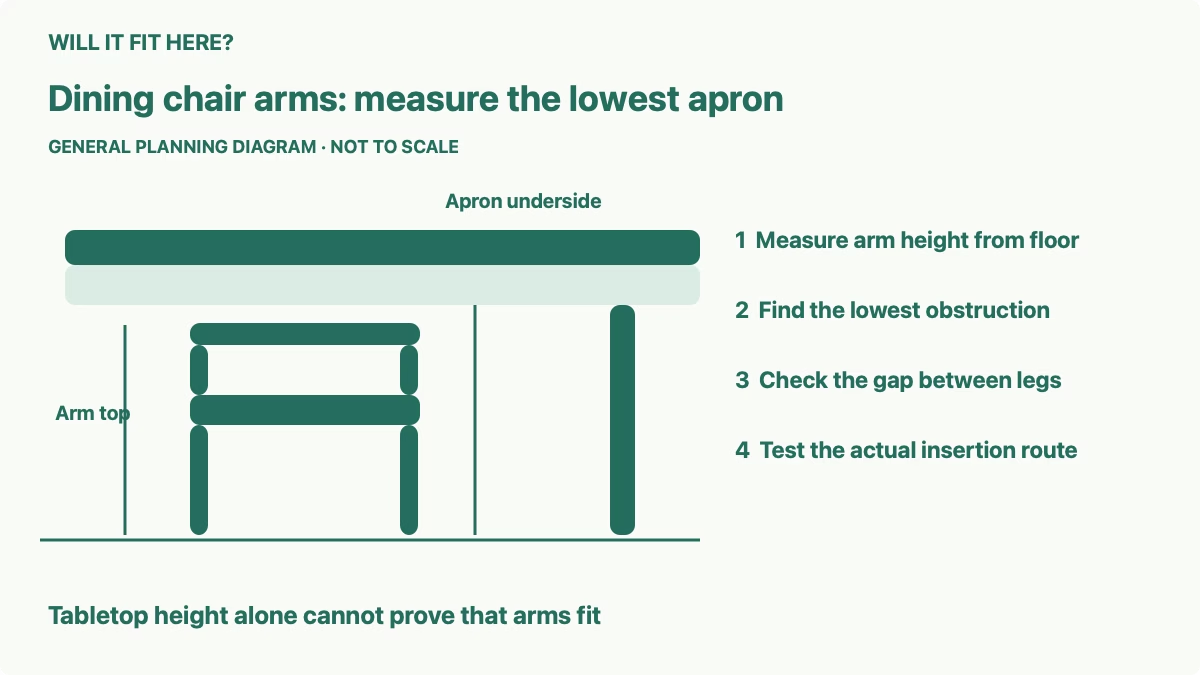
1. Measure the lowest underside, not the tabletop
Start at the position where the chair will enter. Measure vertically from the finished floor to the underside of the table. Look for an apron, a reinforcing rail, an extension mechanism or a bracket that hangs below the top. Record the lowest point the arms would pass beneath.
Repeat at the center and near each end of that seating position. A table can have a high opening in the middle but lower hardware near a leg. Extend the check inward as far as you want the chair to tuck. The front edge is only the beginning of the route.
Use the actual floor surface. A rug changes the chair’s height relative to a table standing off the rug, and an uneven floor can change the apparent clearance. Do not treat the table’s advertised overall height as the available opening. If the underside is absent from the listing, measure your table or ask for a dimensioned drawing.
2. Find the real height of the dining chair arms
Measure from the floor to the highest arm point with the chair fully assembled. Include the upholstered cover, curved arm tip and any manufacturer-approved feet or glides. The seat height and overall back height do not supply this measurement.
A useful example of missing information is IKEA’s English China listing for SAKARIAS chair frame with armrests, article 503.843.31. It gives a 60 cm overall width, 67 cm depth, 96 cm height and 52 cm seat height. Those values do not state the armrest height. A buyer cannot conclude that its arms clear a particular table from that list alone. The page also notes that its cover is sold separately.
Request the complete chair’s arm height when a product page omits it. If you can inspect a display chair, measure the actual version and cover you plan to buy. Avoid deriving arm height from a photograph: perspective and upholstery make a visual estimate unreliable.
3. Compare the vertical clearance with a practical margin
Subtract the arm height from the lowest underside height. A negative result means the arms cannot pass straight underneath. An exact equality leaves no room for normal movement or measurement uncertainty. A small positive value still needs a physical check rather than a guaranteed-fit claim.
For a hypothetical example, an underside 67 cm above the floor and an arm top 66 cm above the same floor leave only 1 cm. That is the arithmetic difference, not a universal recommended clearance. A raised rug edge, curved arm or slightly tilted chair could use it up. Decide whether the route is comfortably clear in the real setting.
Do not rely on upholstery squashing down as the chair slides in, and do not remove a structural table apron to make it fit. If the chair cannot park where you need it, choose a lower arm, an armless chair or a different seating position. The useful decision is made before buying a whole set.
4. Check width between legs and the insertion depth
Measure the narrowest horizontal opening between table legs at the heights where the chair’s arms, seat and legs will pass. Splayed table legs can narrow that opening closer to the floor. An upholstered chair can be widest at its arms rather than its seat.
Make a tape outline of the complete chair width and depth. Slide the outline toward the table along the intended route, then compare the parked projection into the room. A chair’s arms might clear the apron while its front legs meet a stretcher, leaving the back farther from the table than expected.
Check each location if you plan several armchairs. End positions can differ from side positions, and a pedestal table has a different obstruction pattern from a four-leg table. Extendable tables should be checked in every configuration you expect to use. Moving the leaves may also move the available seating positions.
5. Test the seated position and everyday movement
Once the empty chair fits, sit down and check normal use. Can you reach the table without leaning forward? Can you pull out far enough to enter without catching an adjacent chair? Do the arms meet the edge before the seat reaches a comfortable dining position?
Open nearby drawers and check the walking route behind an occupied chair. The tucked position answers the storage question; the occupied position answers the dining question. Both matter in a small room. If only the parked outline fits, reducing the number of chairs may be more useful than forcing a tightly spaced arrangement.
Finish with a simple record for each chair position: lowest underside, highest arm, narrowest gap between legs, intended tuck depth and occupied route. Include model numbers and units so that a later upholstery or table variation is not confused with the one you measured. Confirm local specifications and assembly instructions before ordering.
Common questions before choosing dining chairs
Does seat height tell me whether the arms fit? No. The armrest can rise well above the seat. You need its highest point measured from the floor.
Will a chair that fits one side fit every side? Not necessarily. Legs, rails and extension hardware can change the opening at another position.
What if the listing has no armrest dimension? Ask the manufacturer or seller for it, or inspect the complete chair. Keep the purchase decision unresolved until that measurement is available.
Sources and related fit checks
Manufacturer example: IKEA SAKARIAS listed chair-frame measurements. This English regional page was checked October 7, 2026 and is used to show which measurements are supplied and which still need confirmation.
For the surrounding layout, see our dining table size and chair-space guide. For a taller surface, use the separate counter stool fit checks, which compare seat height, knee room and the complete stool base.