Quick answer: Ceiling fan clearance depends on the blade sweep, the installed ceiling-to-blade drop and the nearest walls or obstructions. Check the exact fan manual before choosing its diameter or downrod. A fan that fits between walls can still hang too low, and a shorter downrod does not automatically create an approved installation.
This guide helps someone replacing a bedroom light, selecting a fan for a low ceiling, or checking a sloped-ceiling location before booking an electrician. It covers the space the assembled fan needs. Room area alone cannot tell you whether the blades, mounting arrangement and light will fit safely.
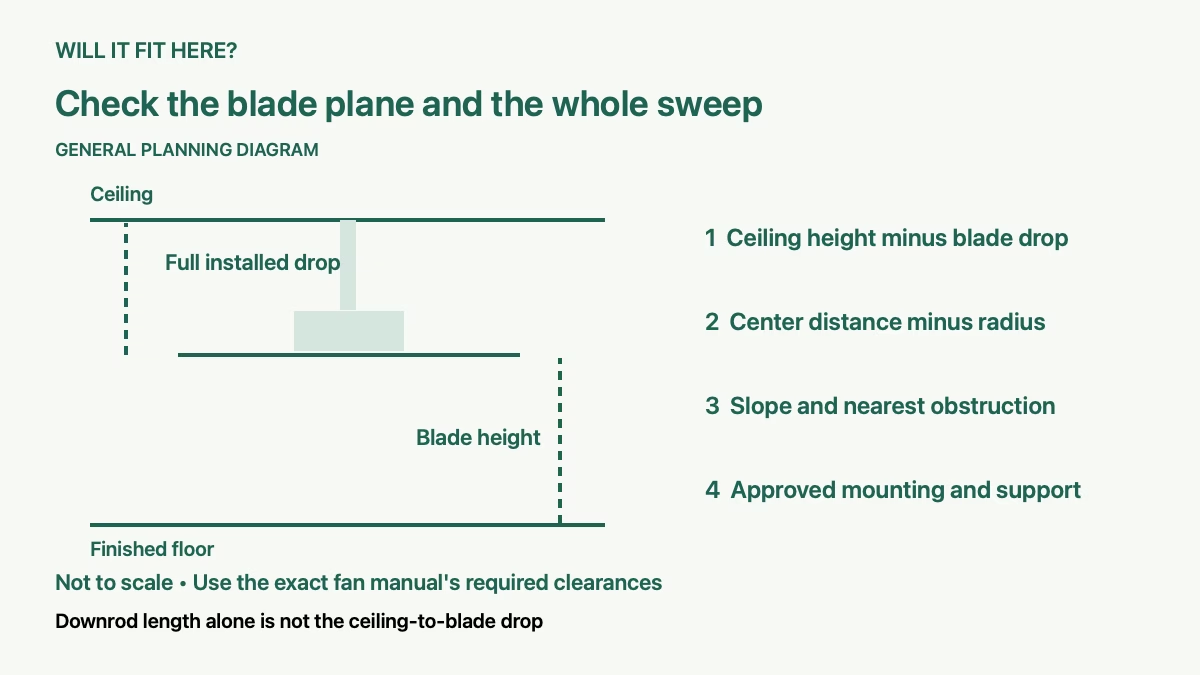
1. Record the complete ceiling fan clearance dimensions
Record the full model number, blade diameter, approved mounting methods and installed drop for the arrangement you intend to use. Check which downrod is included and whether an alternate downrod or low-profile installation is permitted. Some fans cannot use every mounting method shown in a retailer’s general guide.
Separate the ceiling-to-blade measurement from the fan’s overall height. A light kit may hang below the blades. Both matter: the blade plane has a safety requirement, while the lowest point also affects movement through the room and the appearance above furniture.
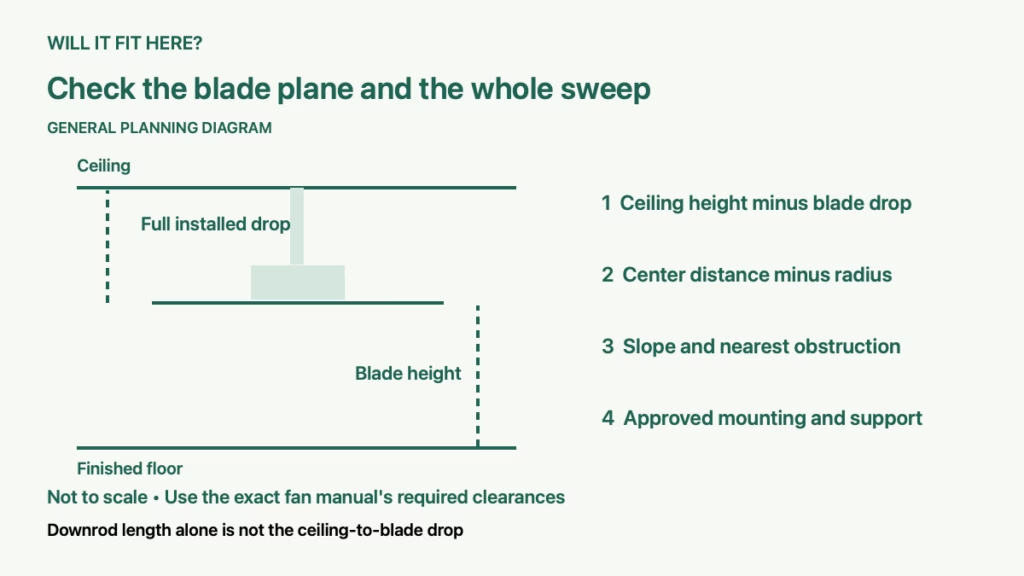
Do not treat the downrod length as the total drop. The canopy, motor and other assembled parts contribute to the ceiling-to-blade distance. If a specification gives only overall height, ask the manufacturer for the blade-plane dimension for the chosen configuration.
2. Calculate vertical ceiling fan clearance
Measure finished floor to finished ceiling at the intended mounting point. Subtract the installed ceiling-to-blade drop to find the blade height above the floor. Compare that result with the exact manual’s minimum. Keep measurements in one unit so that a feet-to-inches conversion does not hide a shortfall.
Hunter’s current installation guide specifies at least 7 feet between floor and fan blades. This is a Hunter planning reference; confirm the instructions for the exact fan and any local requirements with the installer. It is not permission to modify a fan whose approved configuration does not fit.
A hypothetical 96-inch ceiling with a 14-inch installed drop would leave an 82-inch blade height. Against the Hunter guide’s 84-inch minimum, that example fails by 2 inches. Those ceiling and drop figures are illustrative, not specifications for a product. Recheck the approved low-profile options or choose a different fan instead of improvising a shorter suspension.
3. Measure horizontal ceiling fan clearance from blade tips
Mark the proposed center on a room sketch and draw the blade sweep as a circle. Half the stated blade diameter is the sweep radius. Measure from the center to the nearest wall or obstruction, then subtract that radius to estimate the remaining blade-tip gap.
Hunter’s guide calls for 30 inches between blade tips and the nearest wall or obstruction. Use that figure as a clearly identified requirement from that guide, rather than substituting a generic clearance remembered from another fan. The exact model manual and installer should settle any conflicting instruction.
Include beams, sloping ceiling sections, tall cabinets and anything that occupies the blade plane. A room can be wide enough at floor level and narrower where the fan will turn. Moving the fan center to make one side fit can reduce clearance on the other side.
4. Check slopes, lights and furniture together
For a sloped ceiling, record the angle and the mounting-point location. Ask whether the exact fan needs an angled adapter and which downrods are approved. Lowering the fan to clear a slope also lowers the blades toward the floor; both conditions must work together.
Check nearby doors and the lowest light-kit point. Include tall furniture and bunk-bed locations in the sketch sent to the installer. Passing a floor-to-blade measurement does not resolve every reachable obstruction or furniture conflict. Do not use a bed or cabinet as an assumed safe reference height.
If an existing ceiling box is offset from the room center, evaluate the actual position. A drawing that places the fan in the middle of the room does not prove fit at the available box. Have an electrician review any relocation rather than planning around a connection point that is not there.
5. Confirm ceiling fan clearance and support before ordering
Keep a worksheet with ceiling height, installed blade drop, diameter, nearest center-to-obstruction distances, slope and light-kit height. Add the exact manual page references and approved accessory identifiers. An installer can then distinguish a dimension problem from a mounting or electrical problem.
Hunter requires a suitable ceiling-fan-approved box or approved structural support. An existing light fixture does not establish that its box can support a fan. Use a qualified electrician for new wiring, an unsuitable or uncertain box, or work you are not qualified to perform. This guide does not provide wiring or structural fastening instructions.
Before installation, resolve every measurement that fails the manufacturer requirement. A smaller diameter can improve horizontal space without fixing a low blade height. A different mounting method can change vertical space without resolving an obstruction beside the blades. Select the complete approved configuration, then have the installed result checked before use.
Questions before replacing a ceiling light
Does a small room need a small fan? Room size influences selection, but the actual blade sweep, clearances and mounting location still need separate checks.
Can I shorten any downrod? Follow the fan manufacturer’s approved parts and configurations. Do not cut or substitute suspension components to make a failed measurement pass.
Is the overall fan height enough? Ask for ceiling-to-blade drop as well as the lowest assembled point, especially when a light kit is fitted.
Source and related room measurements
Source checked October 6, 2026: Hunter’s official ceiling fan installation guide. Confirm the model manual before buying hardware. Our measurement guides explain other fit checks, and our roller shade depth guide gives another example of separating final fit from installation access.