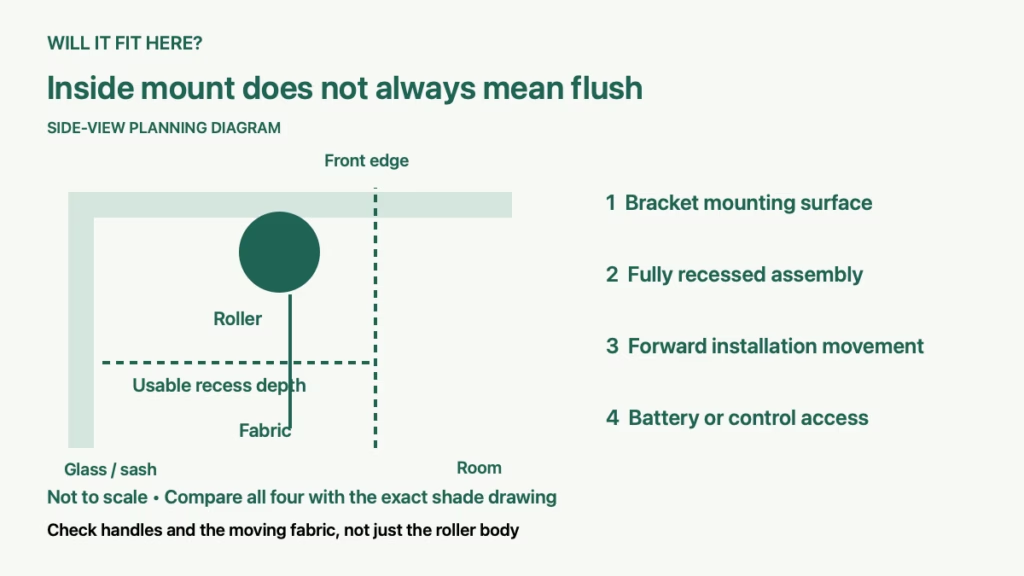
Quick answer: Roller shade depth is not a single measurement. Check the mounting surface needed by the brackets, the depth needed to hide the whole shade inside the window, and the clear space needed to install and service it. A window recess can accept a bracket while leaving the roller projecting into the room.
This guide helps someone ordering an inside-mount shade for a shallow window or replacing a blind with a larger motorized roller. It separates general measurement steps from a specific Lutron Caséta example. Use the dimensions and approved mounting options for the exact shade you intend to buy.
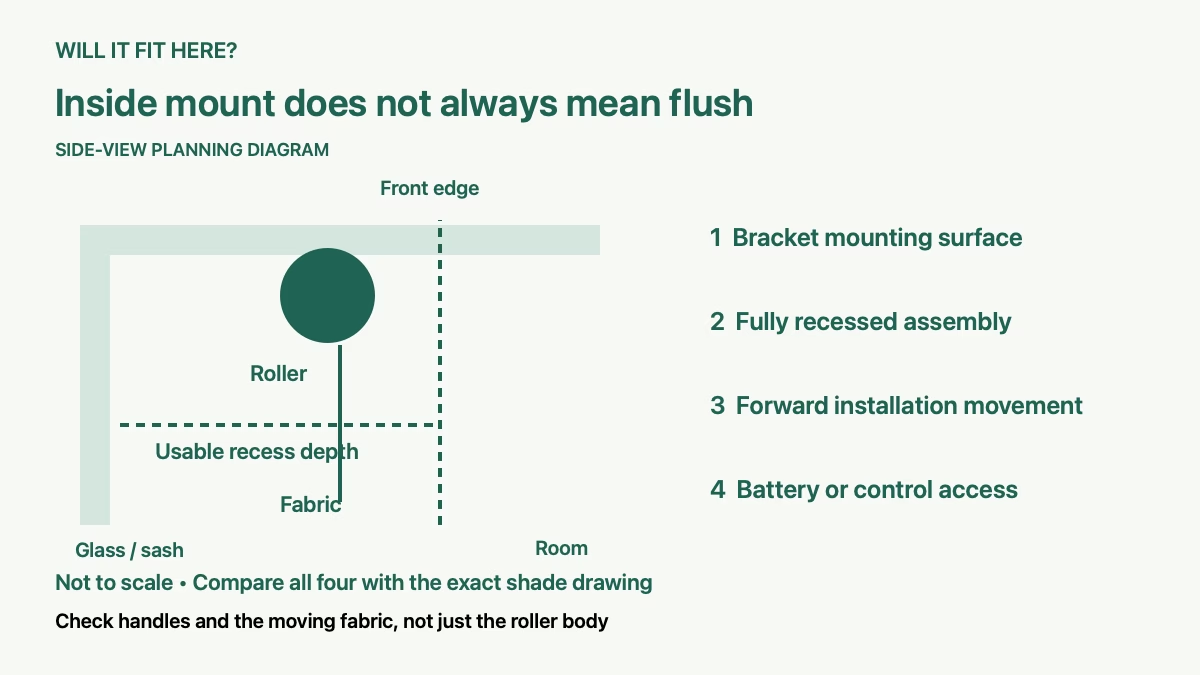
1. Confirm roller shade depth for the complete assembly
Record the shade family, bracket type, power arrangement and any fascia or end caps. The fabric roll alone does not describe the installation envelope. A battery-powered system may need access that a wired system does not, and a decorative cover can change the depth or width.
Ask for the installation drawing before placing a custom order. Find the arrows for minimum mounting depth, fully recessed depth and any forward service clearance. These describe different things. If a retailer gives only one depth number, ask which of those conditions it represents.
For a replacement, photograph the existing opening without assuming the new hardware can reuse its holes. Old brackets can conceal an uneven surface, an obstruction or a mounting position that is unsuitable for the new assembly.
2. Measure roller shade depth at the actual bracket position
Measure from the room-facing edge of the opening back to the nearest obstruction at each proposed bracket. That obstruction may be a window sash, glazing bead or handle rather than the glass itself. Repeat the measurement at both ends; trim and frame profiles can differ.
Record the usable flat mounting surface separately. A deep-looking recess with a narrow ledge is different from a broad, flat header. Do not count an angled or decorative surface as suitable structure without the installer or manufacturer’s confirmation.
Write your results as three entries: left mounting depth, right mounting depth and the shallowest obstruction in the roller’s path. Include a side-view sketch showing where the shade fabric will hang. That sketch makes it easier to spot a handle that clears the roller but catches the fabric farther down.
3. Compare roller shade depth with the recessed-depth requirement
The Lutron Caséta Smart Roller Shade guide, document 045992, says the window jamb must be at least 3.75 inches (95 mm) deep to fully recess the shade. It also specifies front clearance for final installation: 3.75 inches for Type A brackets or 3.5 inches for Type B. These are requirements for the assemblies covered by that guide, not a standard for every roller shade.
A shade can therefore raise two different questions: can it be mounted using an approved method, and will it sit completely inside the opening? Passing the first does not necessarily give the flush appearance expected from the second.
For example, imagine a shallow window that accepts the selected bracket but cannot hide the roller. The useful choices are to accept the approved projection, select a different shade system or review an outside-mount option. Do not simply push the bracket farther toward the glass if that violates the drawing or causes the fabric to touch the sash.
4. Check fabric travel, width and light gaps
Move the window handles through their normal travel and consider the window both closed and open. Check the fabric’s path, the bottom bar and any nearby drapery. A shade that clears the hardware while fully raised can still catch when lowered.
Lutron’s measuring guidance distinguishes bracket-to-bracket width from fabric width: the complete width includes the operator-side and idler-side light gaps. It also notes that roll direction can affect clearance around window hardware. Confirm those choices in the selected system’s ordering instructions.
If blackout is the goal, ask about the actual fabric edges and permitted light-control accessories. A neat inside fit does not promise a dark room. Avoid adding side channels or changing the roll direction without checking their compatibility with the exact assembly.
5. Preserve roller shade depth for installation and servicing
Check the movements needed to fit the shade into its brackets and to remove batteries or reach controls. Nearby walls, valances and curtain rods can block that movement even when the closed assembly fits. Keep the service drawing with your measurements rather than measuring only the final resting position.
The Caséta guide requires access for battery changes and mounting to suitable structural material. It does not treat the battery-powered assembly as suitable for a closed pocket installation. Have an installer confirm the mounting surface and the model’s fastening requirements if these are uncertain; this guide does not specify substitute anchors.
Before ordering, send the installer the finished opening measurements, photos of the obstructions and the selected shade drawing. Measure after trim and other finishes are complete. A planned opening on a drawing can differ from the finished space that must accept the hardware.
Questions for a shallow window
Can I use the same depth for every window? Measure each opening. Identical-looking trim can conceal different sash or handle positions.
Does inside mount always mean fully flush? No. Ask for the fully recessed requirement and compare it with the usable depth you measured.
Should I subtract a standard amount from the width? Follow the exact ordering instructions. Factory deductions, end caps and bracket systems vary; applying a second deduction can make a custom shade unnecessarily narrow.
Sources and related measurement guides
Sources checked October 6, 2026: Lutron Caséta Smart Roller Shade assembly and installation guide and Lutron Application Note 598: measuring for shades. Confirm the guide that applies to your bracket and shade configuration.
For other examples of separating the object from its operating space, see our drawer-clearance checks and measurement guides.