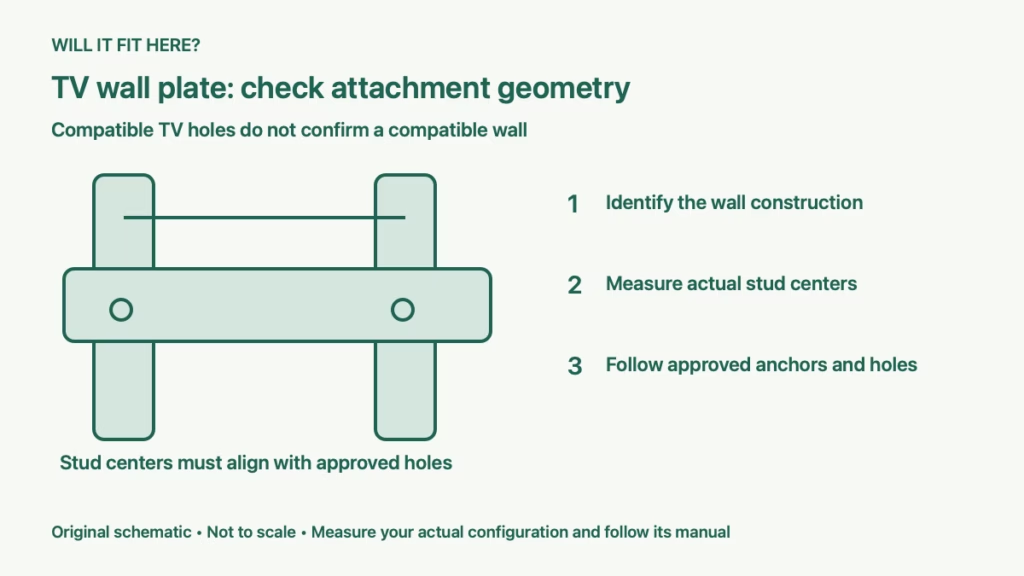
Quick answer: A TV wall plate fits your stud layout only when its approved attachment holes can align with the actual fixing points required by the mount’s instructions. Compatible VESA holes on the television do not answer that question. Check the wall construction, measured stud centers, plate drawing and final screen position before buying or drilling.
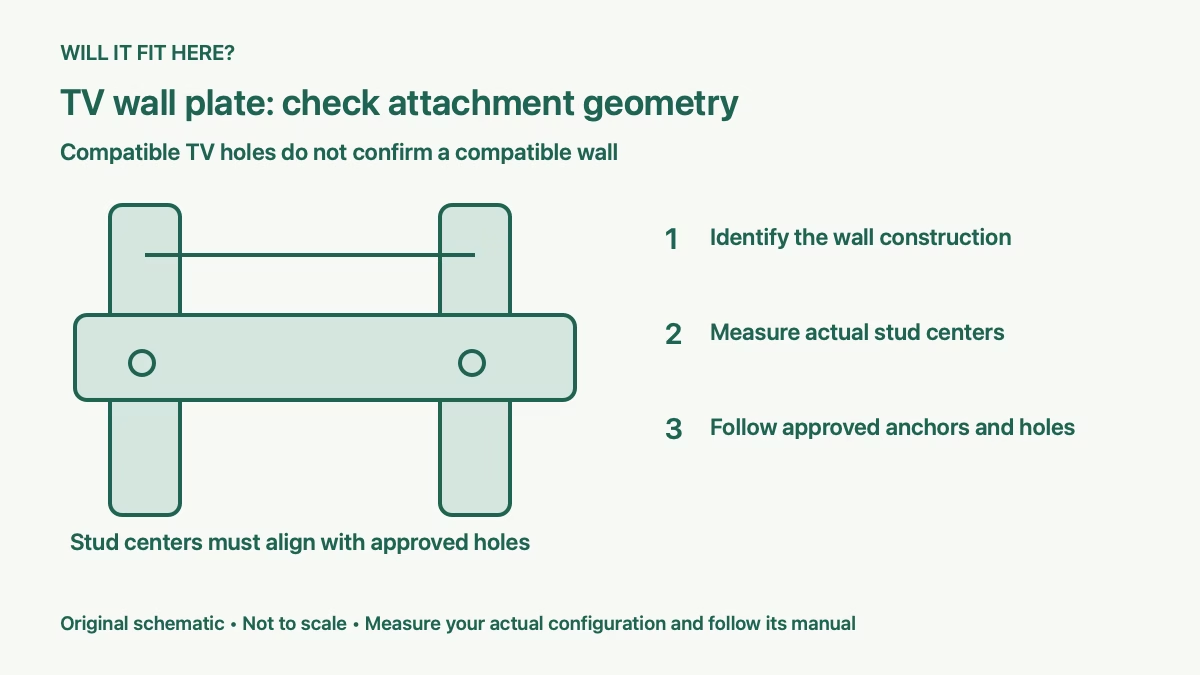
This guide is for someone who has confirmed that the mount accepts the television but is unsure whether the wall plate will work on the intended wall. It helps collect the measurements an installer needs; it does not substitute generic anchor advice for the mount’s instructions.
1. Identify the TV wall plate and permitted wall types
Find the complete mount model, including any revision on the label. Download its current installation manual and technical drawing. Read which wall constructions it permits and whether an accessory kit is required for a particular arrangement. A wood-stud installation method cannot automatically be used on metal studs, hollow masonry or an unknown wall.
The SANUS VLT7 resource section, for example, provides separate installation-manual and technical-drawing downloads. The drawing describes geometry; the installation manual defines the approved attachment method. You need both kinds of information for a TV wall plate check.
2. Measure actual stud centers at the intended height
Locate and verify the fixing structure using an appropriate method for the wall. Measure center to center, not between the near edges of two studs. Record the position relative to a permanent room reference, such as a corner, as well as the spacing.
Do not assume a familiar nominal spacing applies everywhere. A window, corner, fireplace chase or repair can alter the layout. Check the points where the wall plate must attach, and account for the wall finish thickness where the instructions require it. If the construction or hidden services are uncertain, have the wall assessed before any drilling.
Write the results on a simple wall sketch: left fixing center, right fixing center, proposed plate height and desired TV center. This makes it easier to see why a mount can accept a screen yet fail to position it where you want.
3. Compare spacing with approved holes, not overall width
A wide TV wall plate may still have limited usable attachment positions. Look at the hole or slot locations permitted by the manual, the required number of fasteners and any restrictions near slot ends. Do not assume every visible opening is a fixing hole.
Place the supplied template at the planned height and compare it with the verified centers. Mark any conflict with an outlet, trim or other obstruction. Do not drill extra holes into the plate, omit required fasteners or invent a combination of anchors to resolve a mismatch. Select a mount or manufacturer-approved arrangement that supports the actual wall instead.
4. Check where the screen can sit on the plate
The TV’s center and the TV wall plate’s center are not always the same. Some designs allow specified lateral adjustment after attachment; others provide little positioning flexibility. Confirm the allowed movement and any minimum engagement or lock requirements before shifting the screen.
SANUS describes side-to-side shift on the VLT7 for centering with off-center studs. That is a feature of that product, not a general promise that any mount can overcome any stud layout. Mock up the screen outline at the position permitted by your chosen mount.
Check the television itself with our VESA, weight and rear-hole compatibility guide. Keep that screen-to-mount check separate from the wall-to-plate check.
5. Include movement, cables and installation access
A TV wall plate can line up correctly while an extending arm hits a side wall or a screen edge collides with cabinetry. Draw the intended motion envelope and include the actual panel width, rear casing and accessory brackets. Verify cable slack through the permitted movement.
Make sure the release mechanism and locking components remain accessible. An outlet placed behind an open plate still needs its cover, plugs and cable bends to clear the installed hardware. Our TV cable clearance checks cover that connected depth.
Decision: A TV wall plate passes when the permitted wall construction, verified fixing centers, approved hole positions, required hardware and desired screen position agree. If any item is unknown, resolve it with the manufacturer or installer before making a permanent attachment.