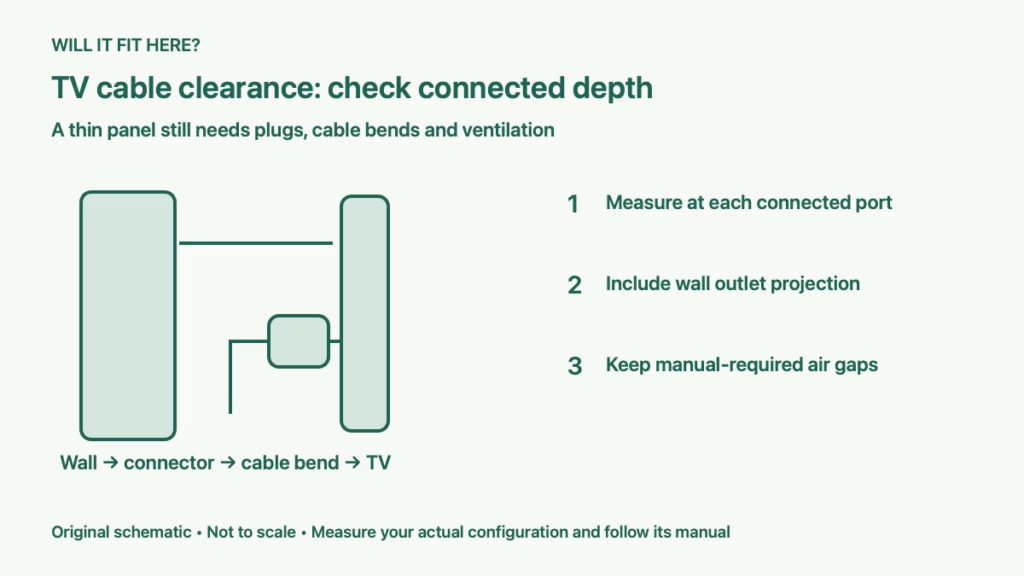
Quick answer: TV cable clearance in a recessed niche must include the connected plugs, their relaxed cable bends, the wall outlet and the ventilation space required by the exact television. A screen that fits the opening can still be impossible to connect or remove. Measure the complete installation before choosing a shallow mount or building the recess.
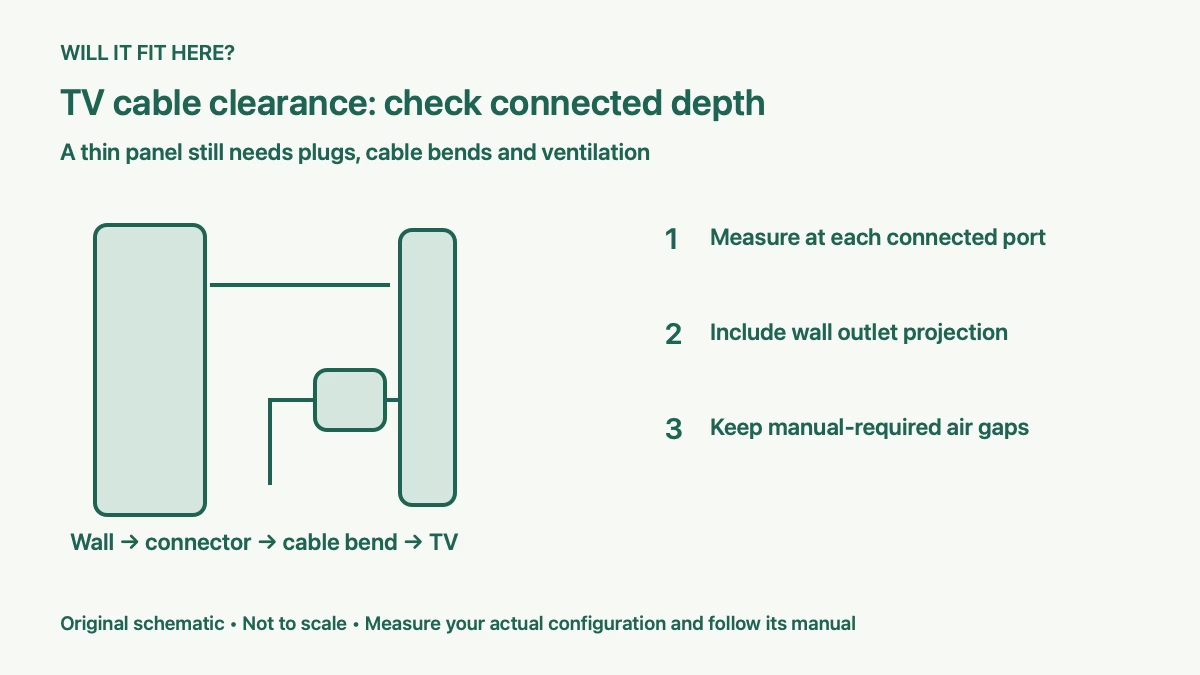
This guide is for someone whose TV width and height already look suitable, but whose HDMI and power connections will sit behind the panel. The useful question is how much working depth remains once everything is plugged in, including the connections you will add later.
1. Map every port before measuring TV cable clearance
Find the exact model and regional version on the label. Photograph the rear panel or use its installation drawing. Mark whether each required port faces backward, sideways or downward. A side-facing HDMI socket and a rear-facing power socket create different clearance problems even on the same television.
Make a connection list: power, soundbar, game console, streaming device, antenna and network cable if used. Include any external connection box and its required cable route. Do not assume that a showroom display with no connected accessories represents your setup.
2. Measure plugs and bends in their working position
Connect the actual cables with the television safely supported according to its manual. Measure how far each plug and natural cable bend projects beyond the panel. Do not force a cable sharply against the socket to make a smaller number. A bulky adapter can consume more space than the original plug.
For each connection, record the panel surface, plug projection and the direction the cable must leave. Keep the cable manufacturer’s bend requirements where specified. A right-angle connector is only an option after checking connector orientation, electrical compatibility and the signal features required by your equipment; it is not an automatic fit fix.
3. Compare the mount with the actual connected envelope
TV cable clearance is not simply the mount’s advertised depth. That dimension uses the manufacturer’s stated reference points and does not necessarily describe your rear casing, protruding socket or wall outlet. Check the mount drawing and the television’s mounting geometry together.
For example, the SANUS VLT7 product page lists a 2.10-inch product depth and describes extension for cable access. Those are features of that mount, not a universal connected-TV clearance requirement. An outlet cover, surface-mounted box or cable trunking still occupies space in your recess.
Make a side-view sketch showing the wall, mount, TV casing, plug and bend. If an outlet overlaps the wall plate or a connector overlaps an arm, the installation may fail even when the total depth appears sufficient. Compare this with our existing TV mount compatibility checks.
4. Keep ventilation separate from TV cable clearance
Read the television’s installation instructions for required air space and permitted mounting arrangements. Use the Samsung manual finder or your manufacturer’s equivalent with the full model number. A cable fitting behind the screen does not establish adequate airflow around it.
A deep niche can surround the top and sides even when the TV front is flush. Mark each manual-required gap independently. Do not fill ventilation space with loose cable coils, a power brick or decorative trim. If the planned enclosure is not covered by the instructions, obtain model-specific guidance before closing it in.
5. Test access and motion before finishing the niche
Allow a practical route to release the mount locks, unplug equipment and remove the screen. TV cable clearance must remain usable when a tilting or extending mount moves; check that cables neither pull tight nor snag. The screen must also clear the niche edges through its intended motion.
Use a cardboard side profile and tape marks for an early check, then confirm with the actual equipment before permanent finishing. Have the appropriate help for handling the TV. For the earlier delivery stage, our boxed TV transport guide explains why packed dimensions require their own check.
Decision: Proceed only when TV cable clearance, permitted ventilation, mount operation and service access all pass. If one fails, revise the recess, cable route or approved mount arrangement. A tight visual fit is not proof that the completed installation will work.