Quick answer
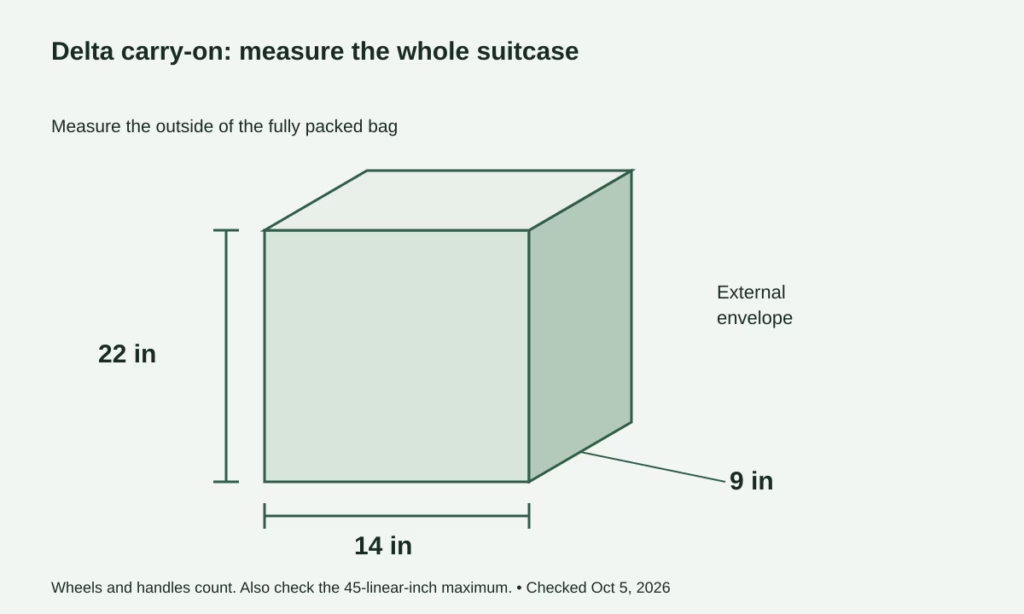
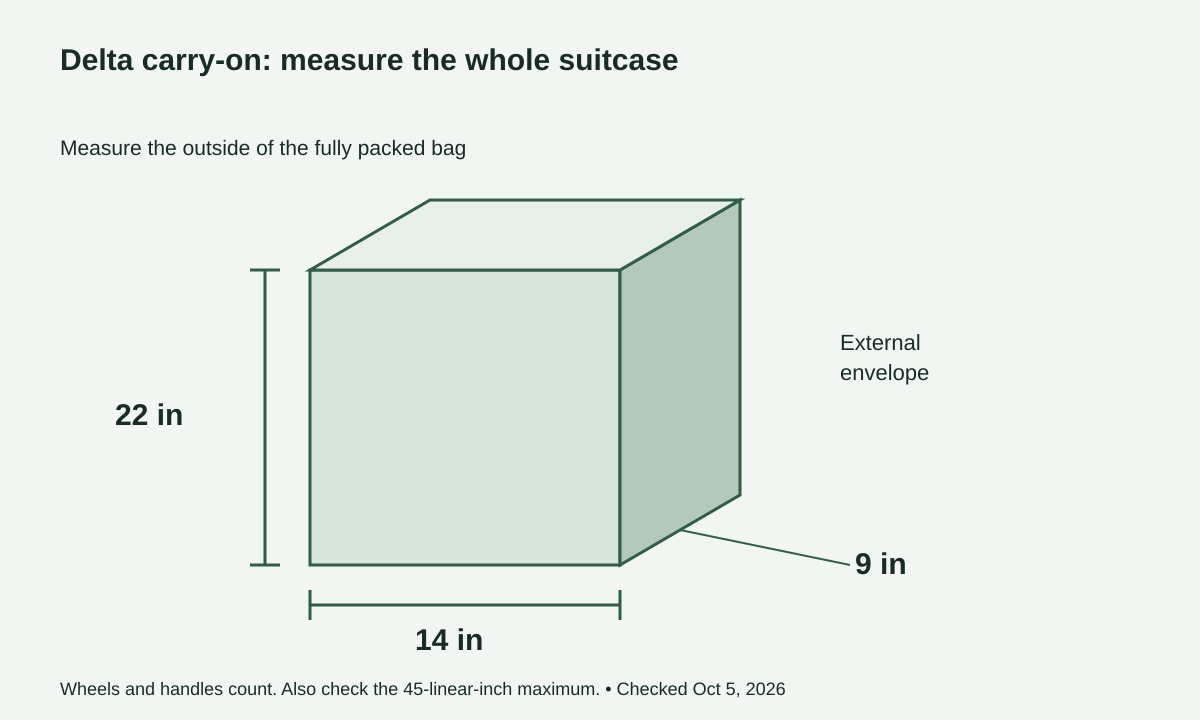
Delta’s carry-on size ceiling is 22 × 14 × 9 inches, including wheels and handles, with a combined maximum of 45 linear inches. A “22-inch suitcase” can be too tall if 22 inches describes only its shell. A bag within the size limits can still need gate checking when aircraft storage is limited.
Policy checked October 5, 2026 · Original measurement guide
In this guide
The Delta carry-on size checks
Delta publishes both individual measurements and a combined linear limit on its carry-on baggage page, checked October 5, 2026. Use both. Adding dimensions is not a way to trade spare width for extra height.
Delta also lists metric figures of 56 × 35 × 23 cm and 114 cm combined. These are the airline’s published rounded figures; exact conversion of 22 × 14 × 9 inches is 55.88 × 35.56 × 22.86 cm. Do not mix rounded values from different unit systems to manufacture a larger allowance. If a metric-only product is borderline against the published metric figures, confirm with Delta rather than rounding in your favor.
The important shopping distinction is between a nominal size, shell size and overall size. Only the full exterior can be compared meaningfully with a limit that includes the hardware.
Shell height versus overall height
A suitcase shell is the main container. Overall height includes whatever extends beyond it when the bag is ready to stow: wheels below, a fixed top handle above, and sometimes feet or protective corners. Product listings do not all use the same size naming convention.
For example, a shell measuring 21 inches may become 22.5 inches once its wheels and top handle are counted. That illustrative case is half an inch above Delta’s height limit even though the shell is comfortably shorter than 22 inches. A product named “22-inch” could have a different relationship between those measurements.
Look for a specification labeled “overall,” “exterior including wheels” or an equivalent clear description. If the page gives only one number with no diagram or explanation, ask the seller. Measure the delivered suitcase yourself while you can still return it.
Do not assume a model’s newer generation has the same wheel housings or handles as an older review.
Measure a packed suitcase in five steps
- Close the case with your actual load inside and set expansion to its travel position.
- Retract the telescopic handle and include the remaining fixed hardware.
- Measure overall height from the floor to a flat book resting on the highest point.
- Measure width and depth between parallel flat surfaces, including pockets and feet.
- Add the three overall measurements, then compare each measurement individually.
Stand back and check that your reference surfaces are parallel. A tilted book can exaggerate height, while a tape draped over a curved lid measures surface length rather than the outside envelope. Repeat a borderline measurement rather than rounding it down.
For soft-sided luggage, weight in the pockets can change the result. A bulging front panel may establish the depth instead of the molded bottom. For hard-sided luggage, an expansion section can create the same problem even when the unexpanded case was purchased specifically as a carry-on.
Write down the packed results and the date. That record is useful for your own planning, but is not an approval certificate.
Why 45 linear inches is not enough
| Overall dimensions | Sum | Dimension verdict |
|---|---|---|
| 22 × 14 × 9 in | 45 in | Meets these published numerical limits |
| 23 × 13 × 9 in | 45 in | Height is 1 in over |
| 21 × 14 × 10 in | 45 in | Depth is 1 in over |
| 21.5 × 13.5 × 8.5 in | 43.5 in | Below each individual limit |
All four are hypothetical measurement examples. The second and third show why a product description that says only “45 linear inches” is incomplete. Their totals look right, but one side is too large. A long narrow box could satisfy a sum while being completely unsuitable for a typical bag compartment.
Use a two-stage checklist: first compare all three sides, then add them. For an ordinary rectangular bag measured in inches, a bag within all three stated maxima will also total no more than 45 inches. Keeping the sum on the checklist helps reveal a transcribed or misread product specification.
A margin below the maxima is your own planning choice, not a promise of tolerance.
The expansion-zipper trap
An expandable suitcase has at least two relevant sets of dimensions. The unexpanded specification does not describe the bag after you unzip the expansion gusset and fill the extra space. Closing the main zipper without closing the expansion section leaves that extra depth in use.
Suppose your case is 8.5 inches deep unexpanded and 10 inches deep after expansion. The first measurement leaves half an inch below the 9-inch limit; the second is one inch over. Those example dimensions explain why a return journey can produce a problem even when the outbound bag was carefully checked.
Before buying, ask whether the listed dimensions are expanded, unexpanded or both. Before returning home, remeasure with souvenirs and laundry inside. Compressing clothes can reduce a soft bulge, but it cannot remove the dimensions of a rigid wheel assembly or frame.
Do not make a last-minute packing plan that depends on closing an overloaded zipper by force.
Aircraft space and Delta Connection
Delta’s guidance warns that full flights or limited aircraft storage can mean gate checking. Its FAQ specifically describes personal-item-only cabin carriage on Delta Connection flights with 50 seats or fewer, with larger bags tagged for the cargo compartment. Read Delta’s aircraft and carry-on details for the current wording and follow instructions for your flight.
This is a different question from whether your suitcase meets the published measurements. Passing the dimensional calculation does not create space in a small overhead bin. Check the operating carrier and aircraft information for every leg, especially when connecting between a mainline flight and a regional service.
Prepare for the possibility that the roller will travel separately. Review the airline’s instructions on items that must remain with you, and keep essentials accessible so you can respond to crew instructions without unpacking the entire case at the gate.
Do not generalize one aircraft’s storage space to every flight carrying a Delta flight number.
A better suitcase buying checklist
- Read the exact model’s overall dimensions, including wheels and handles.
- Check unexpanded and expanded depth separately.
- Compare every dimension, not only the 22-inch product name.
- Check the three-dimension sum in the same units.
- Consider the weight and shape of the suitcase when empty.
- Pack and measure it during the seller’s return window.
- Review the operating carrier and any regional leg before travel.
If the retailer cannot clarify whether wheels count, choose a more transparent listing rather than assuming they do. Reviews can flag ambiguity, but the specification and your own measurement are stronger evidence for your particular purchase.
A smaller case is not automatically better for every traveler. It must still hold what you need and be manageable when packed. Choose a clearly documented exterior that works for your actual itinerary instead of buying the largest nominal number you can find.
Common questions and reference
Can a 23-inch bag qualify because its total is 45 inches?
Not under the ordinary published individual limits. Delta states a maximum of 22 inches in the corresponding direction as well as the combined limit.
Does the 22-inch limit apply to a personal item?
This guide covers the main carry-on. Delta separately describes a personal item that fits underneath the seat; do not use the overhead-bag dimensions as a personal-item promise.
Will a compliant roller always stay in the cabin?
No. Aircraft capacity and operating conditions can still require gate checking.
Official source checked October 5, 2026: Delta Air Lines — Carry-On Baggage. This guide uses published requirements and original illustrative calculations, not a physical airline test. Recheck your itinerary and current policy before flying.
For a European connection, compare a US-size carry-on with Ryanair and easyJet before assuming the same roller fits.