Quick answer
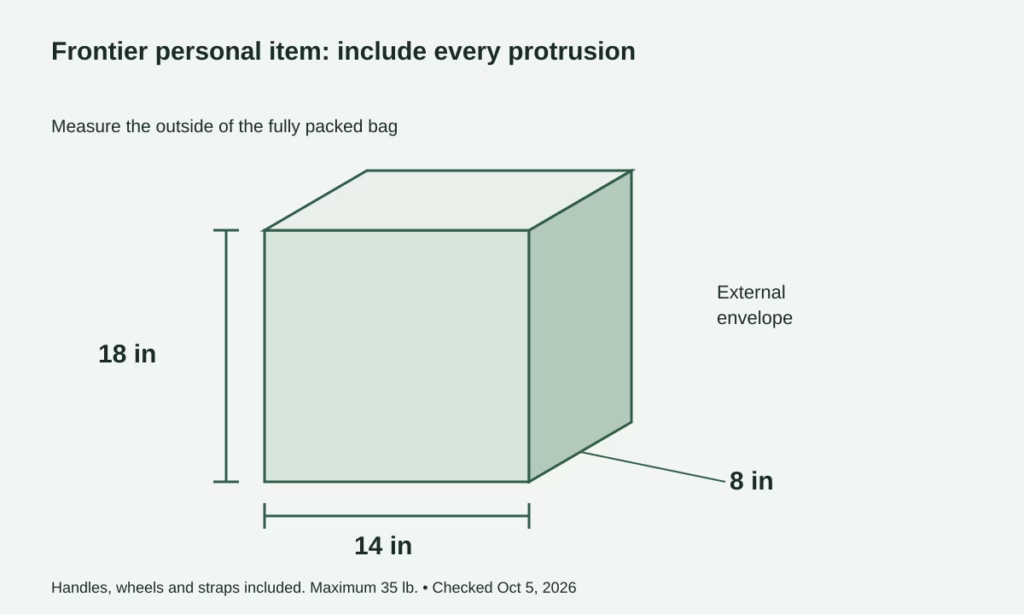
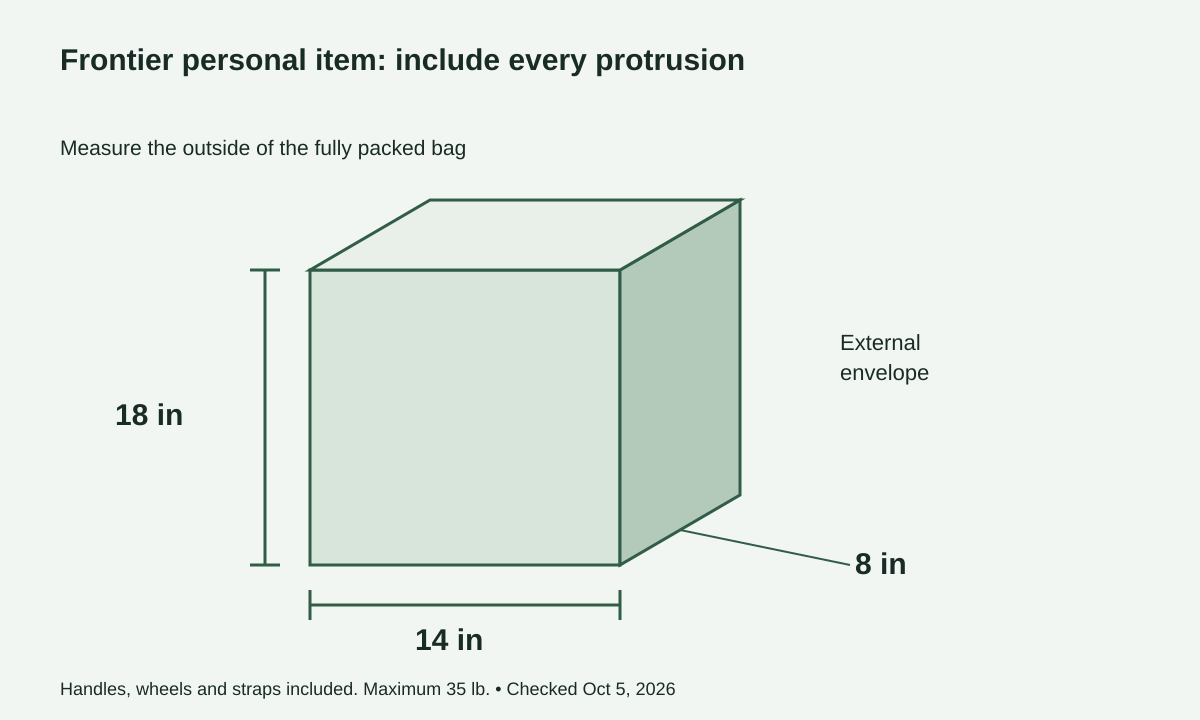
For a Frontier personal item backpack, compare the packed exterior with 18 × 14 × 8 inches, including handles, wheels and straps. The current weight ceiling is 35 lb, and the item must fit under the seat. An empty-bag size or liter rating cannot establish packed fit.
Policy checked October 5, 2026 · Original measurement guide
In this guide
Start with Frontier’s published size
Frontier includes one personal item with every fare. The dimensions and weight in the quick answer come from its official Bag Options page, checked October 5, 2026. This guide concerns that personal item, not the separately listed overhead carry-on category.
Work in inches if that is what your tape and the bag’s specification use. For reference, the exact conversion of 18 × 14 × 8 inches is 45.72 × 35.56 × 20.32 cm, using 2.54 cm per inch. Rounded metric values can conceal a small overage, so keep the original units when a bag sits close to the limit.
A rectangular envelope is a useful way to screen a bag at home. It does not establish the dimensions of a specific airport’s metal sizer or any unpublished allowance around the stated limit.
The straps-and-pockets measurement
Put your normal load in the backpack, close it and arrange its straps as you will carry it. Check not just the fabric body but also the strap padding, buckles, handle and loaded side pockets. A dimension that excludes these parts is not a complete external measurement.
To measure depth, place the bag between a wall and a straight board or large hardcover book. Keep the board parallel to the wall, touching the outermost point without pressing it inward. Measure that gap. Repeat at the widest and tallest points, because a bag with a rounded top is not equally wide everywhere.
Pay particular attention to bottles. A side pocket may look negligible when empty but add meaningful width when filled. A bottle on the front can add depth. Moving it inside is useful only if the resulting bag stays within every limit. Do not assume a clip-on pouch or dangling accessory disappears from the measurement.
Record the results after packing, not from memory or from the empty product page.
Why an extra inch of depth matters
| Packed backpack | Difference from limit | Conclusion |
|---|---|---|
| 17.5 × 13 × 7.5 in | Below each dimension | Dimensionally within the envelope |
| 18 × 14 × 9 in | 1 in too deep | Fails the dimensional comparison |
| 19 × 12 × 7 in | 1 in too tall | Less width does not offset extra height |
These are hypothetical bags. They show why an 18-inch product label is incomplete. The second bag reaches the height and width limits exactly but exceeds depth by 12.5%. A soft sweater in the front pocket might account for that inch; a rigid camera insert might account for it too. The remedy depends on which it is.
For the third bag, look for a fixed frame or laptop compartment. If that component is 19 inches long, reducing the clothing load does not make the bag 18 inches long. Turning it sideways does not solve the sorted three-dimension comparison: its longest dimension is still longer than the largest allowance.
Use the calculations to identify the problem rather than trying to average the three results.
Why liters and “personal item” labels are weak evidence
Multiplying 18 × 14 × 8 inches produces a rectangular box of 2,016 cubic inches, approximately 33.0 liters. That is a geometry calculation, not the usable capacity Frontier promises and not a recommended bag capacity. Interior padding, taper and curved corners reduce usable space. A manufacturer’s capacity method may differ too.
A 25-liter bag can be too tall. A larger stated capacity can be achieved using expansion panels that make the bag too deep. Neither number gives a reliable verdict without external measurements.
Treat “personal item backpack” as a shopping category rather than a certification. Ask which airline and which current measurements the seller had in mind. If a listing presents photos of several bag sizes under one title, make sure the dimensions belong to the exact option in your cart.
Prioritize a clear dimension drawing and a workable return policy over a long list of airline names.
Build a simple home template
You can test the outline with an 18 × 14-inch paper rectangle plus an 8-inch depth gauge. For a more complete screening tool, use an open box whose inside space matches those measurements. Check each inside dimension after assembly; cardboard thickness and sloping sides can make a homemade box misleading.
Set the packed bag into the reference space and see which part, if any, crosses the boundary. Keep a note of the packing changes you make. A box that bends outward when the bag is inserted does not demonstrate fit within the original envelope.
This is not a simulation of a particular gate procedure. Its purpose is to find avoidable measurement problems before travel. If your conclusion depends on squeezing a rigid insert or holding the bag down continuously, use a less borderline packing plan.
Repeat the check after adding your final travel-day items. Headphones, snacks and an extra layer may be small individually but occupy the very pockets that set the outer dimensions.
Purchase checklist for a Frontier backpack
- Get exterior measurements for the exact model, with straps and handles considered.
- Check the rigid back-panel length and the minimum depth of any camera or laptop insert.
- Look for an expansion zipper and measure in the setting you will actually use.
- Pack-test side pockets with the actual bottle or accessories you intend to take.
- Weigh the complete travel load, keeping a practical margin below the ceiling.
- Inspect and measure the delivered bag during the return period.
If you are choosing between a rigid organizer and a soft pouch, consider the shape as well as protection and convenience. A rigid organizer establishes a minimum dimension even when half empty. A soft pouch may use irregular gaps more efficiently, but it does not make the airline’s limit larger.
Choose based on what you must carry. Buying a shallower bag is of little use if the equipment you need forces its front panel outward.
If the backpack does not fit
Frontier says it checks personal-item size during boarding and oversized items are subject to an additional charge. Its Bag Options page separates the personal item from the overhead carry-on, which has different limits and may be purchased or included with certain bundles. Confirm your own booking rather than assuming an overhead bag is included.
Before changing baggage, try removing optional items and remeasure. If the excess is structural, a different bag or appropriate baggage allowance is the more predictable solution. Check the current price and conditions directly with Frontier for your flight; this guide does not quote a universal gate fee.
A previous uneventful trip does not prove that a bag meets the current dimensions. Likewise, another passenger’s anecdote about a sizer does not alter the official rule. Base the decision on a repeatable measurement of your own packed bag.
Questions and source
Is 35 lb a target weight?
No. It is the published maximum, and it does not override the size or underseat requirement. Pack a load you can manage comfortably.
Do backpack straps count?
Yes. Frontier explicitly includes straps alongside wheels and handles. Arrange them for travel and account for any remaining protrusion.
Will a 19-inch backpack pass if I underpack it?
Only a real measurement can show its reduced exterior. A rigid 19-inch panel remains 19 inches; a collapsible empty fabric extension may behave differently. No gate outcome is guaranteed.
Official source checked October 5, 2026: Frontier Airlines — Bag Options. Conversions and worked examples are original calculations. The diagram represents a published dimensional envelope, not a measured airline sizer.
Flying with more than one airline? Check the separate Ryanair personal-bag envelope before reusing the same backpack.