Quick answer
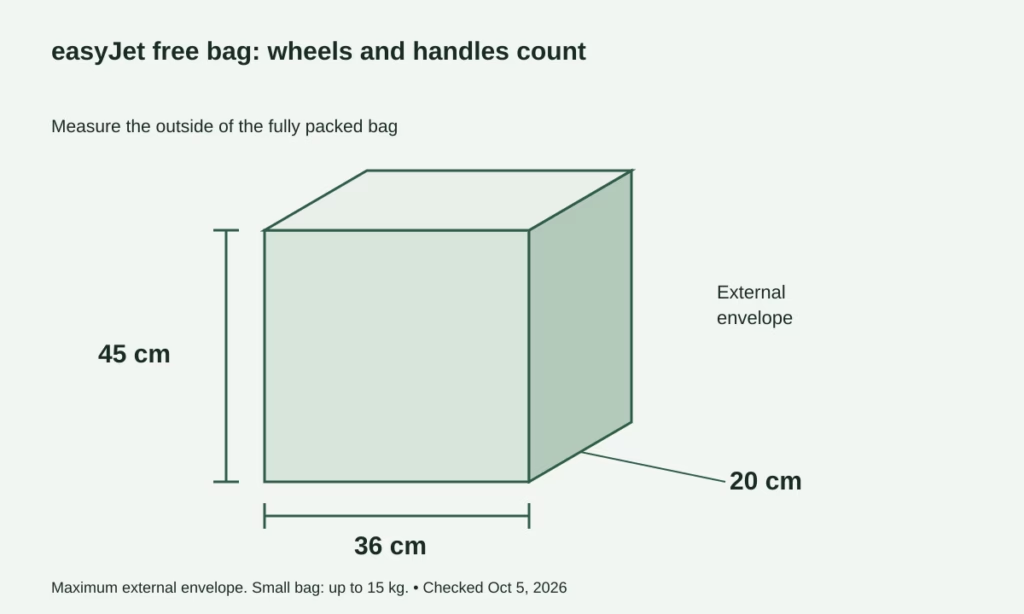
An easyJet underseat bag may be up to 45 × 36 × 20 cm, including wheels and handles, with a maximum weight of 15 kg. It must go under the seat, and you need to be able to lift and carry it yourself. Check a trolley’s overall size, not just its shell.
Policy checked October 5, 2026 · Original measurement guide
In this guide
What the free allowance covers
The current easyJet cabin-bag page distinguishes a small underseat bag from a large overhead bag. This article focuses on the free small bag. Measurements and policy details were checked on October 5, 2026; your booking remains the place to confirm any additional baggage you have included.
A backpack, tote or compact trolley can be assessed using the same outer-envelope method. The product type does not replace the dimension check. A trolley advertised as “underseat” may have protruding wheel housings, while a soft tote can become much wider once its side pockets are filled.
Think of fit as three questions: is the packed exterior inside the allowance, is the weight within the limit, and does the booked bag category match the one you intend to carry? A yes to one does not answer the others.
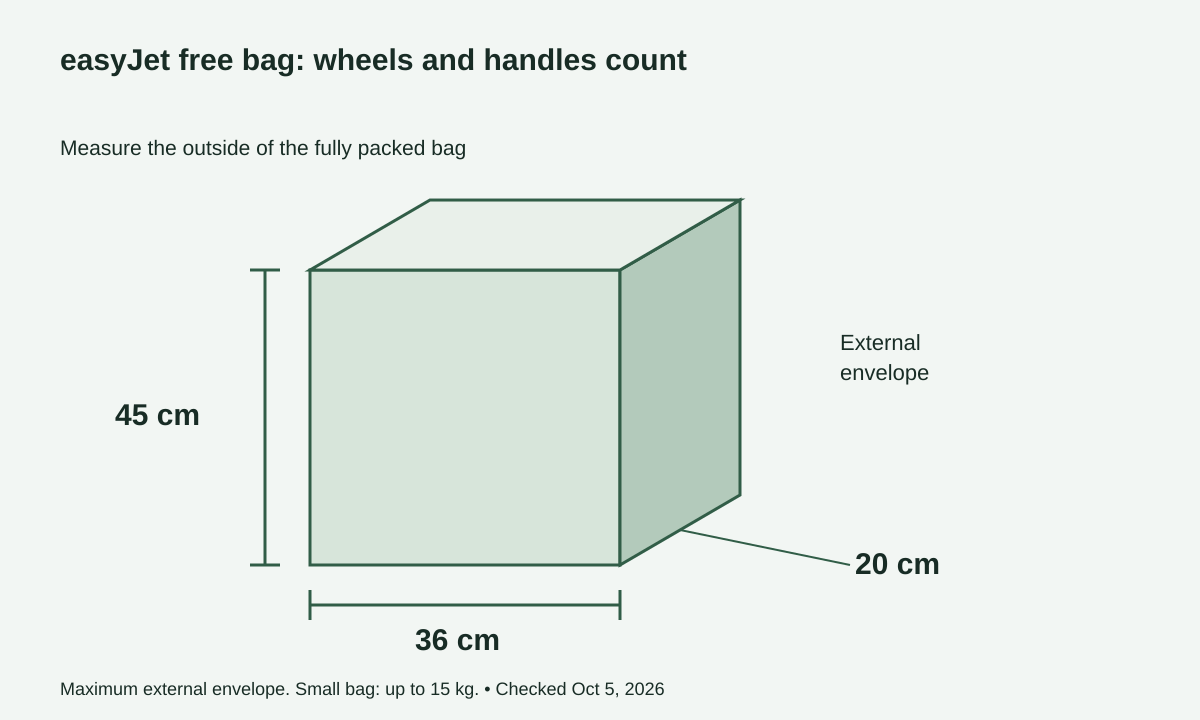
Measure wheels, handles and pockets
For a small trolley, retract the telescopic handle completely and stand the case on a flat floor. Put a flat board or book across the highest fixed point and measure vertically from the floor. This captures the wheels below the shell as well as the top handle. A manufacturer’s “body height” may exclude both.
Measure width at the widest hardware or fabric point. Measure depth with the front pockets packed and any expansion zipper in the position you will use. If a front pocket contains shoes, its bulge may become the deepest point even though the case’s base looks shallow.
- Use two flat surfaces to find the full distance across a curved bag.
- Record overall dimensions with the exact packing load.
- Include fixed feet, rigid handles and wheel housings.
- Do not substitute the handle’s extended pulling height for its stowed travel size.
With a backpack, repeat the depth measurement after putting it on and setting it down. Contents shift. A bag that meets the limit only while flattened by hand needs a more realistic packing check.
Worked examples: backpack versus trolley
| Example | Measured exterior | Fit calculation |
|---|---|---|
| Compact backpack | 44 × 34 × 19 cm | 1 cm height, 2 cm width and 1 cm depth below the limit |
| Trolley with 43 cm shell | 47 × 34 × 20 cm overall | 2 cm too tall once wheels and handle are included |
| Loaded tote | 42 × 38 × 19 cm | 2 cm too wide despite being short enough |
These examples are invented to illustrate the arithmetic, not endorsements or first-hand luggage tests. For the trolley, the relevant number is 47 cm. Its 43 cm shell measurement cannot make it compliant. Reducing the contents is unlikely to change the height of rigid wheels and handles.
The tote may be fixable if the extra width comes entirely from loosely packed side pockets. Emptying those pockets and redistributing the contents could help, but measure again: reducing width can increase depth. You need all three dimensions to work at the same time.
Check the weight separately
easyJet’s current small-bag limit is 15 kg, with self-lifting and carrying required. The official cabin-bag policy is the source for that limit; do not rely on older summaries describing unrestricted weight.
For a home check, weigh the packed bag directly on a suitable scale. If you use a bathroom scale by weighing yourself with and without the bag, the difference is only as dependable as that scale’s resolution and repeatability. Repeat the comparison and leave a practical margin for items added later. That margin is a personal planning choice, not an airline tolerance.
A dimensionally small bag can still be heavy when filled with books, camera equipment or chargers. Conversely, a lightweight but swollen bag can fail the size check. Write the weight beside the dimensions so that neither test disappears from your pre-trip list.
Choose a load you can handle comfortably during the actual journey. A maximum is a ceiling, not a packing target.
Plan around the packed shape
The airline’s allowed dimensions are not a technical drawing of every seat’s usable footwell. This guide does not assign a universal underseat opening size. Your seat, aircraft and surrounding fittings may affect how you position a bag, and crew directions take priority during travel.
Before departure, check whether your bag can retain a flat, compact shape rather than spilling outward when laid on its back. A cylindrical bottle placed along an outside edge can turn a neat rectangle into a curved bulge. Putting that item inside may improve the envelope, provided it does not press against fragile electronics.
Keep frequently needed items accessible without needing to spread the entire bag across the floor. This is a packing convenience, not a rule about acceptance. Do not treat remaining space under the seat as permission to bring a bigger bag than the published allowance.
Before buying an underseat bag
- Request total exterior dimensions, with wheels and handles included.
- Check the exact color, generation and size if the listing groups variants together.
- Ask whether dimensions are expanded or unexpanded.
- Look at the empty bag’s weight before allocating the rest of your load.
- Confirm a rigid laptop case will fit inside without stretching the bag.
- Check the seller’s return window, then measure and pack-test promptly.
Liters cannot settle this purchase. Multiplying 45 × 36 × 20 cm gives a 32.4-liter rectangular envelope, but bag capacity figures describe something different and may be measured differently by sellers. A tall, narrow bag can claim less volume yet still exceed the height limit.
When comparing two options, a slightly smaller bag with clear overall measurements can be easier to verify than one advertised exactly at the limit using ambiguous shell dimensions. Avoid paying more for an airline-branded claim unless the measurements support it.
When you need a large cabin bag
The large-bag envelope is 56 × 45 × 25 cm, including wheels and handles, with a 15 kg limit. It requires the appropriate booked or included allowance. Check easyJet’s allowance table rather than assuming a large bag comes with every ticket or seat selection.
This distinction matters when a small trolley fails only one free-bag dimension. A case may be physically suitable for the overhead category but still require an allowance you have not added. Compare both the bag and the booking before you leave home.
Do not buy an upgrade based only on this article’s dimensions. Read the options offered for your particular flight, their availability and the current price. If you decide to check a bag instead, that is a different baggage route with its own requirements. Keep any carrier instructions about items that must stay with you handy.
Questions and official reference
Does “45 cm suitcase” mean it fits?
Only if 45 cm is the full external measurement in the relevant direction. Ask whether the quoted size includes wheels and handles, then measure the delivered bag.
Can I leave the expansion zipper open?
Measure it that way. If the expanded exterior exceeds the small-bag limits, closing it or changing your baggage plan is necessary.
Can an app measurement replace a tape?
easyJet describes its app sizing tool as a guide and recommends a tape measure before travel. For a borderline bag, a careful physical measurement is more useful than a screenshot.
Official source checked October 5, 2026: easyJet — Cabin bags. Examples are original planning calculations, with no claimed airline testing or guaranteed acceptance. Recheck before departure.
For a European connection with a US-size roller, compare a US-size carry-on with Ryanair and easyJet before choosing your allowance.