Quick answer
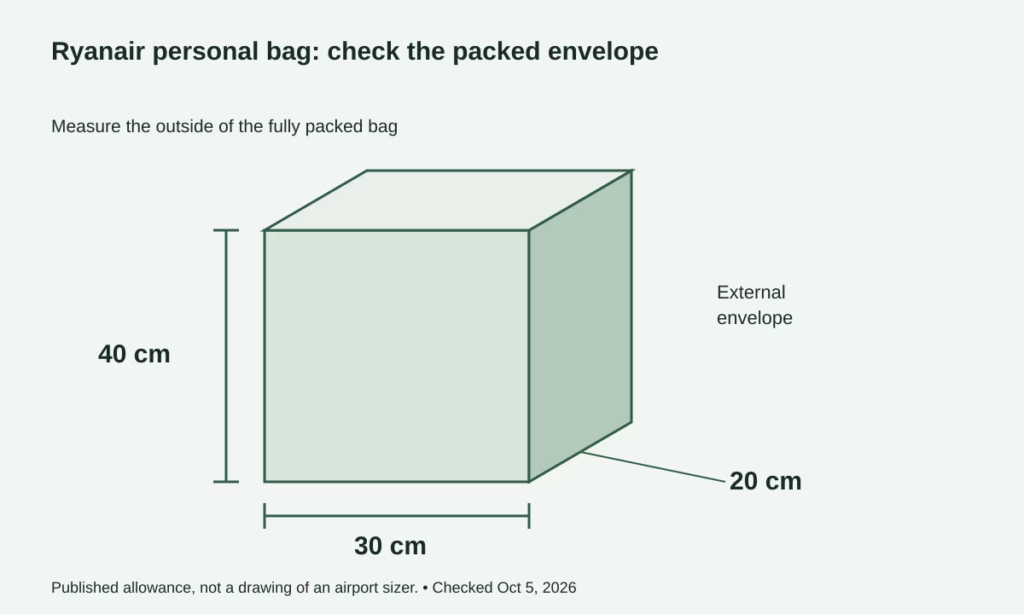
A Ryanair personal bag needs to stay within 40 × 30 × 20 cm and fit under the seat. A backpack labeled “40 cm” is not enough: check its packed width and depth, including bulging pockets. A rigid laptop panel can prevent a soft-looking bag from becoming smaller.
Policy checked October 5, 2026 · Original measurement guide
In this guide
The current Ryanair personal-bag limit
The free personal-bag allowance is one small bag per passenger. The published envelope is 40 × 30 × 20 cm; the bag belongs under the seat. These are the current measurements on Ryanair’s bag-rules page as checked on October 5, 2026. Older size advice should not replace the current page or the allowance shown on your booking.
Start by writing all three numbers on a note beside your bag. Treat them as three separate checks. Being comfortably inside the width limit does not buy permission to exceed depth. This is especially important with backpacks: their height may stay fixed while their front pocket grows by several centimeters once chargers, a fleece and toiletries go in.
The illustration below describes the permitted bounding box. It does not reproduce an airport sizer, establish a hidden tolerance or promise that a particular backpack will be accepted.
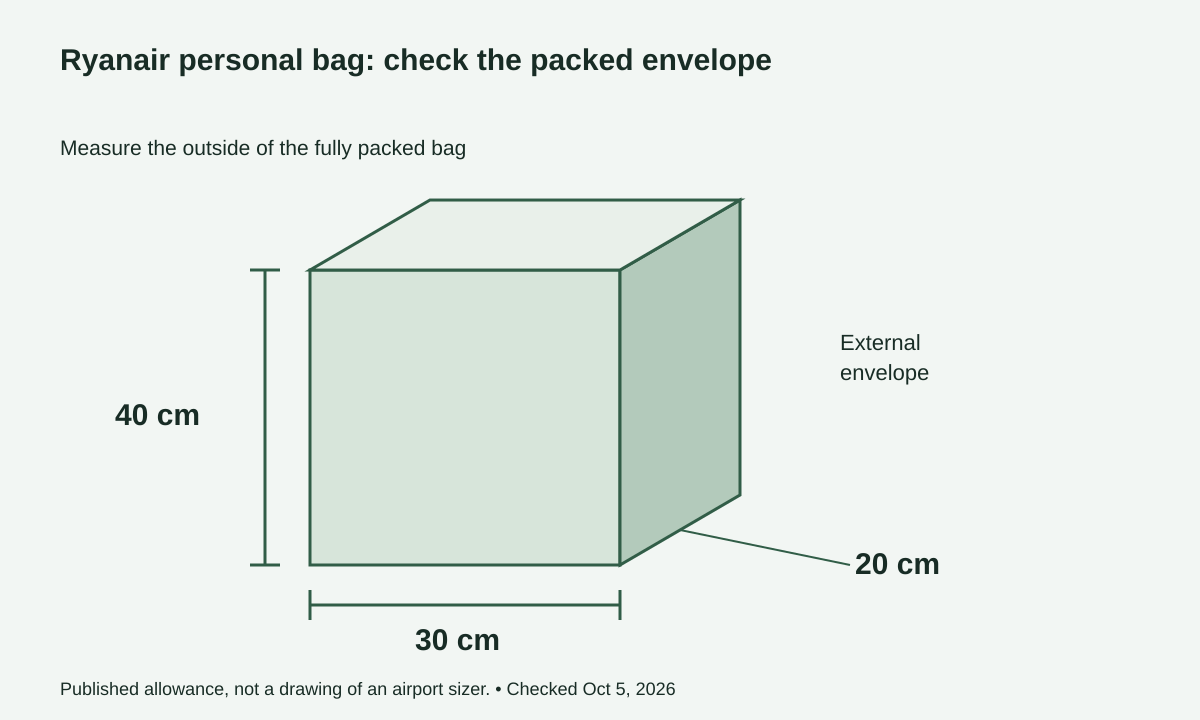
Measure the backpack fully packed
Pack your real travel load before measuring. Put the laptop in its usual sleeve, fill the pockets you plan to use and close every zipper. Set the bag down without pressing on it. Measure between two flat, parallel surfaces, such as a wall and a large book, rather than bending a tape around curved fabric. You want the distance across the outside of the bag, not the length of a curved seam.
- Height: include any part that remains above the main compartment when arranged for travel.
- Width: check the widest loaded point, including side pockets.
- Depth: measure from the rear padding to the furthest front-pocket bulge.
- Repeat after carrying it: settling contents can change the shape.
A carry handle that folds flat can be arranged neatly for your measurement, but do not ignore a rigid handle or a protruding buckle. Measure the bag in the condition you can realistically keep it in, rather than while someone holds every soft panel compressed.
Check the laptop and back panel first
A laptop compartment can be the limiting part even if the clothing area is compressible. Measure the laptop inside its protective sleeve, then compare that envelope with the backpack’s actual usable opening. Screen diagonal is not laptop width, and the manufacturer’s bare computer dimensions do not include your padded case.
Next, feel for a stiff back panel, frame sheet or reinforced base. Removing a sweater will reduce fabric bulge, but it will not shorten a fixed panel. A 42 cm rigid panel remains a problem for a 40 cm allowance even when the front compartment is almost empty. Do not damage protective components or rely on bending electronics to make a bag pass.
For a new purchase, ask the seller whether its dimensions describe the fully assembled exterior or only the main fabric compartment. If the answer is unclear, choose a bag you can measure and return before your trip.
Three packed-bag examples
| Packed bag | Comparison | Practical result |
|---|---|---|
| 39 × 29 × 19 cm | 1 cm below each limit | Within the stated dimensional envelope |
| 40 × 30 × 23 cm | Depth is 3 cm over | Repack and remeasure; height and width do not compensate |
| 42 × 28 × 18 cm | Height is 2 cm over | A stiff 42 cm panel cannot be solved by emptying a pocket |
For a European connection with a US-size roller, compare a US-size carry-on with Ryanair and easyJet before choosing which bag to bring.
These are hypothetical measurement examples, not tested products. In the second example, moving a bulky charger from the front pocket into unused internal space might reduce depth. It might also make the main compartment thicker. Only a new measurement establishes the result. Moving things into another separate bag is not automatically a solution when you have booked a one-bag allowance.
In the first example, the 1 cm margin is an editorial planning cushion, not extra space granted by Ryanair. It helps absorb small measurement errors and changes in packing. A bag right on every limit leaves no such cushion.
Make a useful home fit check
Mark a 40 × 30 cm rectangle on paper or cardboard and use a separate 20 cm depth reference. Alternatively, make an open cardboard box with those internal dimensions. If you measure the outside of thick cardboard, your test space will be too small. Keep its sides square and verify the opening with a ruler.
Place the packed bag into the reference space without forcing it. This is a screening exercise, not an official sizer test. Look for the exact component that protrudes: a top corner, bottle, rigid base or swollen pocket. Fix that component and repeat the check. Avoid interpreting a bag that fits only under sustained pressure as reliably inside the envelope.
Photograph your final packing arrangement for yourself. On the return journey, souvenirs and laundry can occupy different shapes even when the overall weight seems similar. Repeat the measurement rather than assuming the outbound result carries over.
A backpack buying checklist
- Find exterior dimensions for the exact model and size, not another capacity in the same product family.
- Check the packed depth and any expansion zipper.
- Confirm your sleeved laptop fits without distorting the bag.
- Look for pockets that remain inside the measured envelope when filled.
- Check return conditions before removing tags or taking the bag away.
- Measure the delivered item yourself while a return remains possible.
Do not choose by liters alone. A nominal capacity says little about shape: two bags with the same volume can have very different heights and depths. The rectangular limit multiplies to 24 liters, but that is a geometric box volume, not a promise that a bag advertised as 24 liters meets the rule or offers that much usable space.
An airline name in a listing is also not verification. The seller may have used an old policy, measured an empty bag, or attached the same claim to several sizes. Your purchase decision should rest on dimensions you can confirm.
If your bag is too large
First decide whether the excess is removable packing or fixed structure. Soft excess may be solved by taking fewer items or rearranging them inside the same bag. Fixed excess usually calls for a different bag or a different allowance. Recheck before buying an upgrade: a larger allowance still has its own dimensions and weight limit.
Ryanair distinguishes its Priority & 2 Cabin Bags product from a 10 kg checked bag. Under the published Priority option, the overhead bag is limited to 55 × 40 × 20 cm and 10 kg. A checked-bag purchase is not permission to take that bag into the cabin. Confirm the exact product in your booking. See the airline’s baggage options.
Do not plan around someone else’s report of being waved through. Screening can vary, but that does not change the published allowance. Resolve an oversized bag before departure instead of relying on discretion at the gate.
Common questions and sources
Can I use an old 40 × 20 × 25 cm bag?
Compare the actual packed shape with the current limits. In sorted order, 40 × 25 × 20 cm is within 40 × 30 × 20 cm. The old label alone does not tell you whether filled pockets remain inside those dimensions.
Does a soft backpack automatically qualify?
No. Soft material can make repacking easier, but rigid contents, padding and seams still determine its minimum practical envelope.
Does this guarantee gate acceptance?
No. The dimensional checks are a planning aid. Ryanair controls baggage acceptance, and your booking and current rules matter.
Policy source, checked October 5, 2026: Ryanair Help Centre — Bag Rules. Measurements and examples in this guide are an original desk-based calculation method; no airport test is claimed. Recheck the official page before travel.