Quick answer
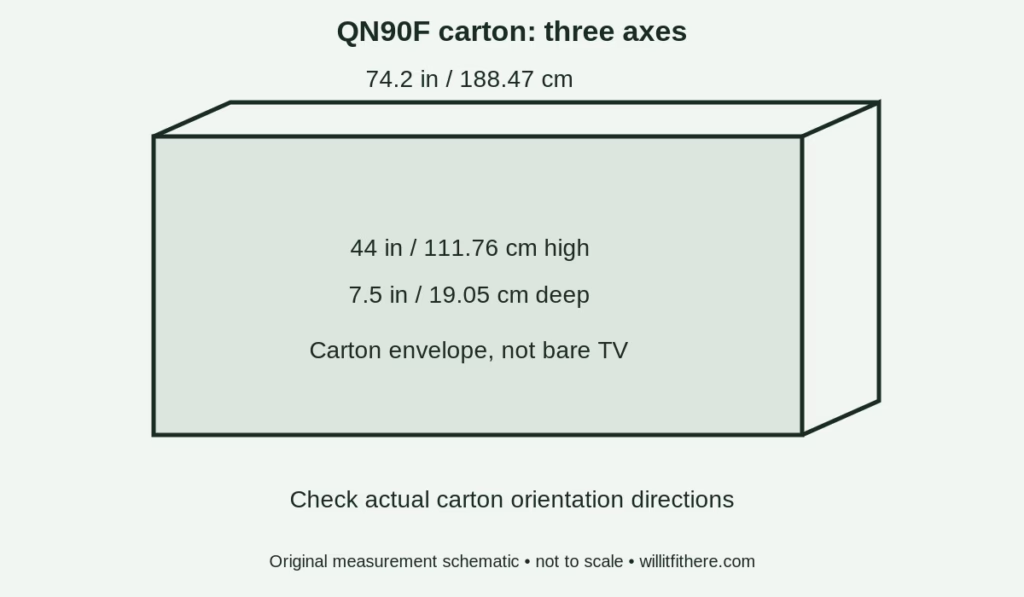
The US QN75QN90FAFXZA shipping carton is listed at 74.2 × 44 × 7.5 inches and 110.7 pounds. That is the starting envelope, not a promise that it fits an SUV. You must also check the opening, closed-door space, loading path and permitted carton orientation.
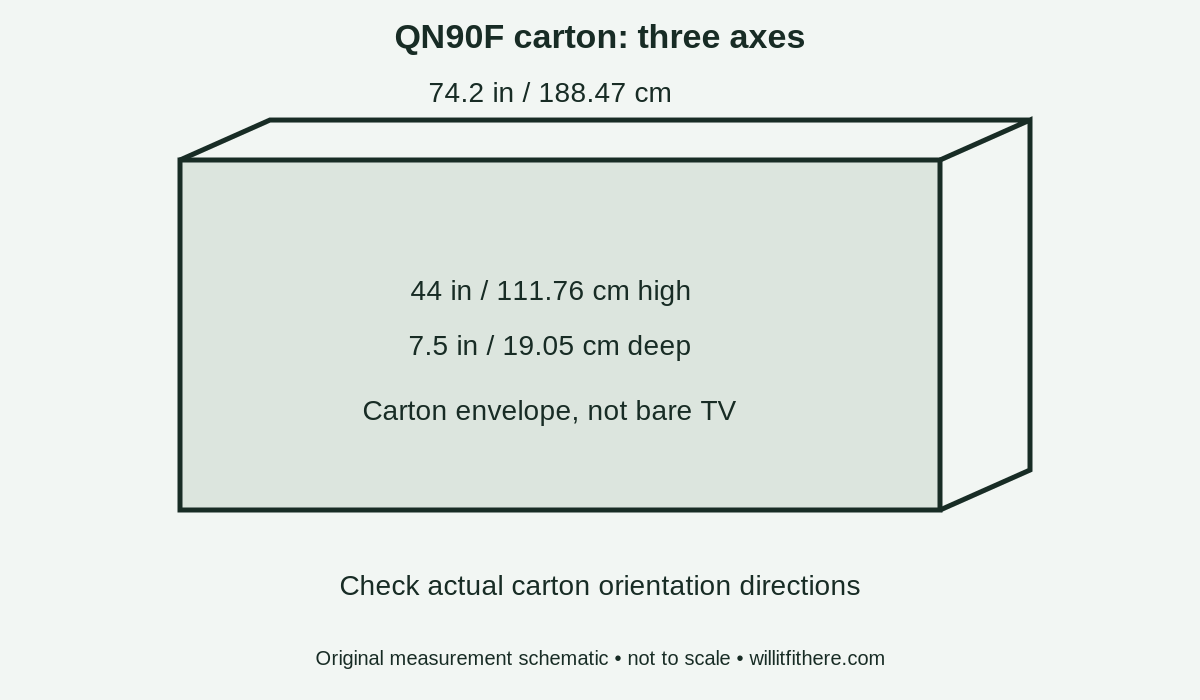
1. Use the carton for the exact model
This guide covers the 2025 US Samsung QN75QN90FAFXZA. It remains a useful pickup example, but it is not described here as a newly released 2026 television. A 75-inch diagonal is not the length of its shipping box. A listing for the 65-inch or 85-inch variant will give a different package.
Samsung’s maker-authored US sheet, hosted by P.C. Richard, lists the measurements in width × height × depth order. Read the QN90F specification sheet, page 2. Keep that axis order beside your measurements so a thin box dimension does not become an assumed loading height.
2. Write down the full shipping envelope
| Shipping measurement | Inches / pounds | Converted value |
|---|---|---|
| Width | 74.2 in | 188.47 cm |
| Height | 44 in | 111.76 cm |
| Depth | 7.5 in | 19.05 cm |
| Shipping weight | 110.7 lb | About 50.21 kg |
The centimeter values are arithmetic conversions using 2.54 centimeters per inch. They do not make the source measurement more precise. Do not use a bare-TV measurement, display diagonal or cargo-volume number in place of these three carton axes. Confirm the physical box dimensions with the pickup location, especially if the product has been repacked or includes additional packaging.
3. Measure the car in its real pickup configuration
Set the seats and cargo floor exactly as they will be during the trip, with the driver retaining a normal driving position. Record the distance available with the hatch or trunk fully closed. Measure at the height occupied by the carton, not just along the longest line on the floor. A sloping rear window can remove substantial space above the floor.
At the opening, measure the narrowest usable width and height between trim, latch housings and other fixed obstructions. Then measure farther inside where wheel arches, pillars or a roof taper reduce the envelope. A wide opening can lead into a narrower interior; a long interior can still have an opening that blocks the box.
Keep required passenger seating available. If the plan depends on moving a seat into an unusable position or leaving the hatch open, it is not the same pickup configuration you just measured.
4. Treat orientation as a handling requirement
The specification sheet establishes size and weight; it does not establish every permitted transport orientation. Before pickup, ask the seller to confirm the handling directions and orientation markings on the actual carton. Plan around those directions. Do not assume that laying the television flat is acceptable simply because that makes the arithmetic work.
This guide uses an upright-envelope example with the 44-inch carton height vertical. That is a conservative planning scenario, not a claim that we verified an exact-model shipping manual permitting every turn or tilt. If the required orientation cannot be maintained through the load path and during transport, choose an appropriate delivery service or vehicle.
A brief position shown in a stand-assembly diagram is not transport approval. Nor does a photograph of someone else carrying a similar box establish what is appropriate for this package.
5. Calculate a pass and a clear failure
Imagine a measured cargo arrangement providing 78 inches along the carton’s long axis, 46 inches of clear height and 10 inches of space for its thickness, with the hatch closed. The arithmetic remainders are 78 − 74.2 = 3.8 inches, 46 − 44 = 2 inches, and 10 − 7.5 = 2.5 inches. This is only a static envelope screen.
Now suppose the opening on that same vehicle is only 41 inches high where the upright box must pass. It is 3 inches short of the 44-inch height. The interior measurements do not solve the opening failure. Do not silently rotate the box in the calculation when the handling plan requires it to stay upright.
Positive remainders also need room for the actual loading process and any required protection or restraint. A zero-clearance fit is not a practical target. There is no universal extra margin: the opening shape, handling directions and loading team determine what is workable.
6. Test the path without using the TV as a test object
Draw the carton and the narrow points to the same scale, or build a lightweight mock-up that represents all three dimensions. A single flat rectangle tests a silhouette but omits thickness. Walk the entire proposed path from the loading area through the opening to the final position. Include the closing sweep of the hatch.
A mock-up passing through is useful evidence of geometry, not evidence that a 110.7-pound fragile shipment can be loaded or secured safely in the same way. Arrange suitable help and have the seller or delivery provider address handling and transport restraint. Do not use pressure on the display or improvised loading tricks to make an otherwise failed plan work.
If the retailer cannot confirm the carton or the route is marginal, delivery avoids turning the pickup counter into an experiment. Check the delivery service’s access requirements before booking.
7. Save a QN90F pickup measurement checklist
- Exact US TV model and actual carton confirmed.
- Three package dimensions recorded with axes labeled.
- Orientation instructions checked with the seller and carton.
- Opening and interior measured in the real seating configuration.
- Hatch closes without contacting the box.
- Loading route and handling plan agreed with suitable assistance.
- Vehicle loading limits and transport requirements checked separately.
Keep a photograph of the model label and your measurement notes together. When asking the retailer for help, give the vehicle measurements rather than saying only “large SUV.” Body style, trim, cargo floor position and seat arrangement can make two apparently similar vehicles differ.
8. Source ledger and the final answer
Package dimensions and shipping weight are from the Samsung-authored US QN90F sheet, exact order-code block QN75QN90FAFXZA. The filename names a 55-inch model, but the document contains multiple sizes; this article uses the 75-inch block. Checked October 5, 2026.
We have not verified a make-and-model vehicle fit or exact-model transport-orientation manual. The answer is therefore conditional: a measured envelope pass, a pass through the entire loading path, and a compliant handling arrangement are all needed. If one remains unknown, confirm it before driving to collect the television.
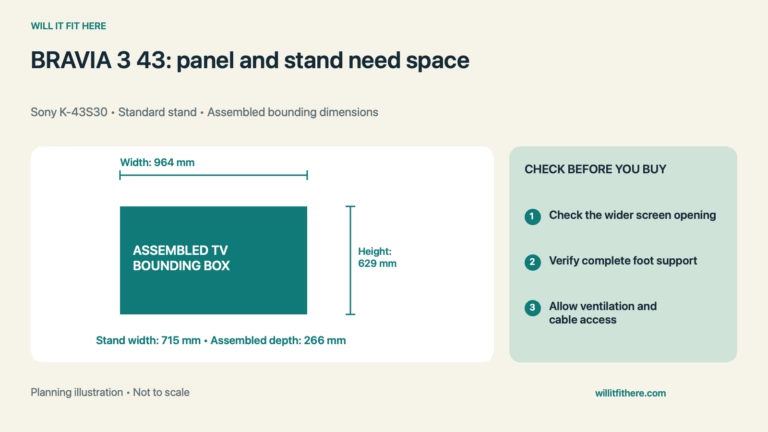
Carton fit and home furniture fit are different tasks. After delivery, use the assembled television and stand dimensions for the cabinet; do not carry the shipping measurements into your furniture layout.