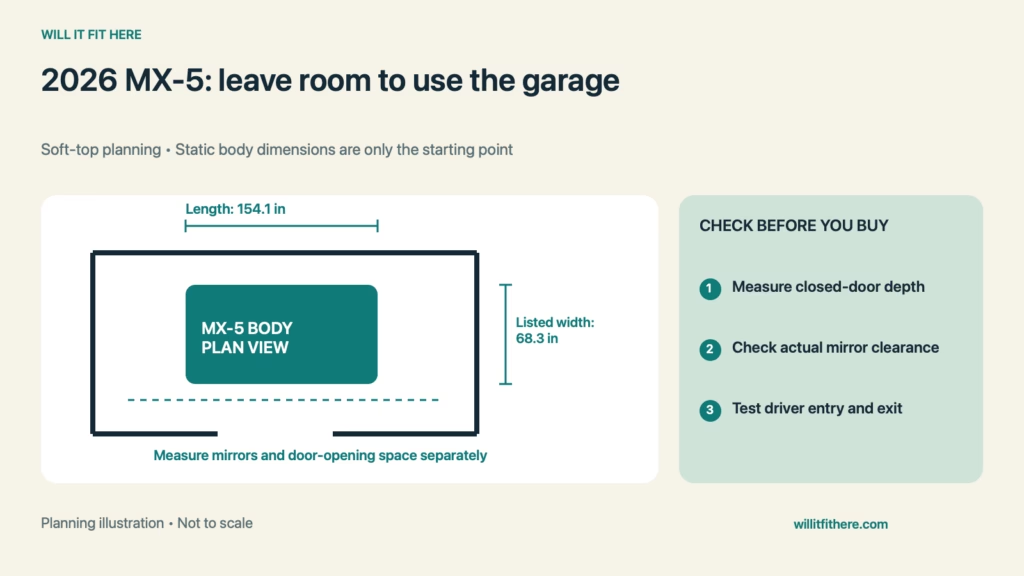
Fit verdict: MX-5 Garage Fit is promising in many compact spaces because Mazda lists the 2026 car at 154.1 inches long and 68.3 inches wide. Those figures alone do not establish usable parking. Mirrors, an open driver’s door, storage shelves, and the approach to the garage can decide the outcome even when the body outline fits on the floor.
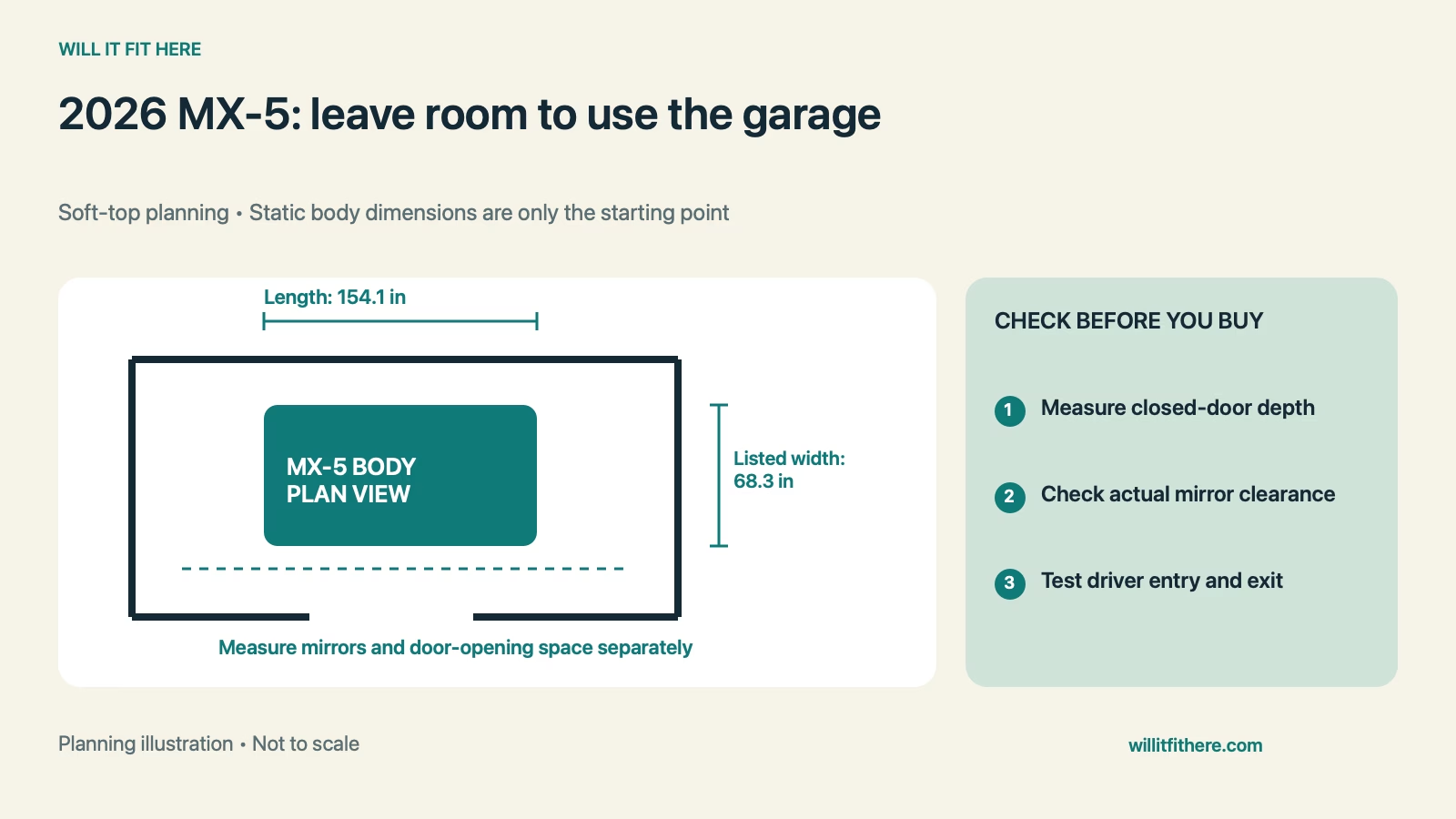
This guide uses published specifications and planning calculations, not a firsthand product test. Examples are hypothetical.
Dimensions and conditions
| Measurement | Published specification |
|---|---|
| Model covered | 2026 Mazda MX-5 Miata soft top, US/Canada specifications |
| Overall length | 154.1 in (3,915 mm) |
| Published overall width | 68.3 in (1,735 mm); verify actual mirror envelope separately |
| Height, 16-inch-wheel soft top | 48.6 in (1,235 mm) |
| Height, 17-inch-wheel soft top | 48.8 in (1,240 mm) |
| Operating clearances | Measure on the actual car and garage; no universal allowance assumed |
1. Measure usable depth with the door closed
Start MX-5 Garage Fit at the nearest real obstruction, not the building’s outside dimensions or a floor-plan label. Measure from the closed garage door to a front wall, workbench, shelving face, or other fixed object along the intended parking line. Include door handles and braces that project inward. Measure at bumper height as well as floor level. A suspended shelf may not reduce floor length but can still conflict with the hood or windshield. Keep both the garage door’s travel and any pedestrian exit clear.
2. Separate entry width from mirror clearance
Measure the narrowest clear opening between jambs, weather seals, tracks, and hardware. Then measure the actual car at its widest relevant points, including mirrors in the position used to enter. Mazda’s 68.3-inch published overall width should not be treated as a verified mirror-to-mirror measurement. MX-5 Garage Fit needs the full moving outline. If the approach is angled, the front and rear corners sweep across different paths. A comfortable straight opening can feel very different when a driveway forces a turn just before the jamb.
3. Check the driver’s door and your exit
Mark the proposed parking position and identify where the driver’s door meets the nearest wall, shelf, or neighboring vehicle. Sitting low in a sports car can make an apparently generous gap difficult to use. Test the actual entry and exit movement while parked safely, ideally with the same coat, bag, or mobility needs you normally have. MX-5 Garage Fit is not useful if parking requires climbing out over the passenger seat. Do not assign a universal door-opening allowance: the usable gap depends on your body, parking position, and nearby obstructions.
4. Walk the vertical and ground-level route
Check overhead storage and the raised garage door against the correct soft-top height. More often, the concern for this low car is near the ground: a steep driveway transition, a raised threshold, or a parking stop can interfere even though the garage interior is spacious. Do not derive approach clearance from overall vehicle height. Inspect the actual route and obtain model-specific guidance where needed. MX-5 Garage Fit should be tested slowly and without contact; do not keep driving over an obstruction to find out whether the underside clears.
5. Preserve storage, access, and a repeatable position
Check whether trunk access, charging accessories you may use, tools, and stored bicycles still have workable routes after parking. Opening the trunk is a separate moving envelope, so test it without letting the lid strike shelving. Reserve any desired walking space before setting a parking reference. A measured floor mark or suitable parking aid can help reproduce a good position, but it cannot make an undersized gap safe. Never use shelving or the closed door itself as a contact stop. Recheck after moving a cabinet or changing the garage layout.
MX-5 Garage Fit: a worked example
Suppose the clear distance from a closed garage door to a workbench is 180 inches. Subtract the car’s published length: 180 − 154.1 = 25.9 inches of combined front-and-rear space. If you allocate a hypothetical 12 inches at the front, only 13.9 inches remains behind. Neither figure is a recommended safety clearance. This MX-5 Garage Fit example simply shows where the available length goes. If a new cabinet projects another 10 inches into that line, the combined allowance falls to 15.9 inches. You must still check door travel, mirror passage, driver exit, and trunk access before calling the parking arrangement workable.
Before you decide
- Measure clear garage depth with the door fully closed.
- Check the actual mirror envelope and the approach angle.
- Test normal entry and exit at the proposed parking position.
- Inspect overhead obstructions, the threshold, and driveway transitions.
- Keep emergency exits and everyday storage access available.
FAQ
Will a 15-foot-deep garage hold the 2026 MX-5?
A genuinely clear 180-inch space exceeds the listed 154.1-inch length, but MX-5 Garage Fit still depends on operational room and obstructions. A nominal 15-foot building measurement is not necessarily 180 usable inches inside.
Can I use 68.3 inches to check a narrow door?
Use it only as the published vehicle-width starting point. Verify the actual mirror-to-mirror envelope and the angle of entry. The width figure does not prove how much clearance remains beside the mirrors.
Do these measurements cover the RF roof opening?
No. This guide uses soft-top height specifications and static garage planning. The RF’s moving hardtop needs its own model-specific operating-clearance review. Do not transfer a static parked-height calculation to a moving roof.
Related fit guides
Checking car-door clearance beside garage storage and Measuring moving rear-lid clearance in a garage.
Official sources
Specifications and instructions checked November 6, 2026. Confirm the exact model and current instructions before purchase or installation.