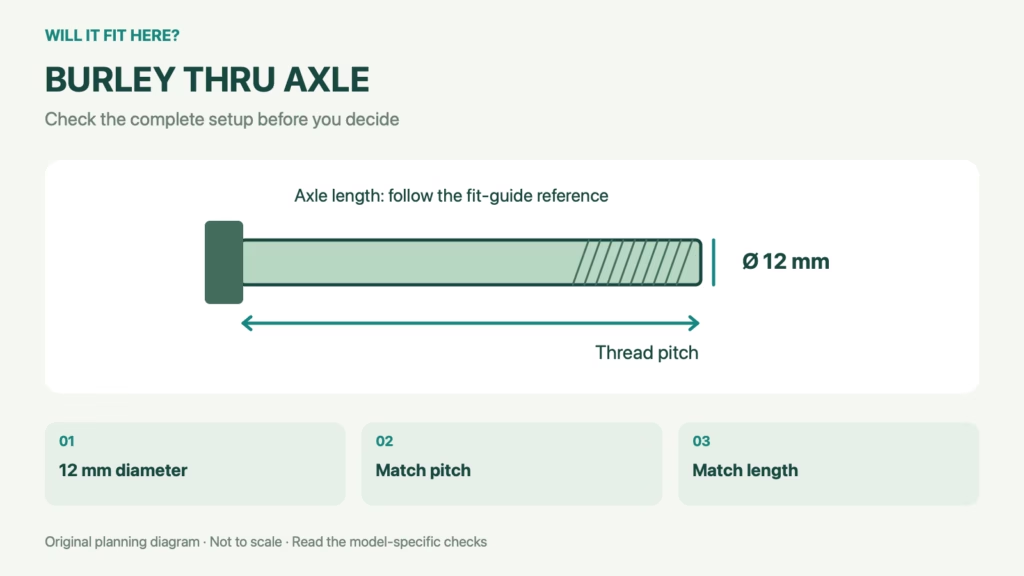
Fit verdict: A Burley thru axle must match the bicycle’s axle diameter, thread pitch and applicable length range. The listed adapters are for 12 mm thru-axle bikes, but 12 mm alone is not a complete specification. Burley offers multiple pitch and length combinations; choose from its fit guide and the bicycle manufacturer’s information.
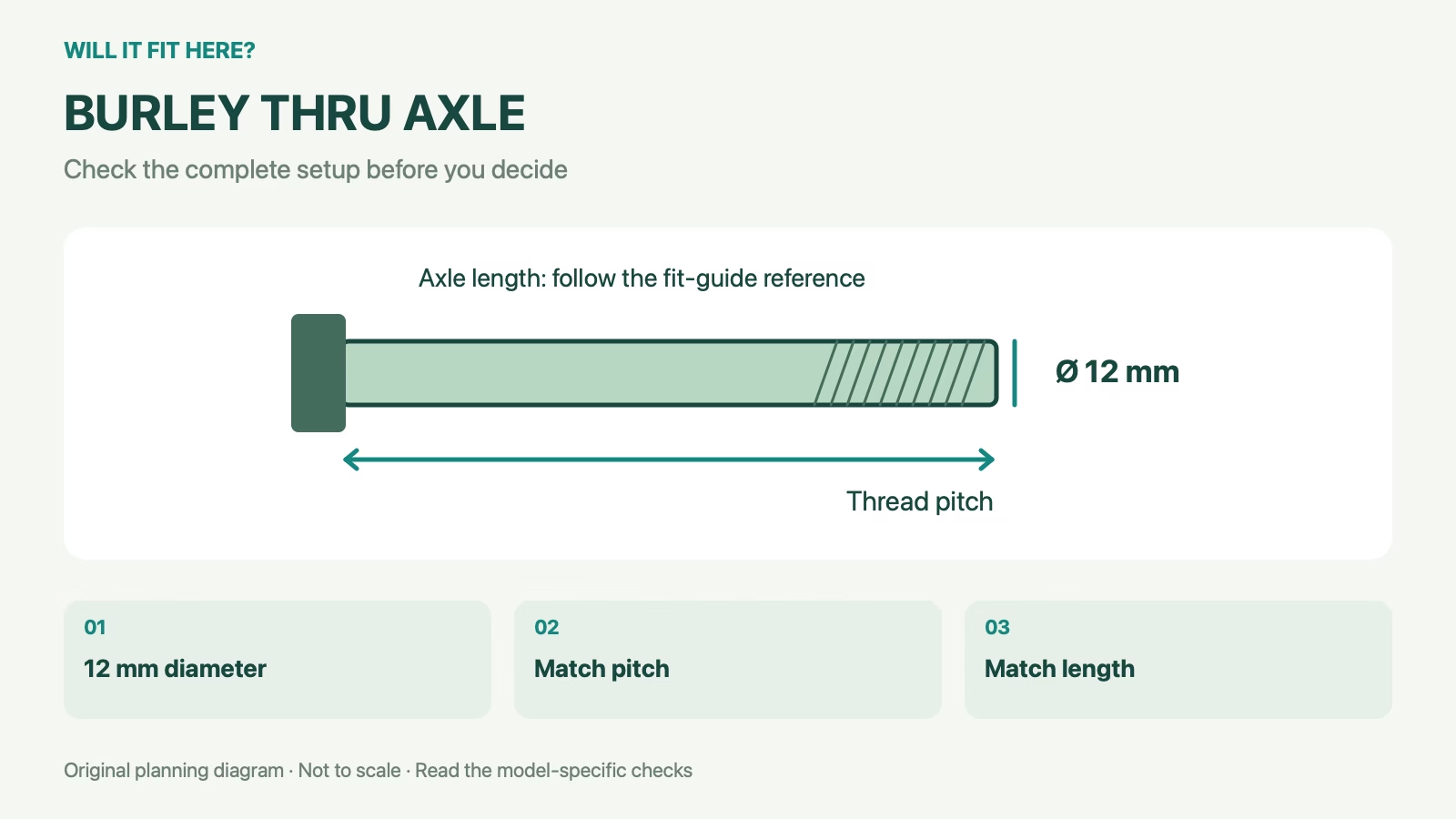
Dimensions and conditions
| Check | Reference | What it means |
|---|---|---|
| Diameter | 12 mm | Not sufficient by itself |
| Listed thread pitches | 1.0, 1.5 or 1.75 mm | Match the original axle exactly |
| Example option | 12 × 1.5; 159–165 mm | One listed variant, not a universal choice |
1. Read the original Burley thru axle requirements
Start with the bicycle make, model and year, then locate the original axle’s specification. A marking such as 12 × 1.5 describes diameter and pitch; it does not tell you that every axle with those numbers is long enough. Hub-spacing labels also are not a substitute for the replacement axle’s measurement method. If the original markings are missing or unclear, ask the bike maker or a qualified shop to identify them. Keep a photograph of the original label alongside the proposed replacement part number.
2. Use the fit guide’s length reference
Compare like with like. An axle’s overall end-to-end length, its effective length and a printed range may refer to different reference points. Follow Burley’s fit guide and the supplied instructions for any flat or conical spacers. Do not add improvised washers to make an unmatched axle appear to fit. A correct-looking end position cannot establish proper thread engagement. Check the frame interface and hitch placement together, including nearby dropout shapes and other hardware.
3. Verify the trailer connection after selection
The replacement axle is one part of the connection. Confirm the intended trailer and hitch arrangement, then use the manufacturer’s installation and torque instructions. The bicycle should not be ridden with an uncertain thread match. If the axle does not start as expected, stop and verify the specification instead of applying more force. Once installed as directed, inspect the area around the hitch for movement clearance and follow the trailer maker’s checks before carrying passengers or cargo.
4. Keep a Burley thru axle fit record
Your measurement note should retain the original axle marking, the replacement part number, the fit-guide length reference and the specified spacer arrangement. Keep the bicycle model year in that note too. A future frame or wheel change can alter the application. Reusing an adapter should therefore begin with a fresh compatibility check rather than the fact that it once fitted another bicycle.
Burley thru axle: a worked fit example
Example: an original axle identified as 12 mm with a 1.5 mm pitch is not interchangeable with a 12 × 1.75 mm adapter, even if both lengths appear close. Conversely, matching pitch still leaves length and frame-interface checks. The catalogue’s 159–165 mm and 172–178 mm options illustrate why the complete specification matters.
Before you decide: 5 checks
- Record bike model, year and original axle markings.
- Match the 12 mm diameter and exact pitch.
- Measure length using Burley’s fit-guide reference.
- Use only the specified spacer arrangement.
- Confirm hitch compatibility and installation instructions.
FAQ
Does 12 mm mean every Burley adapter fits?
No. Pitch, length and the bicycle interface must match.
Can I choose from hub width alone?
No. Use the complete axle specification and the fit guide.
What if the pitch is unknown?
Burley advises checking with the bike manufacturer or a bike shop before purchasing.
Related fit guides
- Will a YETI Tundra 45 Fit Your Sedan Trunk Opening?
- Hitch Bike Rack Fit: 5 Useful Garage Checks
- Vehicles fit guides
Sources
Sources checked 3 November 2026. Product-specific facts are attributed above. Worked examples and measuring methods are planning guidance; example dimensions are not product specifications. Recheck the exact model or current travel policy before acting.