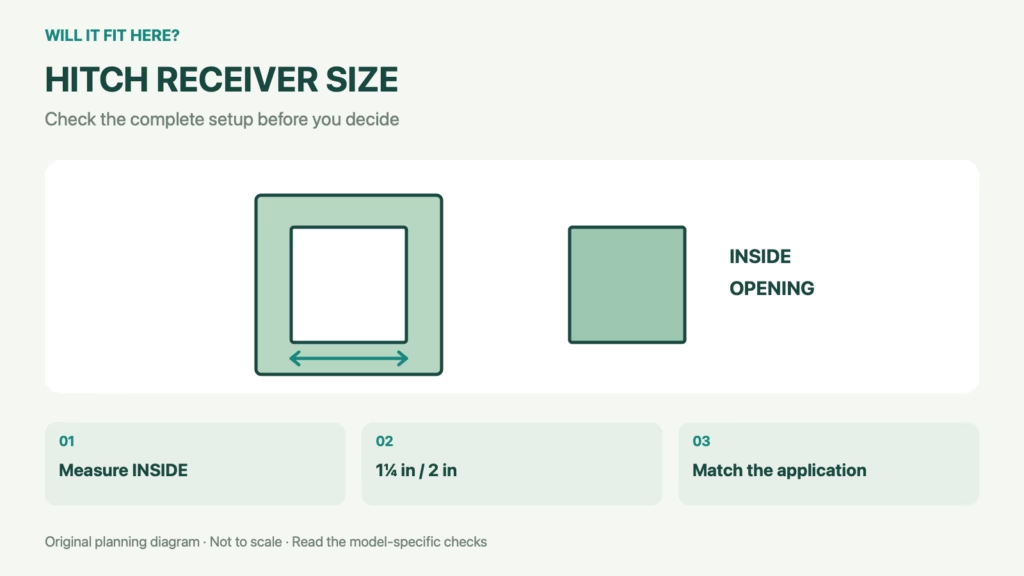
Fit verdict: Hitch receiver size matters: an accessory must match the inside opening of the receiver and the approved application of both components. A 2-inch shank will not directly enter a 1¼-inch receiver. A smaller shank in a larger opening is not a finished installation either: use only an adapter explicitly approved for the accessory, receiver and intended load.
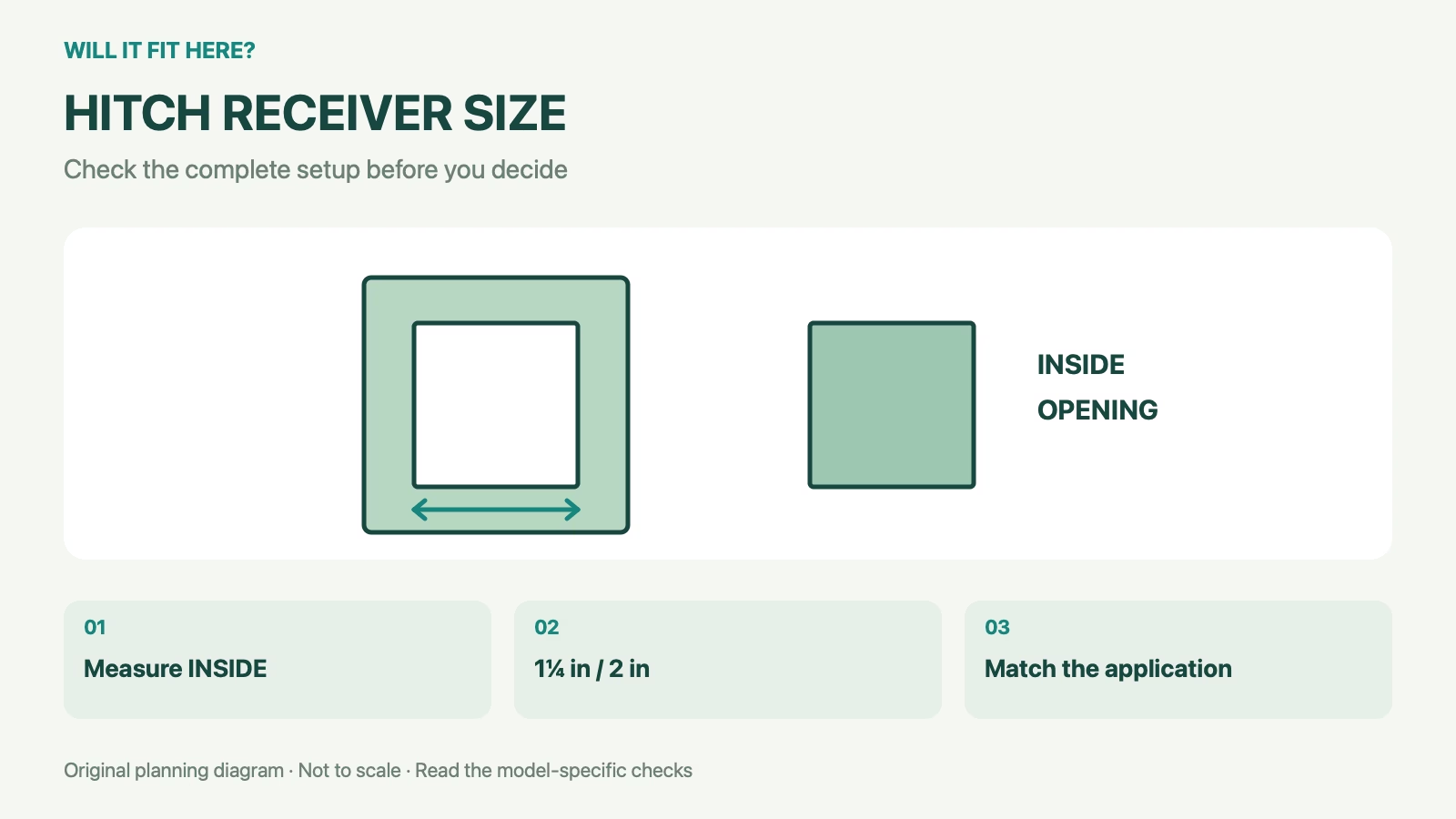
Dimensions and conditions
| Check | Reference | What it means |
|---|---|---|
| Small receiver family | 1¼ in = 31.75 mm | Inside opening, not outside tube width |
| Common larger receiver | 2 in = 50.8 mm | Size alone does not specify capacity |
| Hitch rating | Read the actual component labels | Do not substitute a class maximum |
1. Measure the hitch receiver size at the opening
Remove an existing cover or accessory and identify the receiver manufacturer and model. Measure between the inside faces of the square tube. Measuring the outer steel walls gives the wrong reference. Compare this dimension with the accessory manufacturer’s stated receiver requirement. A photo taken at an angle is useful for identification but cannot establish a small dimensional difference. Also distinguish a removable accessory sleeve from the underlying shank. Do not assume every collar can be removed.
2. Read the application before selecting an adapter
A rack designed for two receiver sizes may include its own dedicated sleeve. A rack built only for a larger receiver is a different case. Follow the rack and adapter instructions rather than treating all metal reducers as interchangeable. An adapter can change the distance of the load behind the vehicle and may impose restrictions or lower limits. It never increases the vehicle rating. Check the vehicle, hitch, accessory and adapter together, including any restrictions on trailers or motorhomes.
3. Confirm pin alignment and operating clearance
A shank must insert to the position required by its instructions, with the correct retention hardware fitted. Check the pin or lock can be inserted and secured without interference from the bumper, sockets or surrounding trim. Then assess the accessory in both working and folded positions. Receiver fit does not automatically establish ground clearance, tailgate access or visibility. Keep the manufacturer’s required hardware with the accessory so that a later vehicle change does not lead to an improvised fastening arrangement.
4. Keep a hitch receiver size fit record
Save the receiver model, accessory part number and any approved adapter in one note. Include the pin specification and the relevant ratings from each label. Treat a change of vehicle or accessory as a new fit check, even when the visible opening looks unchanged. This keeps a previously verified combination from being assumed to apply to a different load.
hitch receiver size: a worked fit example
Example: a rack marked for a 2-inch receiver and a car fitted with a 1¼-inch receiver fail the direct-fit check before weight is considered. Even if a separately sold adapter joins them, that does not establish approval. Write down the exact rack, hitch and adapter part numbers and check all three instructions before treating the combination as usable.
Before you decide: 5 checks
- Measure inside the receiver opening.
- Identify the accessory’s required shank size.
- Verify any sleeve or adapter is approved.
- Check the actual labels and lowest applicable limit.
- Check pin access, ground clearance and folded position.
FAQ
Do all 2-inch receivers have the same rating?
No. CURT lists 2-inch receivers across multiple hitch classes; use the actual part rating.
Can I judge fit from the outside tube width?
No. Receiver size describes the inside opening.
Does a reducer increase the rating?
No. Follow every component’s restrictions and the vehicle limit.
Related fit guides
- Will a YETI Tundra 45 Fit Your Sedan Trunk Opening?
- Hitch Bike Rack Fit: 5 Useful Garage Checks
- Vehicles fit guides
Sources
Sources checked 3 November 2026. Product-specific facts are attributed above. Worked examples and measuring methods are planning guidance; example dimensions are not product specifications. Recheck the exact model or current travel policy before acting.