Quick answer
A 65-inch TV may have a base that fits on a 55-inch-wide console, but that alone does not make the combination suitable. Compare the complete foot or pedestal footprint, the usable top depth, the top-panel load rating, and both manufacturers’ instructions. The TV body will often be wider than the console, and a no-overhang instruction rules that combination out.
Here, 55 inches (139.7 cm) means the measured furniture width. A stand advertised “for TVs up to 55 inches” is a different thing and may be much narrower.
Measure the usable top
Start with the furniture you actually have. Clear the top and measure the flat surface that can support the TV. Exclude raised borders, decorative ends, holes, unsupported extensions, and rounded or beveled edges where a foot would not sit flat.
- Width: measure left to right where the base will sit.
- Depth: measure front to back, allowing for any lip or obstruction.
- Condition: check for loose joints, damage, a sagging top, or an uneven floor.
- Identity: find the console model number and its assembly instructions. A general total-storage capacity is not necessarily the top-panel rating.
Do not substitute the TV’s screen diagonal for any of these measurements. A “65-inch” label describes a screen-size class; it does not tell you the width of the body or the spread of the feet.
Compare two real TV bases
These US-model specifications illustrate why the base matters. They are examples for measuring, not recommendations to put either TV on an unspecified console. The manufacturer-authored sheets are available as LG 65UT7570PUB specifications and LG OLED65C4PUA specifications (retailer-hosted copies).
| Measurement | LG 65UT7570PUB | LG OLED65C4PUA |
|---|---|---|
| Body width | 56.9 in (144.5 cm) | 56.7 in (144.0 cm) |
| Stand width | 54.6 in (138.7 cm) | 18.5 in (47.0 cm) |
| Overall depth with stand | 11.9 in (30.2 cm) | 9.1 in (23.1 cm) |
| Weight with stand | 33.1 lb (15.0 kg) | 40.8 lb (18.5 kg) |
The UT75’s widely spaced feet use nearly all of a 55-inch top. The C4 has a much narrower central base, yet it weighs more. A narrow base does not eliminate the load check, and a light TV does not eliminate the footprint check.
Published inch values above are retained as printed. Centimeters and kilograms are calculated and rounded to one decimal; do not use the rounded conversions to settle a borderline fit. Obtain the exact base drawing or measure the assembled base before buying.
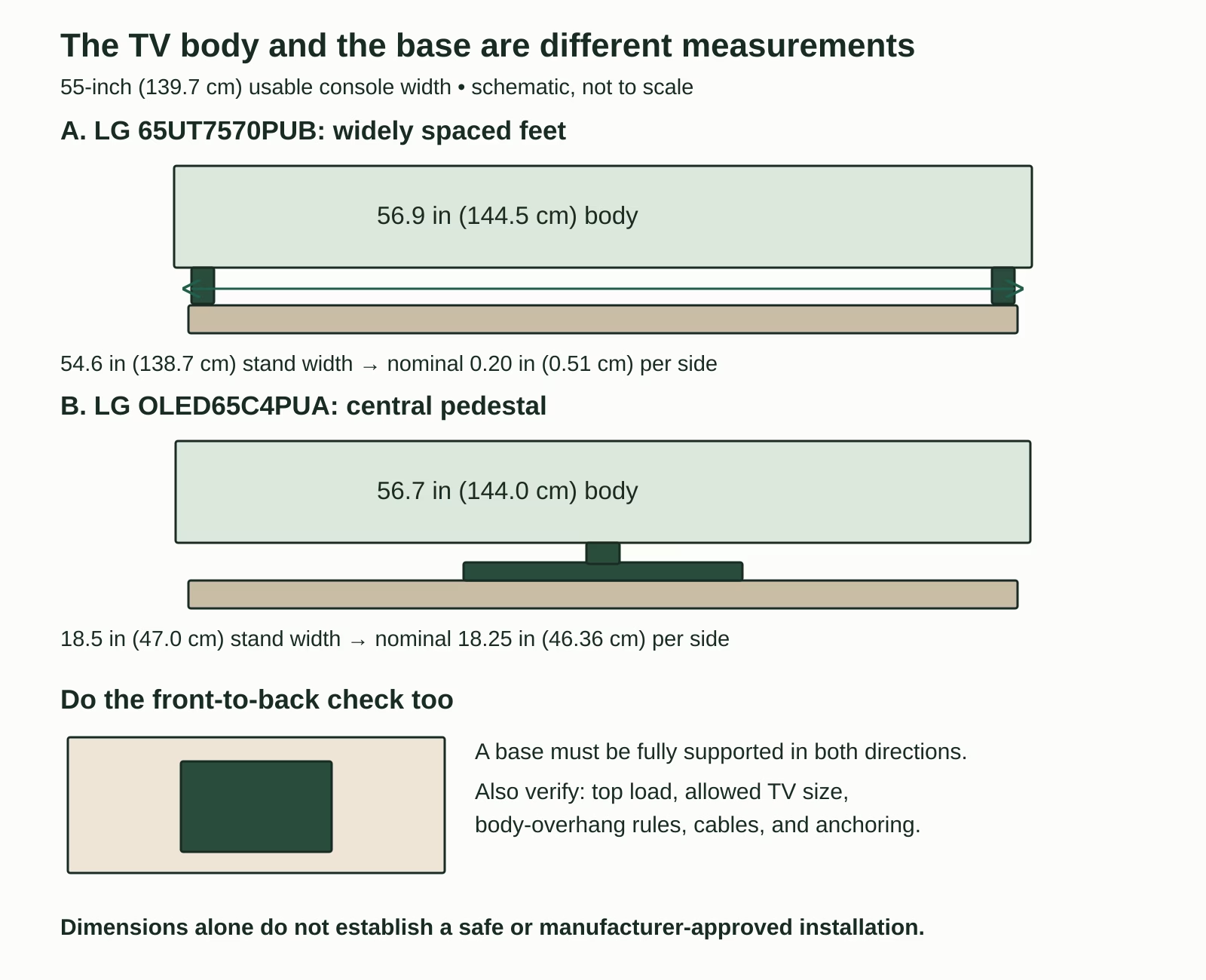
Calculate the remaining margin
For a centered base, the horizontal space on each side is:
(Usable console width − complete base width) ÷ 2.
- UT75 example: (55 − 54.6) ÷ 2 = 0.20 inch per side (0.51 cm).
- C4 example: (55 − 18.5) ÷ 2 = 18.25 inches per side (46.36 cm).
That first result is only a small nominal margin. It could be consumed by an edge bevel, a measurement error, or a different interpretation of “stand width.” It is not a safe minimum. Measure the outermost supporting parts of the feet, not the gap between them, their centerlines, or the screw positions.
Repeat the check front to back. On a hypothetical flat top 16 inches (40.64 cm) deep, an 11.9-inch (30.23 cm) installed depth leaves 4.1 inches (10.41 cm) total. That arithmetic does not specify where to place the TV: foot geometry, rear cables, ventilation, and manufacturer instructions still govern. Never let a foot hang over either edge.
If a model has adjustable leg positions, use only the positions and assembly method approved for that exact model and size. Do not reverse, relocate, or replace legs just because another television allows it.
Check load and manual restrictions
Read restrictions before treating a dimension match as a “yes.” For a real counterexample, the TCL Q610G/Q650G quick-start guide warns against the television overhanging its supporting furniture (printed page 5). TCL’s own US support responses give the 65Q650G a 56.9-inch body width and approximately 54.3-inch traditional foot spacing. The feet may appear narrow enough for a 55-inch top, but the body would overhang. The manual’s restriction still applies.
A furniture size limit can also settle the question. Furinno Classic model 24071AM is described for TVs up to 55 inches, with a 55 lb (24.9 kg) top capacity and a product width of 45.47 inches (115.49 cm), not 55 inches. The C4’s published pedestal width and TV weight are below those corresponding figures, but that does not turn the console into a manufacturer-approved 65-inch stand. Its stated TV-size limit remains a reason to choose another support or obtain explicit manufacturer confirmation.
For your console, add the TV’s with-stand weight to the weight of everything else placed on the top. Include a soundbar and any replacement tabletop mount. Compare that total with the rating for that exact surface and observe any separate TV-weight or screen-size limits. Do not invent a percentage “safety margin” to override a limit.
Secure the complete setup
CPSC’s Anchor It guidance calls for securing TVs and furniture to help prevent tip-over injuries. Follow the TV, furniture, and restraint manufacturers’ anchoring instructions, using hardware appropriate to the wall and furniture.
Anchoring is part of a proper installation. It does not increase a console’s load rating, support an overhanging foot, or cancel a no-overhang warning. Avoid improvised boards, stacked risers, or extra braces as a way to declare an otherwise unsuitable stand safe.
- Keep cords arranged so they do not pull on the TV or invite climbing.
- Keep toys and remote controls away from places that encourage a child to climb.
- Leave required ventilation openings clear.
- Use the number of people and lifting method specified in the TV instructions.
If it fails, choose the next step
The simplest next step is a console whose usable top, load rating, and stated TV-size limits all suit the exact television. A properly installed wall mount can remove the TV’s load from the console, but it brings its own TV compatibility, wall-structure, fastener, and installation requirements.
A compatible replacement tabletop pedestal is another possibility only when the TV and mount requirements can both be met. Check VESA pattern, permitted screen sizes, weight, screw engagement, assembled footprint, and anchoring. A smaller base alone is not enough.
Before keeping the 55-inch console, answer all five: Are all supports fully on the usable top? Is depth adequate? Are the top load and TV-size limits met? Do both manuals allow this arrangement, including any body overhang? Can the TV and furniture be secured correctly? An unknown answer means the fit is still unconfirmed.
Sources checked October 4, 2026. This guide uses published specifications and calculations; no hands-on stability testing was performed.