Quick answer: For the regular US 2026 IONIQ 5 with its factory NACS port, the included 2026 IONIQ 5 CCS adapter connects a compatible CCS1 DC fast-charging cable to the car. A NACS-to-CCS1 adapter is the reverse direction and is not the product for that job. Hyundai’s 2026 model page confirms native NACS charging and the included CCS adapter.
Shopping by “IONIQ 5 adapter” can put two very different products in the same results. Write down what is on the station cable and what is on your car before you compare a listing. This guide covers the regular US 2026 IONIQ 5, not a blanket fitment claim for every IONIQ 5 N or overseas version.
US-market vehicles. Sources checked October 4, 2026. This is a document-based compatibility guide, not a hands-on test.
2026 IONIQ 5 CCS adapter direction comes first
Treat an adapter description as a sentence: “This station cable connects to this vehicle port.” That removes the ambiguity in listings that merely say “NACS CCS adapter.” A product can mention both connector standards and still face the wrong way for your car.
| Vehicle you have verified | Cable you want to use | Decision |
|---|---|---|
| Regular US 2026 IONIQ 5, native NACS | CCS1 DC | Use the included Hyundai CCS adapter as directed |
| Verified CCS1-port IONIQ 5 | NACS DC | Check the Hyundai-approved NACS DC adapter for that exact car |
| Any variant whose port is uncertain | Any connector | Pause the purchase; identify the vehicle and port first |
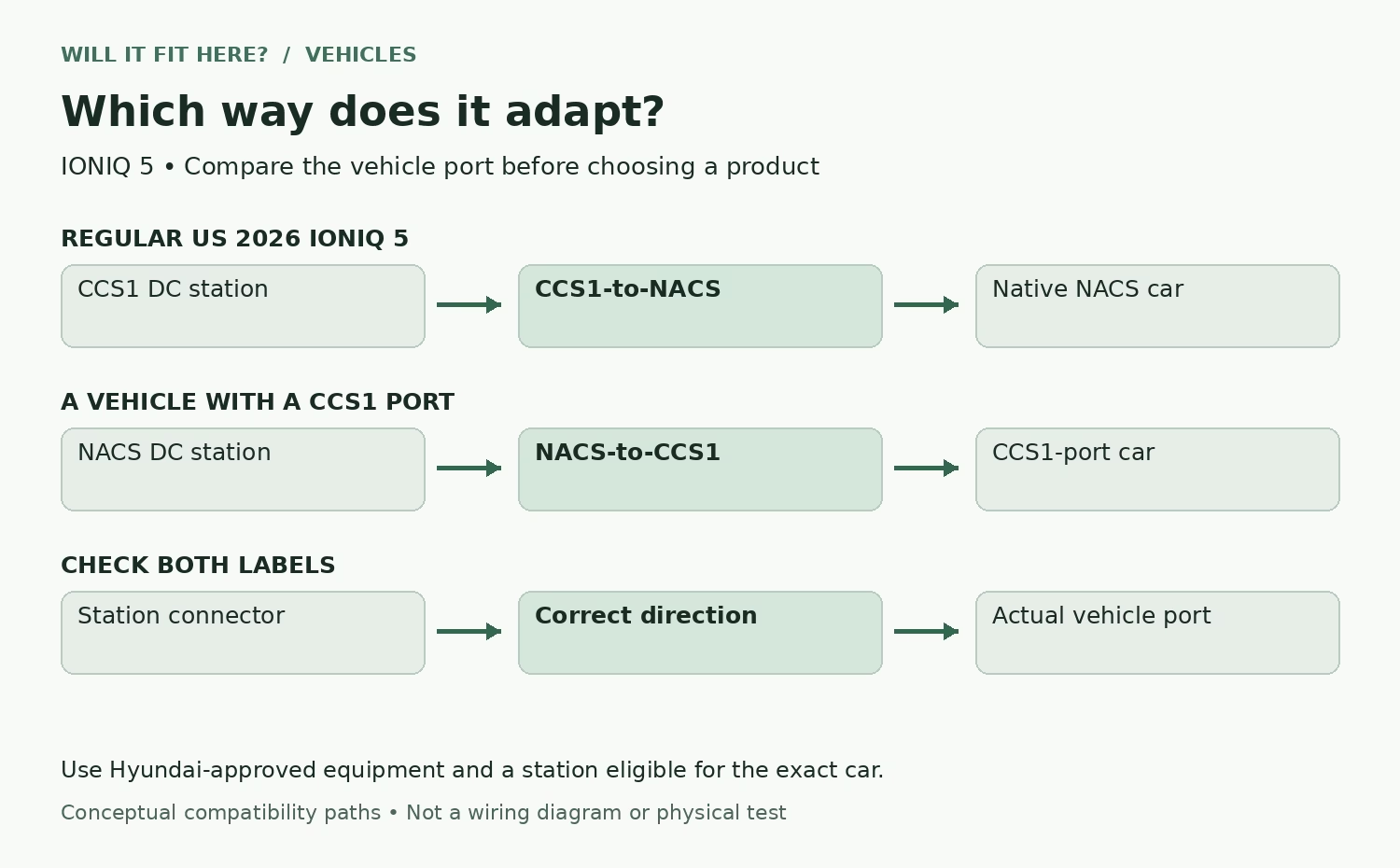
The second row describes a different vehicle-side connection. It is not permission to use that adapter on a native-NACS 2026 car. Physical appearance in a thumbnail is a poor substitute for an explicit manufacturer compatibility statement.
Check the IONIQ 5 N adapter difference separately
Hyundai’s owner adapter FAQ identifies the 2025 IONIQ 5 N as an exception to the native-NACS 2025 IONIQ 5. That is a model-year-specific statement. Do not extend it to a 2026 or 2027 N without checking the exact vehicle’s manual and inlet.
Write the complete model designation when asking for a part. “IONIQ 5, 2026, US market, [trim]” is more useful than “the new Hyundai.” If it is an N model, state that explicitly. Similarly named trims and performance models should not be merged into one fitment assumption.
- Confirm the model year from the vehicle documents, rather than the year it was purchased.
- Confirm the sales market. A foreign brochure does not settle US accessory inclusion.
- Photograph the actual charge inlet without touching its contacts.
- Ask Hyundai to match the adapter to the VIN if the model designation or port is unclear.
Reject an ambiguous adapter listing before checkout
Use the following four-question screen for an OEM part quote or dealer message. A clear answer to one question cannot substitute for the others.
- What does the adapter accept? The answer should name the station’s connector, not just “Tesla” or “public charging.”
- What vehicle port does it fit? Require the vehicle-side connector and exact supported model.
- What charging mode is approved? A DC fast-charging accessory should not be assumed to support AC home or workplace charging.
- Which official instructions apply? Check the manufacturer’s part identification and instructions before committing to the purchase.
If a listing answers only “fits IONIQ 5,” send a clarification request instead of filling the gaps yourself. Avoid third-party compatibility claims, borrowed adapters from another brand and combinations assembled from multiple accessories.
Confirm what is actually in your car
Hyundai advertises a CCS adapter with the regular 2026 model. At delivery, ask the seller to show it and its instructions. With a used car, make an accessory inventory from the items present; the original specification cannot tell you whether a previous owner kept an accessory.
A useful dealer question is: “For this US-market VIN, please identify the included CCS adapter, confirm its station-to-vehicle direction and show me the operating instructions.” Keep any agreement about a missing accessory in the delivery paperwork. Do not assume an old promotional redemption program is still available.
For replacement parts, Hyundai’s owner FAQ points owners to their local dealer. Ask for the exact part identification and current ordering terms; do not substitute a product merely because its name sounds similar.
Separate the port check from station access
Check the Tesla app or map for vehicle-compatible Supercharger sites before planning a stop. Network eligibility is a separate check from adapter direction. A visible NACS cable is not enough evidence that your intended vehicle can charge there.
For a trip, record both your first-choice site and an alternative you have checked. Confirm the connector offered at the actual location, rather than assuming every site under a network’s name has identical equipment. The guide establishes a selection process, not a charging-speed or availability guarantee.
If you are comparing another car during the NACS transition, the EV9 model-year and actual-port guide shows why a year label and a station-access check belong on separate lines.
Your adapter purchase record
- Vehicle: year ___; full model/trim ___; market ___
- Vehicle port identified from: manual / vehicle / dealer ___
- Station cable connector: ___; charging mode: AC / DC ___
- Proposed OEM part and direction: ___
- Compatibility confirmed by: ___; date ___
- Accessory already in the car: yes / no / unresolved
- Decision: use supplied item / obtain exact replacement / pause ___
Do not proceed if the direction, charging mode or model approval remains unresolved. Never force a connection, stack adapters or use an improvised extension.
Sources and scope
References: Hyundai’s US 2026 IONIQ 5 page, Hyundai’s owner adapter FAQ and Tesla’s other-EV charging guidance. Product-page text and official search excerpts were checked on October 4, 2026. This is a documentation-based purchasing aid; no adapter was physically tested.