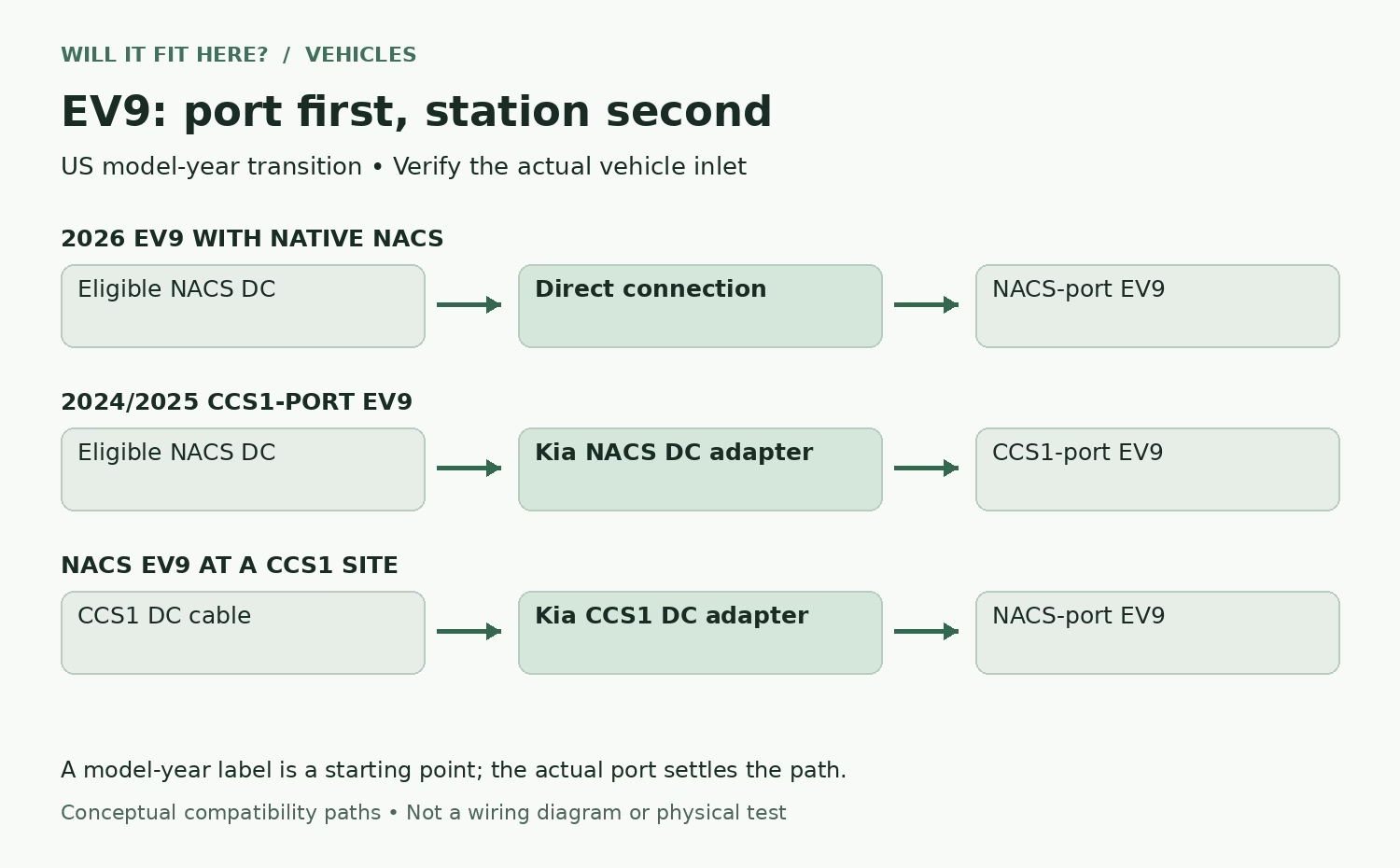
Quick answer: A US 2026 Kia EV9 with a factory NACS port does not need a plug adapter at an eligible NACS Tesla Supercharger. If you are shopping for a 2026 EV9 Tesla adapter, verify the inlet first. A CCS1-port EV9 needs Kia’s approved NACS DC adapter for that connection; a native-NACS EV9 uses a different CCS adapter at CCS1 stations.
Kia’s 2026 US EV9 page lists a built-in NACS inlet. That changes the purchase decision for owners comparing older EV9 advice with the new model. The safe sequence is port, charging equipment, then station access. “It fits the car” answers only part of the question.
US-market vehicles. Sources checked October 4, 2026. This is a document-based compatibility guide, not a hands-on test.
The 2026 EV9 Tesla adapter decision by actual port
| Confirmed vehicle inlet | Station cable | What to check |
|---|---|---|
| NACS on a US 2026 EV9 | NACS DC | Direct plug fit; verify station eligibility |
| CCS1 on an older EV9 | NACS DC | Kia-approved NACS-to-CCS1 DC adapter and eligible station |
| NACS on an EV9 | CCS1 DC | Kia-approved CCS1-to-NACS DC adapter |
| Port or charging mode unclear | Unknown | Pause; identify the car and equipment first |
Kia’s NACS adapter listing describes the DC path from a NACS charger to a Kia CCS1 inlet. Kia’s 2026 owner-manual charging instructions describe the opposite CCS1-adapter path for a NACS vehicle. These are different jobs, even when both listings contain the same connector names.
Check a 2025 EV9 NACS adapter against the car
For a CCS1-port 2024 or 2025 EV9, follow the Kia owner charging guidance for the approved NACS fast-charging adapter. Do not infer that the adapter is included in a used vehicle simply because an earlier owner may have qualified for a program.
A used-car listing often emphasizes trim and mileage while omitting charging accessories. Before collecting the car, ask for a clear photo of the inlet and of each accessory label. Keep the full model year, trim and VIN in the same message so the dealer can check a specific vehicle rather than the model family.
If the documentation and vehicle appear to disagree, stop the accessory purchase. Have Kia resolve the exact configuration. A registration year, sales date or generic stock photo should not overrule the car’s own records and inlet.
Choose the EV9 CCS adapter for the reverse trip
An EV9 with native NACS may still visit a CCS1 fast-charging site. The US 2026 owner manual lists approved CCS1 adapters available through Kia dealers. Ask the dealer to identify the DC adapter for your exact VIN. Kia’s product page also notes that a NACS or CCS adapter may be sold separately; do not promise yourself a universal included kit.
Keep the station-side connector in your request: “I need to connect a CCS1 DC cable to this EV9’s NACS inlet.” That wording helps prevent accidentally ordering the adapter used by an older CCS1-port EV9 at a NACS station.
The Kia adapter safety guidance distinguishes DC adapters from AC connectors and prohibits using damaged or modified equipment. Follow the supplied instructions. Do not assume a part approved for another brand is approved for your Kia.
Pass the station-access check before leaving
Use Tesla’s vehicle-specific map or app to find eligible Superchargers. Tesla separates Tesla-only sites, all-EV sites with its built-in adapter arrangement, and supported NACS sites. Check the actual location for your vehicle; a Tesla sign alone is not sufficient.
- Save the exact site. Record the location you checked, not merely the network name or a nearby retail address.
- Check the intended vehicle profile. Use your EV9’s correct details when looking for compatible stations.
- Confirm the connector path. Compare the listed cable with your car and the approved accessory you actually carry.
- Check before committing to the stop. Review current availability and the offered start/payment method, then keep a separately checked alternative.
A supported combination does not guarantee a working stall, a particular charging rate or an available space. Keep enough flexibility in the plan to choose the alternative without improvising hardware.
Include software in an older EV9 check
Kia published a January 10, 2025 charging-compatibility update for specified 2024/2025 EV9s produced July 29, 2023 through October 14, 2024. The notice addresses NACS DC charging compatibility. It is not evidence that every EV9 needs that update or that it remedies every charging failure.
For a car in that scope, ask Kia to confirm its update status by VIN. If a charging session fails, record the station identifier, time and displayed error for support. Do not repeatedly swap unapproved hardware in an effort to diagnose the problem.
Make a charging-stop readiness card
- Vehicle: model year ___; trim ___; inlet ___
- Primary site: exact location ___; compatibility checked on ___
- Path: direct NACS / Kia NACS DC adapter / Kia CCS1 DC adapter
- Required accessory physically present and identified: ___
- Vehicle update question resolved by Kia, if applicable: ___
- Alternative site and connector: ___
Keep home and hotel charging separate from this DC trip card. The Ford adapter’s AC-versus-DC example illustrates why a fast-charging accessory should not be assumed to solve a Destination Charger problem. It does not establish Ford-part compatibility with a Kia.
Sources and scope
References include Kia’s 2026 EV9 page, Kia’s NACS adapter listing, Kia’s 2026 adapter manual, Kia owner charging information, Kia’s scoped software notice and Tesla’s eligibility guidance. The readiness card is an editorial planning aid. No hands-on charging test was performed.