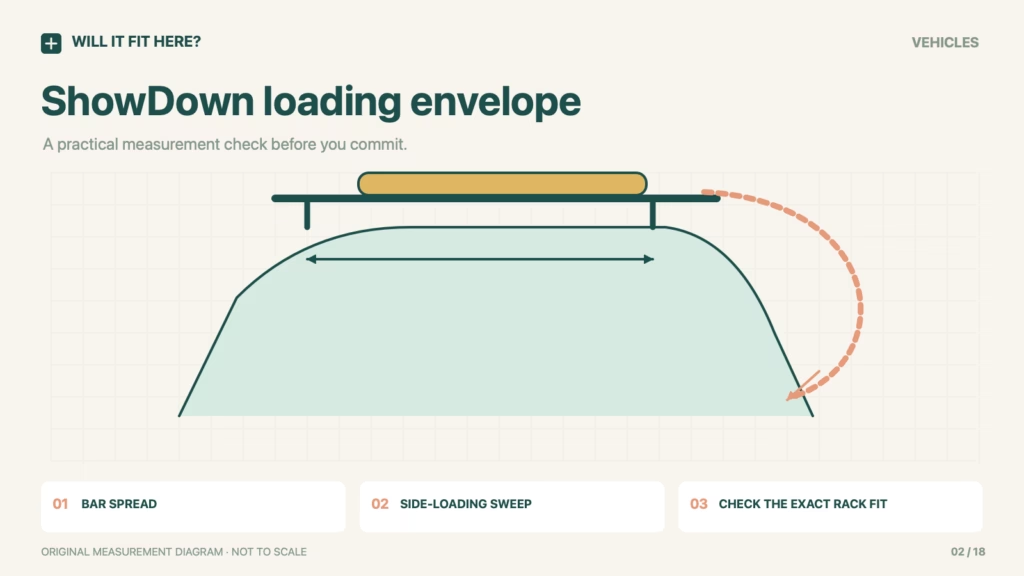
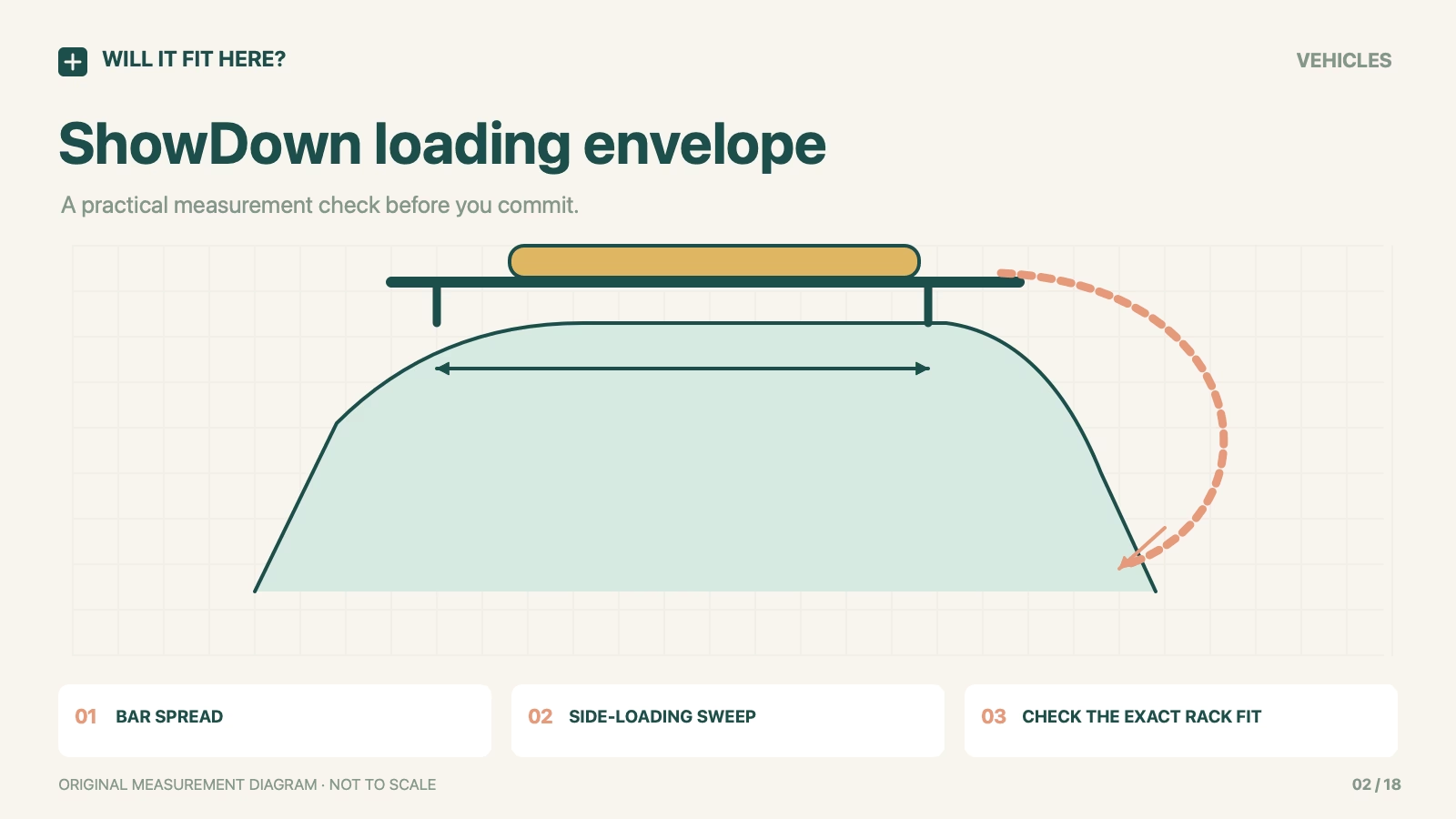
Fit verdict — Conditional. Yakima ShowDown fit depends on the approved roof-rack application and the side-loading movement, not just whether the clamps surround the crossbars. Yakima’s support reference calls for at least 24 inches of crossbar spread, a 165 lb-rated fit and no more than 15 inches from the tower face to the vehicle side. These checks do not turn an unlisted vehicle into an approved fit; confirm that application with Yakima before installation.
Yakima ShowDown fit: scope
Yakima ShowDown with the exact vehicle, tower and crossbar application. The cited support page was updated July 2020; use the current Fit Guide as the application gate.
Dimensions and conditions
| Check | Reference or condition | What it means |
|---|---|---|
| Crossbar spread | 24 in minimum, center to center | Measure front-bar center to rear-bar center. |
| Rack application | 165 lb load rating required by cited fit guidance | Do not confuse that requirement with a kayak payload allowance. |
| Tower-to-vehicle-side distance | 15 in maximum in cited guidance | Use the illustrated tower-face reference, not a roof-width guess. |
| Tower and roof style | Exact approved application required | Yakima flags most BaseLine/Q-Tower naked-roof fits as unsuitable. |
| Loading envelope | Observe the complete permitted lowering movement | Vehicle body, adjacent equipment and loading position must stay clear. |
1. Verify the Yakima ShowDown rack application
Record the vehicle year and body style, tower model, bar model and installed bar position together. A rack assembled from individually familiar parts is not automatically a compatible system. Check the current vehicle result first. If it does not list ShowDown, ask Yakima about that exact combination. Do not replace the missing application result with an improvised pull test or assume that another vehicle with a similar roof proves yours will work.
2. Measure spread and side reach from the correct points
The two roof measurements answer separate questions. Front-to-rear spread establishes the support spacing; the side measurement addresses how far the carrier must reach past the vehicle. Label each reference point on a sketch. Avoid measuring bar-edge gaps for one value and center spacing for the other. Also record the clamps and towers already occupying each bar, so a measurement is not taken across a section that is unavailable for mounting.
3. Reserve the lowered position as well as the roof position
Plan where the person and boat will be during the approved loading sequence. A carrier can occupy the roof neatly yet meet a mirror, door, neighbouring rack or wall as it lowers. Assess the intended parking spot on level ground with the vehicle stationary. Use the installation instructions and a light planning outline to identify clashes before handling a boat. Clearance for the carrier is separate from the space needed to stand and lift comfortably.
Before you decide: 5 checks
- Find the exact vehicle-and-rack application in Yakima’s current guide.
- Measure center-to-center spread without moving bars outside permitted locations.
- Check the tower-face reference and neighbouring bar hardware.
- Calculate the complete roof load using the limits for the whole approved system.
- Check the allowed loading movement and confirm any unlisted application with Yakima.
FAQ
Does a 165 lb roof rating mean I can load a 165 lb kayak?
No. The cited fit requirement is not a boat allowance. The carrier, rack, vehicle and complete load each have limits; use the current matching instructions.
Can longer bars fix every side-clearance problem?
No. Bar length cannot override tower, roof or application restrictions. Use only a configuration approved for the vehicle.
Is an older support page enough for a new vehicle?
No. It explains the measurement concepts. The current Fit Guide and confirmation for the particular application take priority.
Official sources and scope
Checked on 26 October 2026. The cited product, variant and region control. Follow the matching current instructions. The measurement workflow is editorial guidance; no firsthand installation or universal fit is claimed.