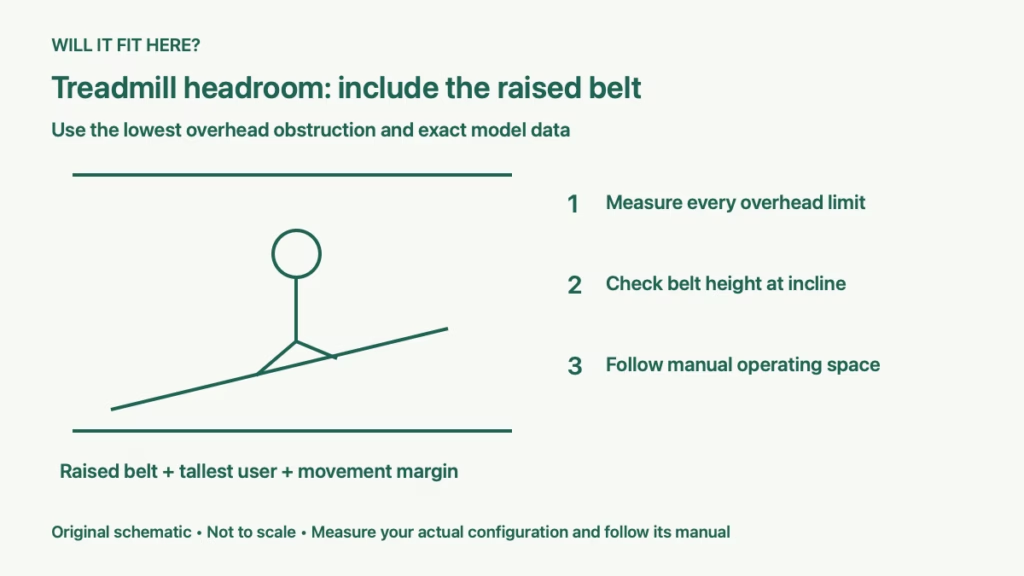
Quick answer: Treadmill ceiling clearance depends on the tallest user, the belt’s height at the intended incline, the floor setup and the exact manufacturer’s headroom requirement. Measure to the lowest obstruction over the running position. A treadmill that fits while folded or powered off may still leave too little room for exercise.
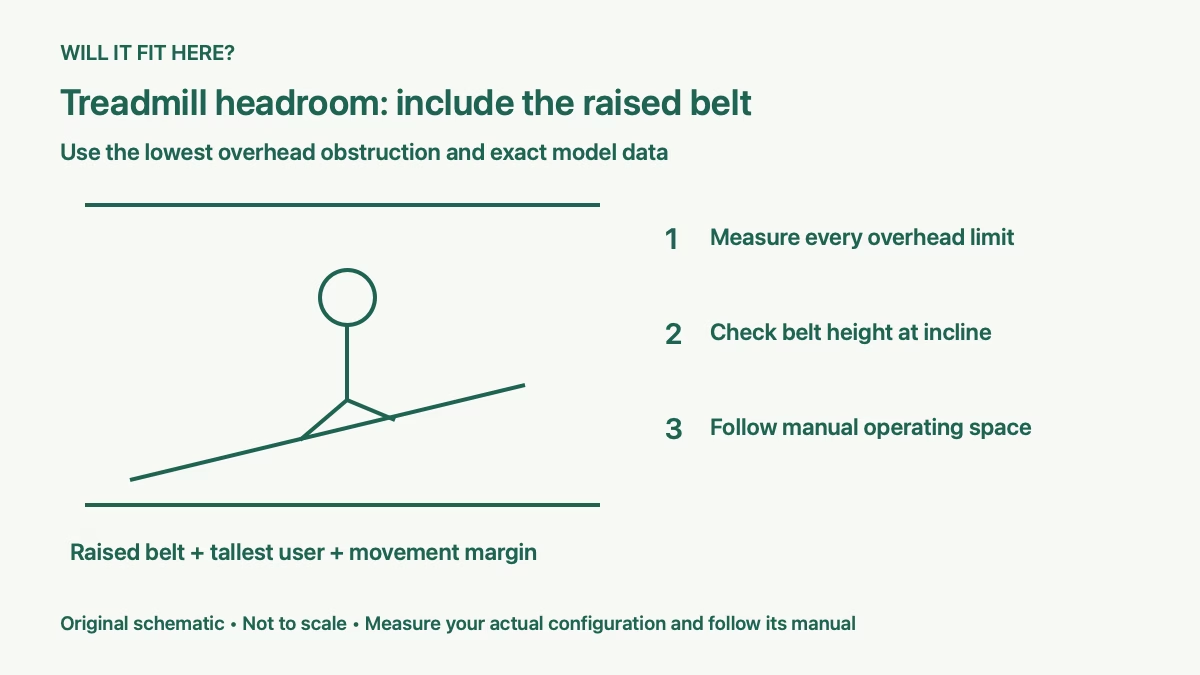
This treadmill ceiling clearance guide helps a basement or spare-room buyer screen a location before ordering. The important question is whether the user can operate the intended model within its required space, including incline. Overall machine height and the room’s advertised ceiling height do not resolve that question by themselves.
1. Measure treadmill ceiling clearance at the lowest obstruction
Measure vertically from the finished floor at the intended treadmill location. Check more than one point along the belt and around the position where the user will stand. Beams, ducts, ceiling slopes, light fixtures and garage-door hardware can sit lower than the main ceiling. Record the smallest relevant measurement.
Include the finished setup. A mat raises the machine, and a new floor covering can reduce the available headroom. Use actual measurements rather than assuming the basement has an eight-foot ceiling. A floor that slopes across the machine also needs review under its leveling and installation instructions.
Map overhead obstructions on a simple plan. Mark the proposed belt, console and nearby access path, then measure each affected area. A low beam behind the console may become relevant when the walking or running position changes. Do not choose a position that requires the user to duck during use.
2. Obtain model-specific treadmill ceiling clearance
Read the current manual and support guidance for the exact model and revision. Ask for headroom requirements, belt or deck height, permitted incline range and any clearances around the equipment. If the published dimensions only describe the console or folded machine, ask the manufacturer for the missing operating information.
As a manufacturer-specific example, Horizon Fitness’s current ceiling guidance says to allow the tallest household user’s height plus 12 inches. That is Horizon’s general guidance, not a universal rule for every treadmill. For a 72-inch user, the arithmetic gives an 84-inch ceiling threshold under that guidance.
The short support article does not provide a separate belt-height value for every incline setting. If a particular model or location is close to the limit, ask Horizon to confirm the complete configuration. Do not add a general allowance to deck height again unless the manufacturer explains that the allowance excludes it; otherwise you may mix two different measurement methods.
3. Check treadmill ceiling clearance at the intended incline
For a direct geometry check, measure from the finished floor to the belt where the user will actually exercise. Incline changes the belt’s position, and the front and rear may sit at different heights. The highest relevant user position matters more than the deck’s lowest edge or a zero-incline brochure measurement.
The geometric space above the user is the overhead height minus belt height at that position minus the user’s standing height in exercise footwear. This calculation describes remaining space; it does not set a safe minimum. The manufacturer’s required allowance and operating instructions still control the decision.
For example, a 90-inch overhead height, a measured 9-inch belt height and a 72-inch user leave 9 inches of static space above the head. Those are hypothetical measurements. They do not approve a model or account for movement, footwear changes or an instruction requiring more space.
Do not estimate the rise by multiplying advertised incline percent by the entire treadmill length. Incline refers to a slope, while the belt’s support geometry and pivot determine its elevation. Obtain the actual model measurement instead. Have an existing machine adjusted only as directed in its manual; keep people clear during measurement.
4. Separate treadmill ceiling clearance from storage fit
Check the treadmill in its assembled operating position, its permitted storage position and the delivery packaging. These are different envelopes. A shorter folded floor footprint may produce a taller stored machine, and the box can have a different shape from the assembled unit.
For example, Horizon’s published dimensions table lists its T101 at 70 by 34 by 55 inches assembled and 46 by 34 by 61 inches folded. Those overall dimensions do not identify the running-belt height or establish user headroom. Confirm the exact version before using the example for a purchase.
Keep required rear and side clearances, access and emergency-control use available. A treadmill can pass the overhead check but still be unsuitable in a crowded room. Move desks, storage and furniture out of the required operating area rather than treating an empty belt footprint as the complete space requirement.
5. Resolve borderline treadmill ceiling clearance before buying
Give the manufacturer the exact model, tallest user height, lowest obstruction measurement, intended incline and mat thickness. Ask for a clear answer for that configuration. A marginal static fit is not a reason to experiment by running beneath a beam or to alter the machine’s supports.
Check delivery separately using the route method in our narrow-door appliance delivery guide. For a shared room, our bed and desk clearance guide helps identify furniture movements that compete for the same space.
Before ordering: confirm treadmill ceiling clearance for the exact machine, user and incline, then confirm the surrounding operating space and delivery route. Choose a different location or model if the maker cannot confirm the available headroom.