Quick answer
A folded stroller may fit behind the Toyota Sienna’s third row, but a universal yes requires measurements the cargo-volume headline does not provide. Check your exact folded stroller against the hatch opening, cargo-well footprint and closed-hatch space with the third row in its normal occupied position.
Keep the third row in the configuration you need
This guide is for a 2026 US-market Sienna with the third row available for passengers. Start there, rather than copying a photograph with the seats stowed. Toyota’s 2026 model announcement describes different seating configurations and the Split & Stow third-row system, but those features do not supply a stroller-sized rectangular opening.
Set the seats according to the vehicle instructions and leave their backs in the position you will actually use. Place your cargo mat or liner in its normal location. Remove loose shopping bags for the measurement, then add the bags you expect to carry when testing everyday usefulness.
Maximum cargo capacity is the wrong shortcut. It may refer to a different seat arrangement, and cubic feet can include irregular spaces beside an object. A stroller has a fixed folded shape that must cross one opening and occupy one continuous space.
Use the stroller’s exact folded configuration
Fold the stroller exactly as you would after a normal outing. Include attached wheels, handlebar, seat and accessories that remain on it. Lock or secure the fold as directed by its manufacturer, then measure the greatest length, width and height. The widest wheel or protruding handle counts.
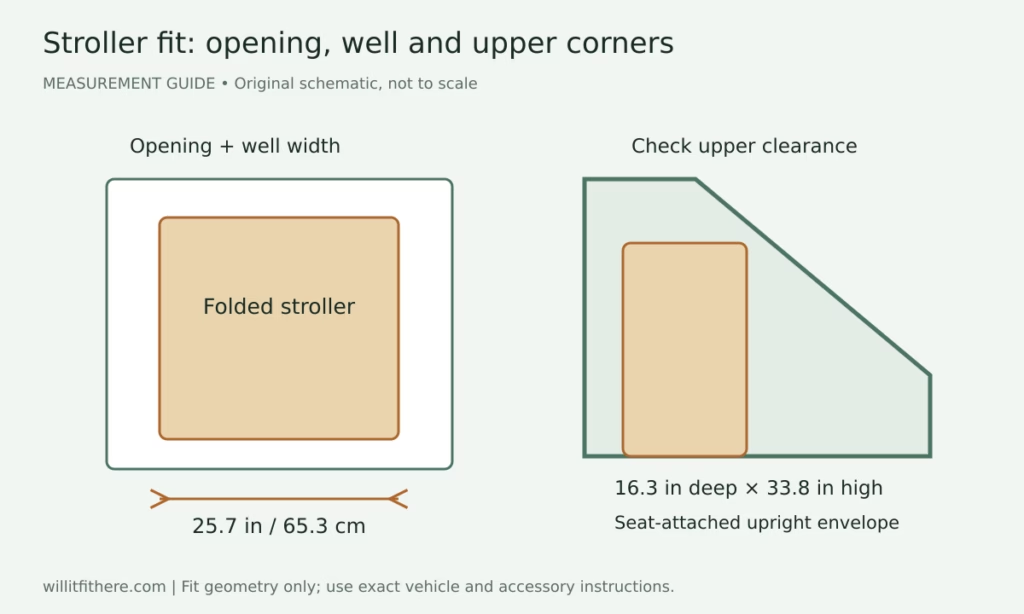
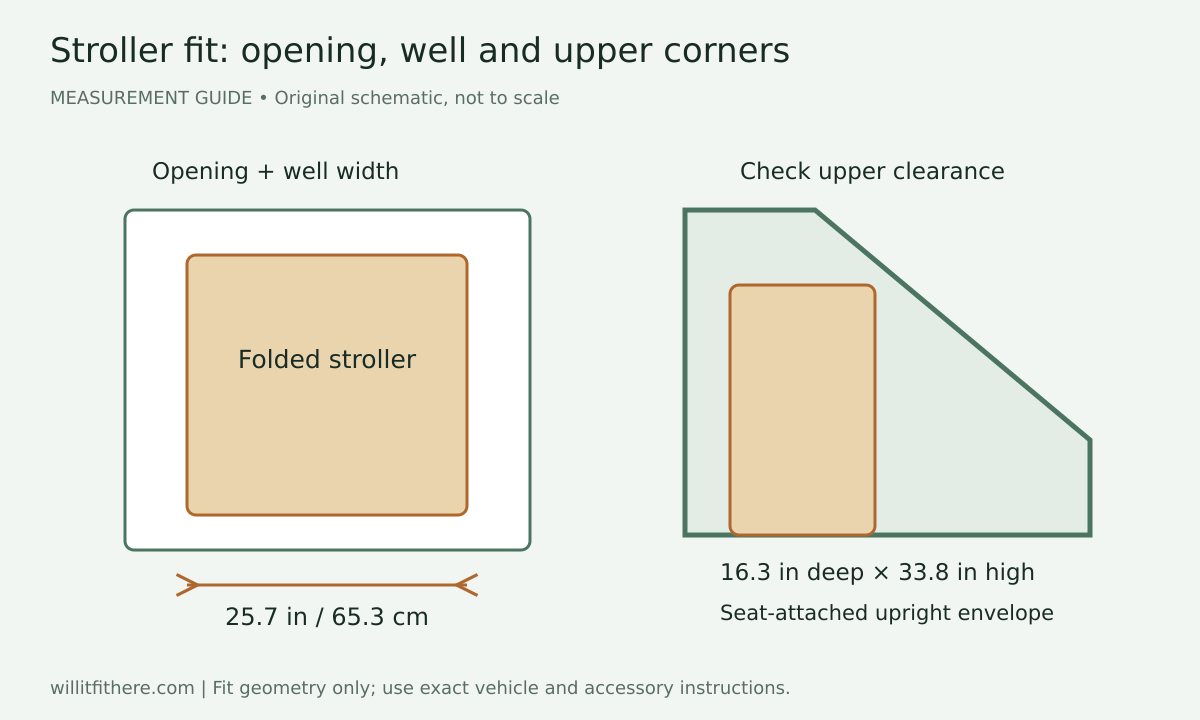
For a specific US example, UPPAbaby lists the Vista V3 at 16.3 inches long, 25.7 inches wide and 33.8 inches high when folded with the seat attached. That is approximately 41.4×65.3×85.9 cm. With the seat removed, the listed folded frame is 11.3×25.7×32.3 inches, approximately 28.7×65.3×82.0 cm.
Those are two different packing plans. Removing the seat makes the frame smaller, but the detached seat still needs a place. Do not compare the frame-only dimension with your cargo space and forget the second item. Check the current instructions for permitted folding and accessory removal.
Measure the well at the stroller’s contact points
The cargo well is not necessarily a box with identical dimensions from bottom to top. Measure usable width and front-to-back depth where the stroller will actually rest. Then repeat at the heights occupied by its widest wheels and handles. A wider upper lip does not prove the base fits below it.
Lay out a paper rectangle matching the proposed footprint. Check the cargo liner’s raised edges and the curve where the floor meets side trim. Record where the wheels or frame would contact the surface instead of assuming every part of a folded stroller occupies its rectangular bounding box.
The box method is conservative: a real stroller may have empty space around its frame. That can help in a physical trial, but it is not a reason to shave a measured dimension off the shopping checklist. Use the full envelope to screen options and the actual empty stroller to resolve a close result.
Check the hatch opening and the loading movement
Measure the narrowest usable opening at the heights needed for the folded stroller. Include the lower sill, upper trim and any side taper. Keep the tape between hard boundaries without compressing seals or trim to make the result larger.
A stroller can fit in the well but still need a rotation to pass the hatch. Trace the whole movement with a lightweight template first if the dimensions are close. Remember that the folded shape will occupy more than its final footprint while being tilted or lowered.
Consider handling as well as the final arrangement. Can you lower the actual stroller without an awkward reach over the sill? Can you remove it without unloading everything else? A measured yes that requires a complicated maneuver after every outing may be less useful than a slightly different packing orientation.
Compare two Vista V3 orientations
Using the published seat-attached envelope, an upright orientation asks for about 25.7 inches of width, 16.3 inches of depth and 33.8 inches of height. A rotated orientation can exchange the height and depth axes, but it still needs all three dimensions and a feasible loading path. Check that the manufacturer permits the intended storage position.
| Illustrative plan | Required rectangular envelope |
|---|---|
| Upright, seat attached | 25.7 W × 16.3 D × 33.8 H in |
| Rotated, seat attached | 25.7 W × 33.8 D × 16.3 H in |
| Frame only, upright | 25.7 W × 11.3 D × 32.3 H in; seat stored separately |
Suppose a measured well offers 17 inches of depth where the upright stroller rests. Subtracting 16.3 gives 0.7 inch, or about 1.8 cm, of nominal difference. That small result does not answer whether the wheels clear the sides or whether the upper handle meets the closed hatch. The 17-inch well is an example, not a Sienna specification.
Now imagine the upright top projects into the hatch’s sloping area. The floor may pass while the top fails. A template that represents only the wheel footprint would miss that conflict. Check the whole volume before calling either orientation successful.
Leave room for the things that travel with it
After the stroller-only trial, add your normal bags. Keep the third row usable and avoid treating an empty passenger seat as extra storage if someone will occupy it. Test whether the stroller can come out first, since it may be the item you need immediately on arrival.
If you remove a seat, wheel or accessory for packing, give that component a repeatable location and account for it in the measurement. The goal is a practical routine, not a single impressive arrangement that takes ten minutes to recreate. Follow the stroller’s instructions when reinstalling components.
Check closed-hatch clearance without using the powered door to push on the stroller. Stop and reposition if anything is uncertain. The ability to close the door does not establish cargo securement or child-related safety; use the vehicle and stroller instructions for those separate matters.
A five-minute showroom checklist
- Bring the actual stroller or a full-size labeled template.
- Confirm the Sienna model year, seating configuration and cargo liner.
- Keep the third row upright in its intended position.
- Record the stroller’s seat-on or seat-off folded dimensions.
- Check well width and depth at more than one height.
- Check the opening and complete rotation path.
- Check the upper folded frame against the closed-hatch space.
- Try removal with your normal bags present.
Ask the dealer before bringing a stroller into a display vehicle and keep its wheels clean. A physical trial of your own equipment is more useful than a generic claim that a minivan has a large trunk.
Make the fit answer specific
The useful conclusion should read “this folded stroller, in this orientation, behind this third-row setting.” Without those details, “Sienna stroller fit” can hide very different packing arrangements. No unverified linear Sienna cargo dimensions are used here.
- Toyota USA: 2026 Sienna model information
- UPPAbaby USA: Vista V3 dimensions and configuration information
Sources checked October 5, 2026. Numerical vehicle-space examples are hypothetical. This is a measurement guide, not a hands-on stroller test or a cargo-restraint recommendation.