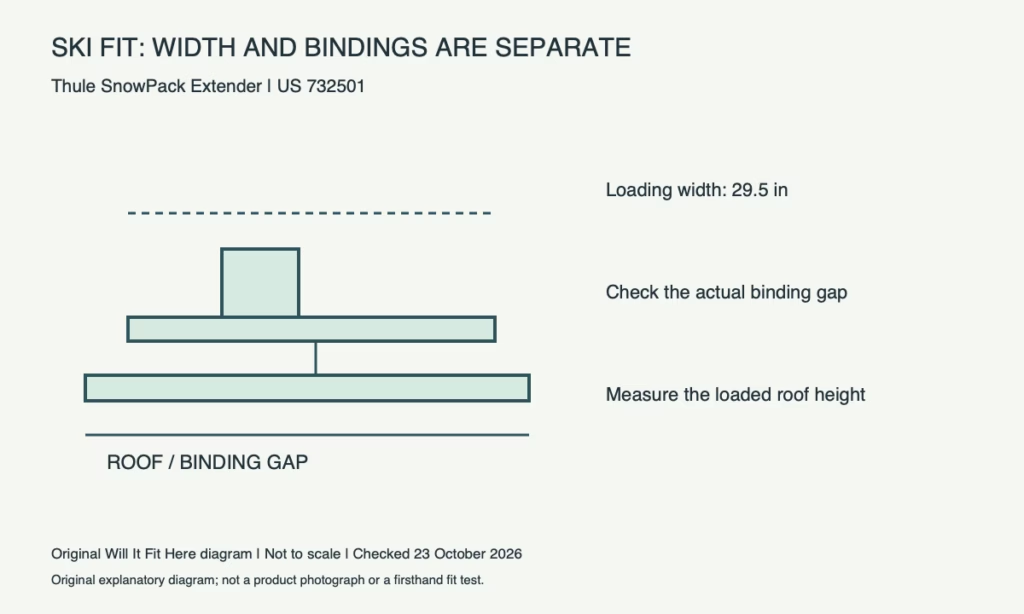
Result — Conditional. Thule SnowPack Extender US model 732501 has a published 29.5-inch loading width. That is the usable carrier-width specification, not a promise that six pairs of your particular skis fit. Check bindings, the approved mounting arrangement and the height of the complete loaded vehicle separately.
1. Identify your Thule SnowPack version
Read the product number on the carrier before comparing measurements. This guide uses the current US 732501 page and the linked North American 7325 instructions. Other markets list different capacities and loading widths under similar names. A photograph of the label is more useful than a seller’s description saying only “SnowPack Extender.” Keep the instructions with that identification so you do not borrow a convenient figure from another version.
2. Dimensions: compare usable width with your equipment
Lay out the equipment in the arrangement allowed by the instructions and measure the width it actually occupies at the gripping location. Include the widest relevant parts instead of multiplying the narrow waist width of one ski by the advertised pair count. As an illustrative calculation, a hypothetical approved layout occupying 28 inches leaves 1.5 inches against the stated 29.5-inch width. That arithmetic does not create an extra allowance or approve an arrangement that cannot close and latch correctly.
| Check | Reference / action |
|---|---|
| Scope | US 732501; match the actual product label |
| Loading width | 29.5 in / 749.3 mm by exact conversion |
| Listed carrier outline | 31 × 2.8 × 5.5 in; not binding clearance |
| Published maximum count | Up to 6 ski pairs or 4 boards; equipment dependent |
3. Check bindings above the roof
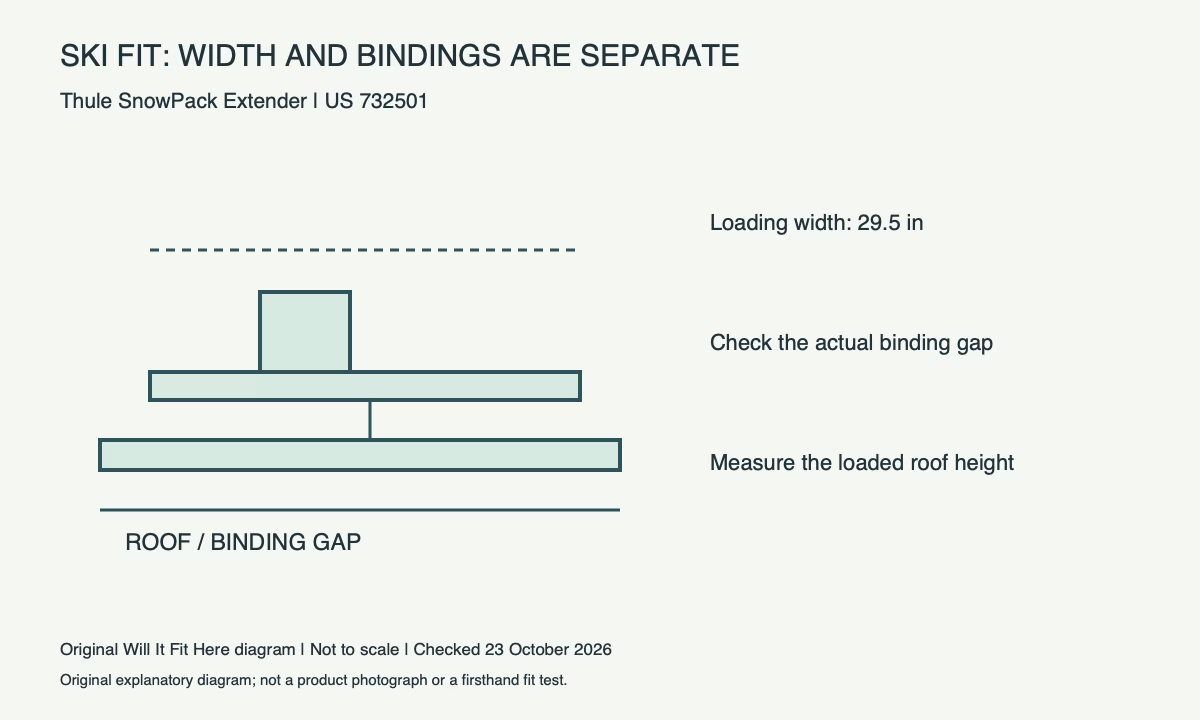
The raised design is intended to provide extra room for tall bindings, but the published overall carrier height is not a guaranteed binding-to-roof gap. With the correct carrier installation, inspect the lowest binding component relative to the actual roof surface. Roof curvature and bar height change that relationship. A simple cardboard side profile can help plan the check without placing metal equipment on paint; confirm the real arrangement carefully before travel. Do not add improvised spacers to manufacture clearance.
4. Confirm mounting and slide-out access
The US page describes T-Track and Speed-Link mounting options. Compatibility still depends on the exact bars and the matching instruction steps. Measure bar position at the reference points shown in those instructions. Also consider the carrier when extended: the loading operation needs space beside the vehicle and access to its controls. Park where you can stand securely and handle the equipment without leaning it against another car. Return the carrier fully to its required travelling position and verify its intended latches.
5. Measure the loaded vehicle before the garage
Write down the highest point of the final travelling arrangement, measured from level ground. Do not calculate it simply by adding the catalogue carrier height to the vehicle brochure height: bar towers, mounting position and equipment orientation matter. Include the rack and accessories when checking the vehicle’s permitted roof load. If a second roof accessory shares the bars, inspect its actual envelope too. A ski carrier can pass its own width test while the combined roof arrangement remains unsuitable.
Before you decide
- Match product number, region and instructions.
- Measure the intended gripping layout and inspect closure.
- Check binding-to-roof separation and slide-out access.
- Record loaded height and the lowest applicable roof-load limit.
FAQ
Does six-pair capacity guarantee six wide skis fit?
No. The count is an upper capacity statement. Your permitted arrangement must also fit the usable width and close properly.
Can I use the 5.5-inch carrier height as binding clearance?
No. It is an overall product dimension. Measure the actual gap on the correctly installed rack.
Official sources and scope
Checked on 23 October 2026. These references apply to the identified product, version and region. Follow its matching current instructions. Any worked measurement example is hypothetical.