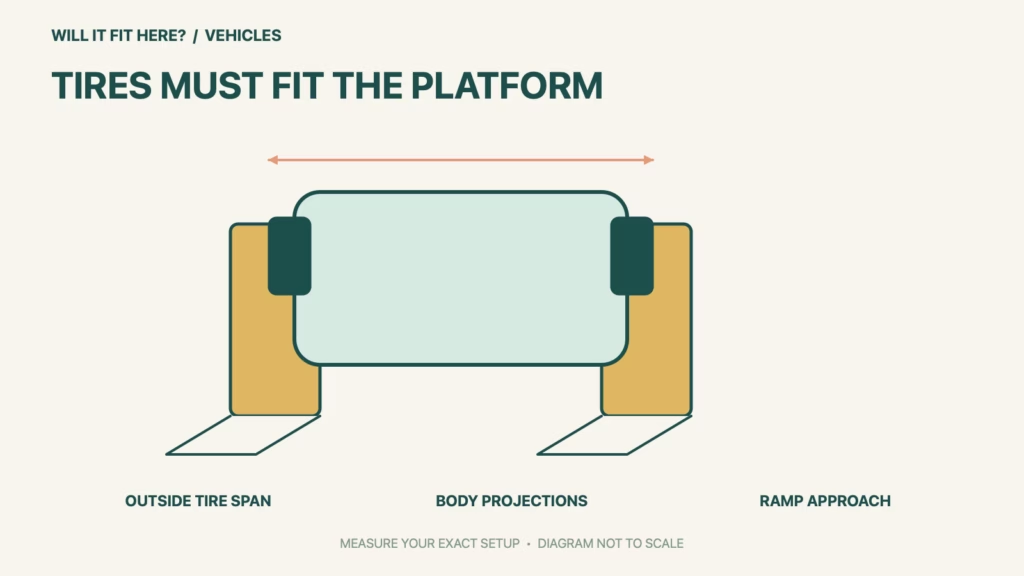
Fit verdict: A U-Haul Auto Transport is suitable only after U-Haul approves the complete towing combination and the vehicle’s tires fit the assigned trailer’s ramps and platform. Body width alone is insufficient. Modified wheels, low bodywork and tire-strap contact can change a result that looked acceptable from a stock vehicle description.
This guide concerns the Auto Transport car trailer, not the two-wheel Tow Dolly. Dimensions below are the current rental-page references checked on the date shown. Confirm the actual trailer and exact vehicles with U-Haul; this article does not replace the company’s equipment selection or loading instructions. The rental page lists a 76-inch outside-tire maximum, while the user instructions distinguish 79 inches for a silver platform and 75 inches for an orange platform. These are not one universal limit: ask U-Haul to resolve the assigned model before loading.
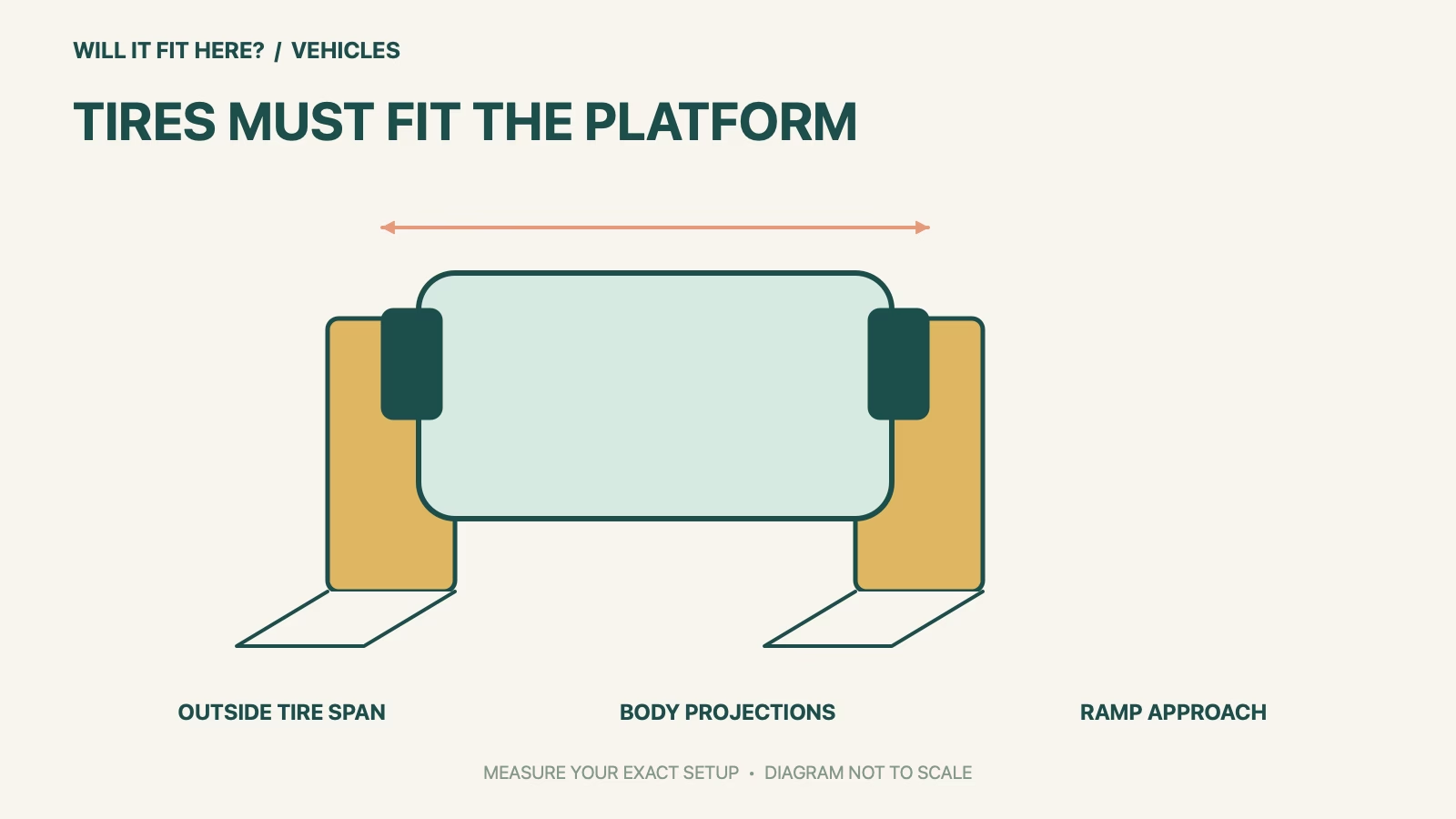
Dimensions and conditions
| Check | Official reference | What to verify |
|---|---|---|
| Outside tire width | Rental listing: maximum 6 ft 4 in | Measure across the outside of the tires, not the mirrors. |
| Instructions by platform | Silver: 79 in; orange: 75 in | Different from the rental-page figure; confirm the assigned model. |
| Inside tire width | Rental listing: minimum 3 ft 8 in | Check the inner tire edges and assigned platform. |
| Outside body width | Rental listing: maximum 6 ft 7 in | Include relevant bodywork separately from tire track. |
| Ramp reference | Listed extended length 6 ft 6 in | Length alone does not establish underbody clearance. |
| Final compatibility | Approved combination and physical tire support | Verify modifications and the actual equipment before loading. |
1. Identify the U-Haul Auto Transport combination
Prepare the year, make and model of both the towing vehicle and the vehicle being carried, along with the hitch information U-Haul requests. State any wheel, tire, suspension or body changes. A stock-model lookup can miss a wider wheel offset or a lowered front bumper. Ask the rental location to confirm the exact combination and equipment before committing to a loading plan. A vehicle that fits within a width rectangle can still be unsuitable because of weight, towing capacity or another application restriction.
2. Measure tire track and body width separately
With the vehicle parked on level ground and its wheels straight, measure the outside-to-outside tire span at the front and rear. Also record the inside-to-inside tire spacing where it is relevant to support on the trailer tracks. Use two people or clear floor marks so the tape stays square rather than diagonally shortening the measurement. Measure body projections separately. Compare these notes with U-Haul’s current listing and the assigned trailer. Do not average a wider axle with a narrower one; both need to work.
3. Assess the approach and usable loading position
The loading path includes the road-to-ramp approach, the change of angle onto the platform and the final tire position. A long wheelbase, low splitter or low center section can create a problem even when width passes. U-Haul provides specific low-clearance loading guidance; obtain help from the rental staff if the arrangement is unclear. Do not improvise extensions or load an unapproved vehicle to see what happens. Confirm the tire straps, driver exit and prescribed securing points using the current instructions for the actual trailer.
Before you decide: 5 checks
- Confirm Auto Transport rather than Tow Dolly and obtain combination approval.
- Report nonstandard wheels, tires, suspension and bodywork.
- Measure front and rear outside tire spans and relevant inside spacing.
- Check body projections and the complete approach path separately.
- Have U-Haul verify support, restraints and the assigned trailer before loading.
Keep a short U-Haul Auto Transport fit record with the exact product or service identity, the official rule you checked and the measurements from your own setup. Mark anything you could not verify as unresolved. Recheck the record if the product, accessories, route or surrounding space changes; an earlier fit result belongs to the configuration that was actually checked.
FAQ
Does U-Haul Auto Transport approval depend only on width?
No. U-Haul’s combination check and the current instructions also control. Weight, towing equipment, modifications and loading geometry must be resolved.
Can I use mirror-to-mirror width for the tire measurement?
No. Tire span and body width describe different interfaces. Record the specified tire-edge measurements as well as any relevant body projections.
Will stock-model approval cover aftermarket wheels?
Do not assume it does. Tell U-Haul about changes that affect track width, tire size, clearance or weight and obtain a fresh confirmation.
Related fit guides
Continue with Dometic CFX5 35 Fit: 5 Vehicle-Space Checks or browse Vehicles fit guides. Check each item against its own specifications; a related guide does not establish this product’s compatibility.
Official sources
- U-Haul Auto Transport current rental dimensions
- U-Haul Auto Transporter user instructions
- U-Haul official loading and low-clearance videos
Sources checked 28 October 2026. Measurements and conditions are attributed above; room and packing checks are planning guidance. Recheck the current official instructions before purchase, installation or travel.