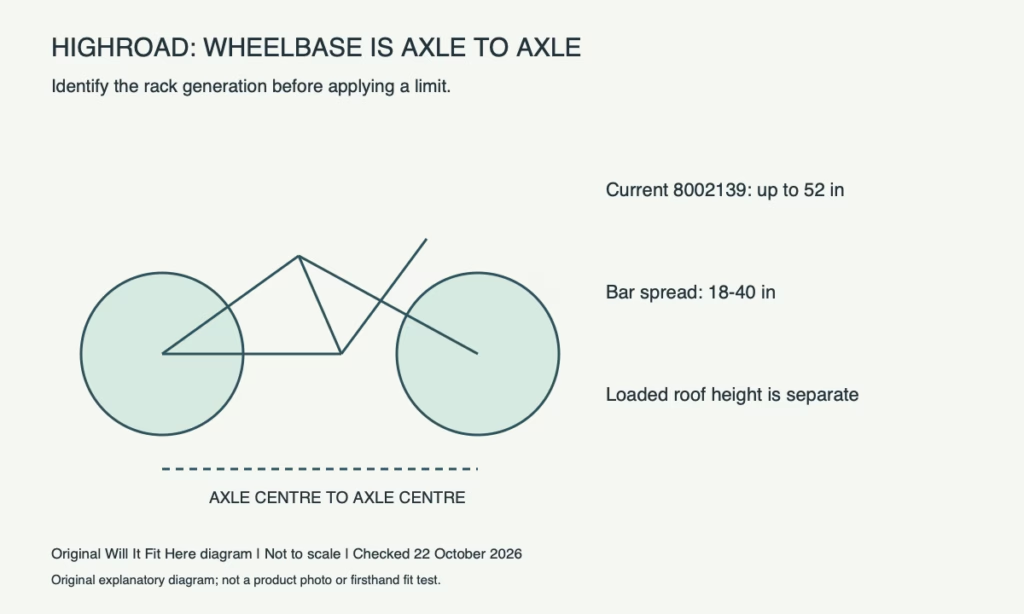
Result — Conditional. The current US HighRoad, SKU 8002139, accepts a wheelbase up to 52 inches, but that specification must not be applied automatically to an older HighRoad. Wheel size, tire width, bike weight and crossbar spacing must pass independently.
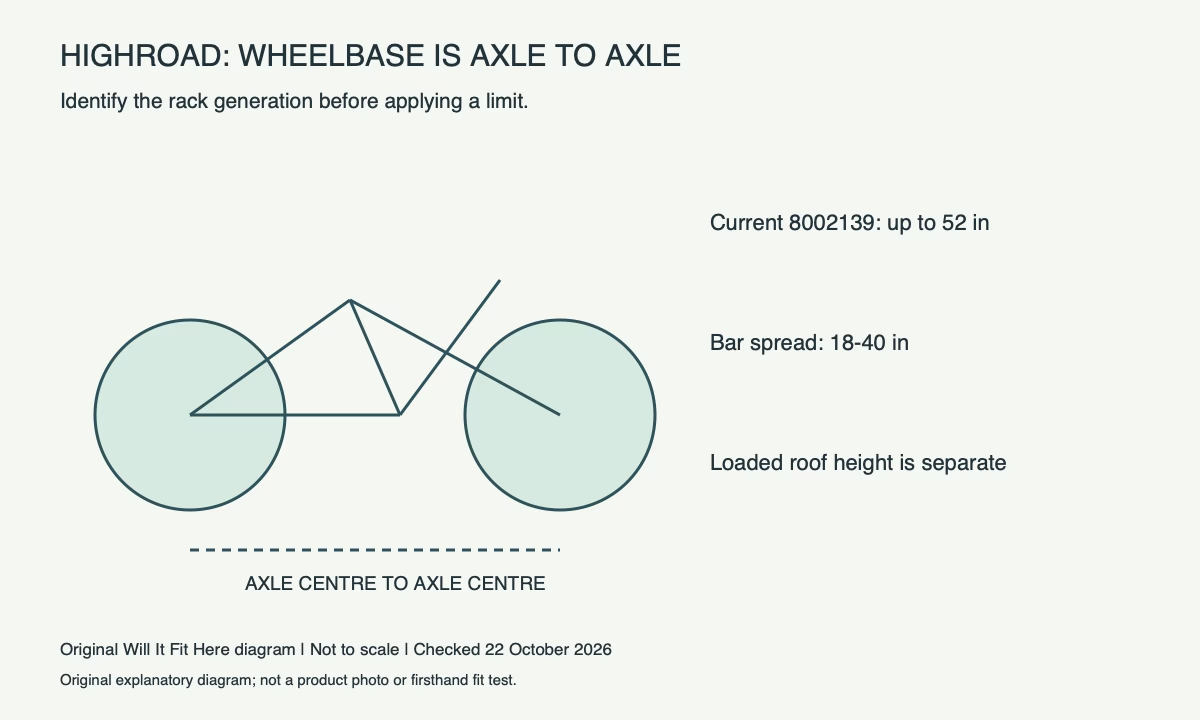
Read the rack label before measuring the bike
A used rack advertised simply as “HighRoad” needs a model check. The current Yakima product page identifies SKU 8002139 and lists 26–29 inch wheels, tires from 23 mm to 4.0 inches, and a 52 inch maximum wheelbase. Yakima’s older support article identifies HighRoad 8002114 and a narrower tire range ending at 3.25 inches. These are different published specifications. Photograph the label and obtain the instructions for that exact rack before buying a bike around it.
Dimensions: measure axle to axle
Wheelbase is the distance between the front and rear axle centres, with the front wheel straight. It is not total bicycle length, frame size or the distance between tire contact patches. Use the bicycle maker’s geometry chart for the exact frame size, then confirm the measurement on the assembled bike. Tire bulge and accessories still need separate checks.
| Current SKU 8002139 check | Published limit | What to record |
|---|---|---|
| Wheelbase | Up to 52 in / 1320.8 mm | Exact frame-size wheelbase |
| Wheels and tires | 26–29 in; 23 mm–4.0 in tire width | Actual wheel/tire combination |
| Crossbar spread | 18–40 in | Front-to-rear bar spacing |
| Bike weight | 45 lb on road; 27 lb off road | Complete carried bike weight |
Work through a close comparison
For a hypothetical 1,300 mm wheelbase, the arithmetic against 52 inches is 1,320.8 − 1,300 = 20.8 mm. That is a difference between two measurements, not an extra installation tolerance or permission to exceed another limit. It says nothing about whether an older rack, a different tire, or a particular roof system is approved.
Measure crossbar spread using the mounting reference in the rack instructions, rather than the visible gap between bar edges. Confirm the vehicle, towers and bars accept the carrier and the complete load. Do not move fixed mounting points beyond their approved positions to achieve a convenient spread.
Check the loaded roof, not the empty tray
The empty carrier is listed as 57.5 × 9.5 × 4.5 inches and 18 lb. Its low tray does not represent loaded vehicle height. Check the mounted bike against the hatch’s opening sweep and measure the highest point from the ground before approaching a garage. Use the specified wheel retention method; a wheel resting in a tray without correct hoop engagement is not a completed fit.
Before you decide
- Record the HighRoad SKU and matching instructions.
- Measure axle-centre wheelbase and complete bike weight.
- Check wheel diameter, actual tire width and permitted road use.
- Confirm bar spacing, roof load, hatch sweep and loaded height.
FAQ
Will a 29er always fit?
No. Wheel diameter is only one limit; frame size changes wheelbase, and tire width and weight also matter.
Can I use the new 52-inch limit for a used HighRoad?
Only if the rack is the version covered by that specification. Match its label and manual first.
Official sources and scope
Specifications and guidance checked on 22 October 2026. The named model and region control; follow the matching current instructions for your product. Worked examples are identified as hypothetical.