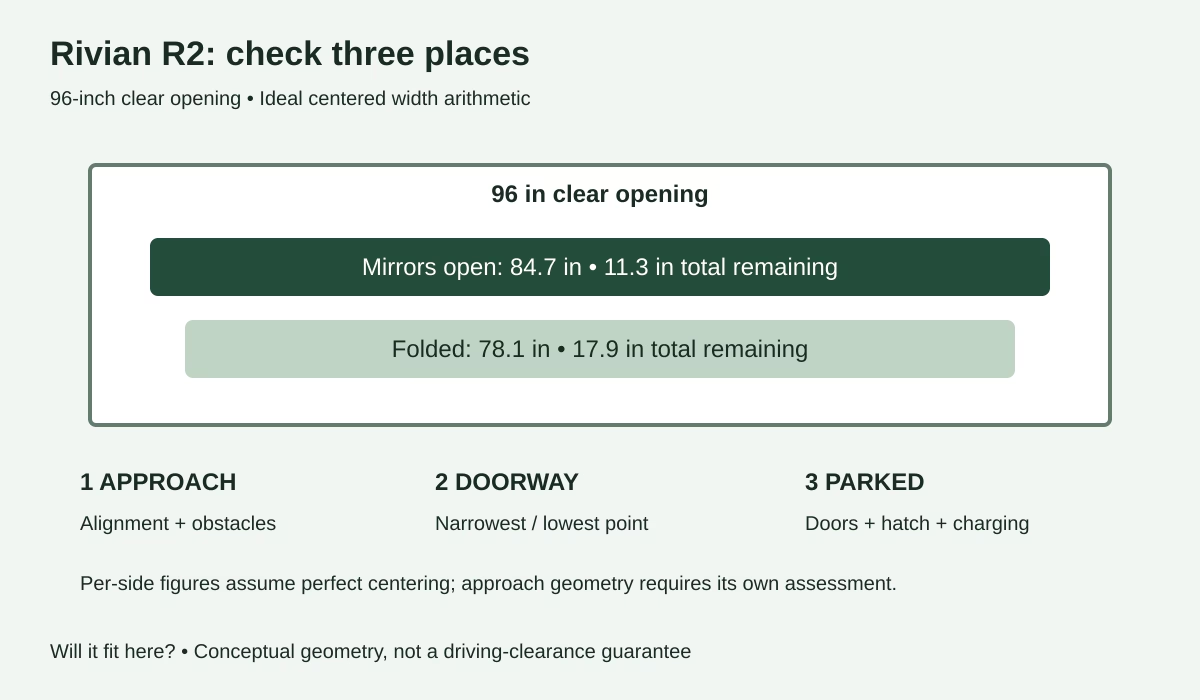
Quick answer: On paper, the Rivian R2 is narrower than a truly clear 8-foot (96-inch) garage opening. Its published mirror-open width is 84.7 inches, leaving 11.3 inches total, or 5.65 inches on each side under perfect centering. With mirrors folded, the published 78.1-inch width leaves 17.9 inches total. These are stationary calculations, not a guarantee that you can drive through your doorway.
Checked October 4, 2026 · US specifications · Documentation and measurement guide; no hands-on fit test.
Rivian R2 dimensions that matter for a garage
Rivian announced R2 production on April 22, 2026, making this a new-vehicle garage decision. That dated announcement is not a claim about current inventory.
Use the R2 figures, not dimensions for the larger R1S. The current Rivian R2 specification page supplies the following measurements. Confirm the exact vehicle and accessories before making a tight-fit purchase decision.
| Dimension | Published inches | Calculated millimeters |
|---|---|---|
| Mirrors open | 84.7 | 2,151 |
| Mirrors folded | 78.1 | 1,984 |
| Length | 185.9 | 4,722 |
| Height | 66.9 | 1,699 |
Metric values here are conversions from the published inch figures, rounded to the nearest millimeter. A closed-body height says nothing about the space needed by an open liftgate or an installed roof load.
What 8- and 9-foot openings leave
| Measured clear opening | Mirror state | Total remainder | Ideal remainder per side |
|---|---|---|---|
| 96 in (2,438 mm) | Open | 11.3 in (287 mm) | 5.65 in (144 mm) |
| 96 in (2,438 mm) | Folded | 17.9 in (455 mm) | 8.95 in (227 mm) |
| 108 in (2,743 mm) | Open | 23.3 in (592 mm) | 11.65 in (296 mm) |
| 108 in (2,743 mm) | Folded | 29.9 in (759 mm) | 14.95 in (380 mm) |
Subtract vehicle width from the actual clear opening. Divide by two only to describe a perfectly centered, straight vehicle. Independent rounding means the metric side values may not add to the rounded total.
An advertised 8-foot door does not establish a 96-inch clear passage. Trim, weather seals and hardware can reduce the usable width. A 94-inch measured opening, for example, leaves 9.3 inches total with the mirrors open. That is two inches less than the nominal-door calculation, before considering alignment.
Use a three-station garage worksheet
Record the tightest point at each station. A wide room behind a narrow door cannot compensate for the entry.
| Station | Write down | What it answers |
|---|---|---|
| 1. Approach | Clear route width: ___ in; turn required: ___ | Can the vehicle line up before the opening? |
| 2. Doorway | Narrowest clear width: ___ in; lowest obstruction: ___ in | What must the closed vehicle pass through? |
| 3. Parking position | Clear depth: ___ in; left/right working space: ___ / ___ | Can you park, exit and use the car? |
Measure the opening with the door fully raised, including any lower edge that still projects into the path. Look at obstacles at mirror height as well as floor level. Inspect the approach for a turn, offset pillar or slope; the width subtraction does not model the vehicle’s swept path.
For depth, measure from the nearest front obstruction to the inside limit of the closed garage door. Include shelves and anything stored behind the vehicle. Mark the R2’s 185.9-inch published length on a floor plan, then identify where people, the charging connection and the liftgate need space. Do not treat unused length as automatically available behind the car.
What folding the mirrors changes
The published folded span is 6.6 inches narrower overall than the open span. That helps the width calculation but leaves the turn-in, body position and interior door-opening problem unchanged. A vehicle offset to one side can have far less room there than the centered table suggests.
Check the actual R2 owner guidance and vehicle controls for mirror operation. This guide does not assume location-triggered folding, a particular automatic parking feature or that a sensor will prevent contact. If the fit remains uncertain, arrange measurements of the exact parked vehicle at the dealer before attempting the passage.
Make the Rivian R2 worksheet a record of your actual garage rather than a list of brochure figures. Date the measurements and note whether storage, door hardware and charging equipment were in their normal positions. Photograph the doorway from inside and outside, then mark where you measured the narrowest clear opening. That helps a dealer or another driver understand which space the number describes.
For the approach station, record anything that prevents a straight, centered entry: a turn, a wall, a post or stored objects. The mirror-open subtraction assumes perfect centering and does not describe that route. At the doorway station, keep the measured clear width distinct from the nominal door size. At the parking station, write down usable depth and the places where you need to stand, open a door or reach the charging connection.
If one field is unknown, leave the fit decision open. A useful next step is a measurement of the exact vehicle or a supervised visit arranged with the seller, where permitted. Keep the mirrors folded only within the vehicle’s instructions; do not assume that folding resolves a poor approach or insufficient working space. Recheck the sheet after moving shelves or changing the parking position. These records organize the evidence; they do not establish a safe driving margin.
A practical pre-purchase decision
Keep three separate answers: entry width, overhead clearance and usable parked space. A positive width result is only the first screen. If the doorway measurement is uncertain, measure again rather than converting a few theoretical inches into a driving recommendation.
- Record the actual mirror state you would use.
- Check roof accessories against the lowest obstruction along the route.
- Plan access for the occupants who will use the garage every day.
- Verify liftgate and charging access while the vehicle is stationary in a known-clear location.
No single universal minimum margin is supplied here. Your measured route, vehicle configuration and ability to align the vehicle determine whether further assessment is needed.