Quick answer: A toolbox fits only if its actual installed shape clears the bed, wheelhouses and accessories. For the 2026 Maverick, Ford publishes a 54.4-inch bed length, 53.3-inch maximum width and 42.6 inches between wheelhouses. Screen a floor-standing chest against the narrowest space it will occupy, then measure the real truck with the tailgate closed.
A Ford Maverick bed fit check starts with the box’s installed position, not its advertised capacity. Keep the floor opening, rail mounting and lid movement as separate checks.
A storage chest can look small enough in a product photo and still be the wrong shape for a Maverick’s bed. Start with where the box will sit: on the floor between the wheelhouses, across the bed rails, or in a model-specific side mount. Each creates a different measurement problem.
Ford Maverick bed dimensions that matter
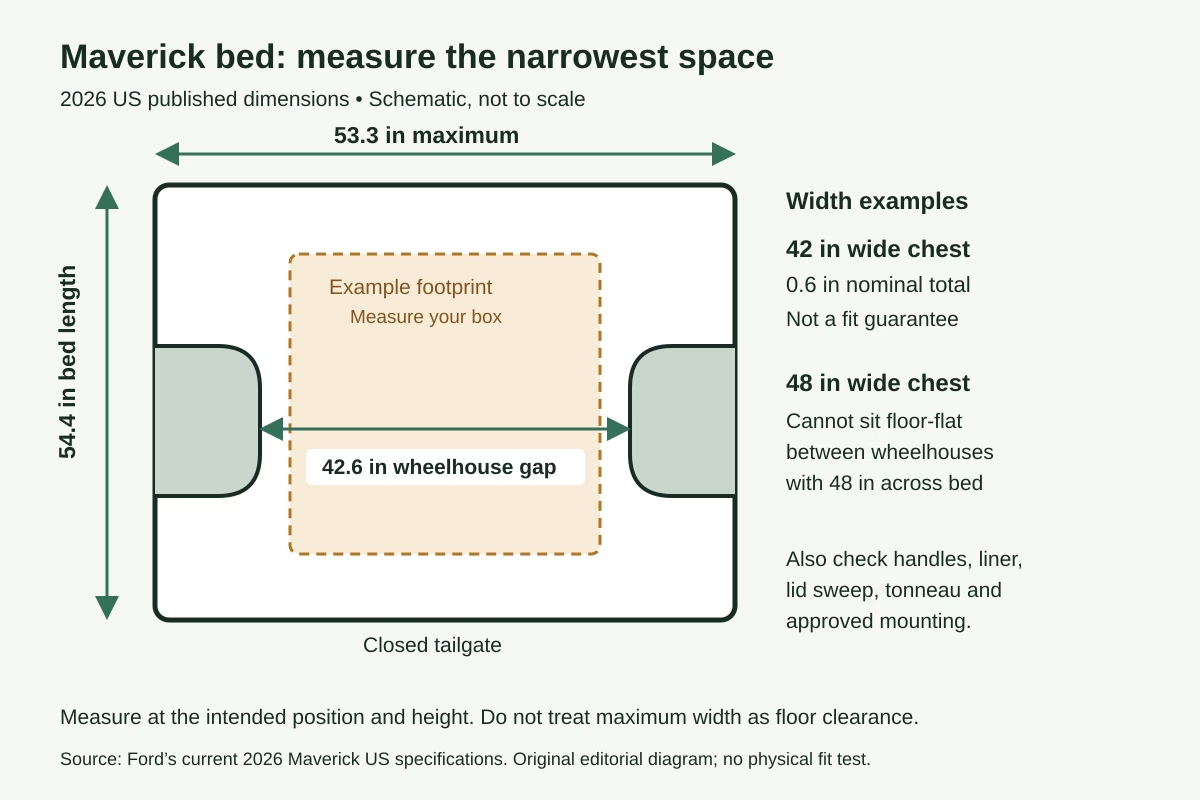
Ford’s current 2026 US Maverick page gives these figures in its specifications graphics and cargo-bed FAQ:
- Bed length: 54.4 inches
- Maximum bed width: 53.3 inches
- Width between the wheelhouses: 42.6 inches
Use the wheelhouse gap to screen a floor-standing chest that must occupy that narrowed section. Maximum width describes a different part of the space. Bed volume cannot tell you whether a rectangular box will clear an obstruction.
Ford’s FAQ also uses a nominal 4-foot-5-inch description. For the numerical screening here, we use the more precise 54.4-inch value shown in its 2026 dimension graphics. Measure your actual usable closed-tailgate space before ordering, including any liner or accessories.
Choose the box type before measuring
Floor-standing storage chest
Draw the chest’s installed footprint on paper, with its intended orientation. Include feet, handles, latches, hinge projections and mounting brackets wherever they extend beyond the main shell. Record their heights too: a handle above a wheelhouse can create a different constraint from a foot near the floor.
Measure the bed at the exact position and height those parts will occupy. A cardboard footprint can reveal obvious interference while the truck is parked, but it does not verify the lid opening or an approved installation. Keep the tailgate closed for a closed-bed fit assessment.
Crossover or rail-mounted toolbox
A box intended to bridge the bed rails needs its maker’s exact-vehicle fit approval. Overall width alone leaves out the lower tub, support surfaces, mounting brackets and clearance around the cab. Ask for a dimensioned drawing showing both the upper body and the section below the rails.
Check compatibility with your liner and tonneau together. A cover’s rails or clamps may occupy space that appears available in an empty-bed photo. If either manufacturer cannot confirm the combined installation, keep that combination undecided.
Side-mounted or swing-out box
For this style, obtain the manufacturer’s fit instructions for your exact year and side of the truck. Include the full opening or swing path in the measurement. A box that fits while closed can still block a tie-down, cover latch or another item you need to reach.
Will a 42-inch or 48-inch chest fit?
The following are width-screening examples, not tested product recommendations. Assume the stated box width is its full outside width across the truck and the box must sit flat on the floor between the wheelhouses.
- 42 inches wide: 42.6 minus 42 leaves only 0.6 inch total nominal space. That is 0.3 inch on each side only if perfectly centered. A liner, handle, tolerance or mounting requirement can use up that difference. The result is “measure carefully,” not “fits.”
- 48 inches wide: it is 5.4 inches wider than the published wheelhouse gap. It cannot sit flat between the wheelhouses in that orientation. The 53.3-inch maximum bed width does not change that obstruction.
Turning a box changes which dimension runs across the bed and which runs along it. That creates a new fit question requiring both measurements, its intended mounting arrangement and access checks. Do not assume that rotating, raising or resting a chest on other bed surfaces is an approved solution.
Copy this pre-purchase measurement worksheet
Fill in the truck and box columns using inches consistently. Keep unknown values marked “unknown” rather than treating a seller’s rounded size as a measurement.
| Check | Truck / installed space | Box / required space |
|---|---|---|
| Exact combination | Year, liner, tonneau: ____ | Maker, model, mounting kit: ____ |
| Across-bed space | Narrowest width at box location and height: ____ | Widest outside dimension including projections: ____ |
| Front-to-back space | Usable length with tailgate closed: ____ | Installed depth including hardware: ____ |
| Closed height | Space below tonneau / its hardware: ____ | Base to highest closed point: ____ |
| Opening path | Cab, cover, tailgate and other obstructions: ____ | Lid / hinge / handle sweep: ____ |
| Mounting and access | Approved attachment points and access retained: ____ | Required mounts and maker confirmation: ____ |
Ask the seller for missing external dimensions and the installation document before checkout. Internal storage capacity, shipping-carton size and the name printed on the product are not substitutes for an installed drawing. If a return would be expensive, get exact-year fit confirmation in writing and read the return conditions first.
Check the lid and tonneau as a system
There are at least three separate clearance states to consider: box and cover closed, box opening, and cover opening or retracting. The mechanism can occupy different space in each state. Include the hand room needed to unlock and operate the box; a lid that technically moves a little may still make the chest frustrating to use.
For a chest near the cab, record any rearward lid travel specified by its manufacturer. For a retracting cover, obtain its installed component dimensions rather than assuming the whole bed remains usable. Evaluate these with the actual accessories installed or with reliable dimensioned drawings; there is no single deduction that works for every setup.
When the answer is yes, no or still unknown
- No in the planned position: any required box dimension exceeds the actual available space, or its opening path hits an obstruction.
- Still unknown: only nominal dimensions are available, clearance is marginal, or mounting and combined accessory compatibility remain unconfirmed.
- Ready to buy: exact-vehicle compatibility, usable dimensions, operating clearance and the approved mounting method are all resolved for the specific product.
Follow the vehicle and box manufacturers’ directions for installation and securing the box. This dimensional guide does not approve drilling, alternative mounting points or carrying arrangements. It makes no road-legality or load-capacity determination.
Scope: 2026 US Ford Maverick accessory fit. Checked October 4, 2026. This is an evergreen buying question verified against current specifications, not an announcement of changed bed geometry. Examples are calculations, not physical tests.