Quick answer: No. Ford’s Fast Charging Adapter (NACS) does not work with Tesla Destination Chargers or AC home chargers with NACS connectors. Ford explicitly excludes Level 1 and Level 2 AC use on its official adapter product page. Keep this accessory for the approved DC fast-charging use described in its instructions.
Pairing a Ford NACS adapter with a Tesla Destination Charger can look plausible when you recognize the plug. The missing detail is the charging mode. This guide is about Ford’s named Fast Charging Adapter (NACS), not every adapter sold for a Mustang Mach-E or F-150 Lightning.
US-market vehicles. Sources checked October 4, 2026. This is a document-based compatibility guide, not a hands-on test.
Ford NACS adapter and Tesla Destination Charger compatibility
Ford identifies this accessory as a fast-charging product and expressly rules out AC Level 1/2 charging. Its adapter selection guide limits the intended use to designated Tesla Superchargers and other supported NACS DC fast chargers. A plug’s familiar shape cannot broaden that approval.
| Charging equipment | Charging mode | Use this Ford Fast Charging Adapter? |
|---|---|---|
| Designated compatible NACS fast charger | DC | Yes, within Ford’s vehicle and station approval |
| Tesla Destination Charger | AC | No |
| Tesla home charger with NACS cable | AC | No |
| Unidentified “Tesla charger” | Not established | Do not assume; identify the equipment first |
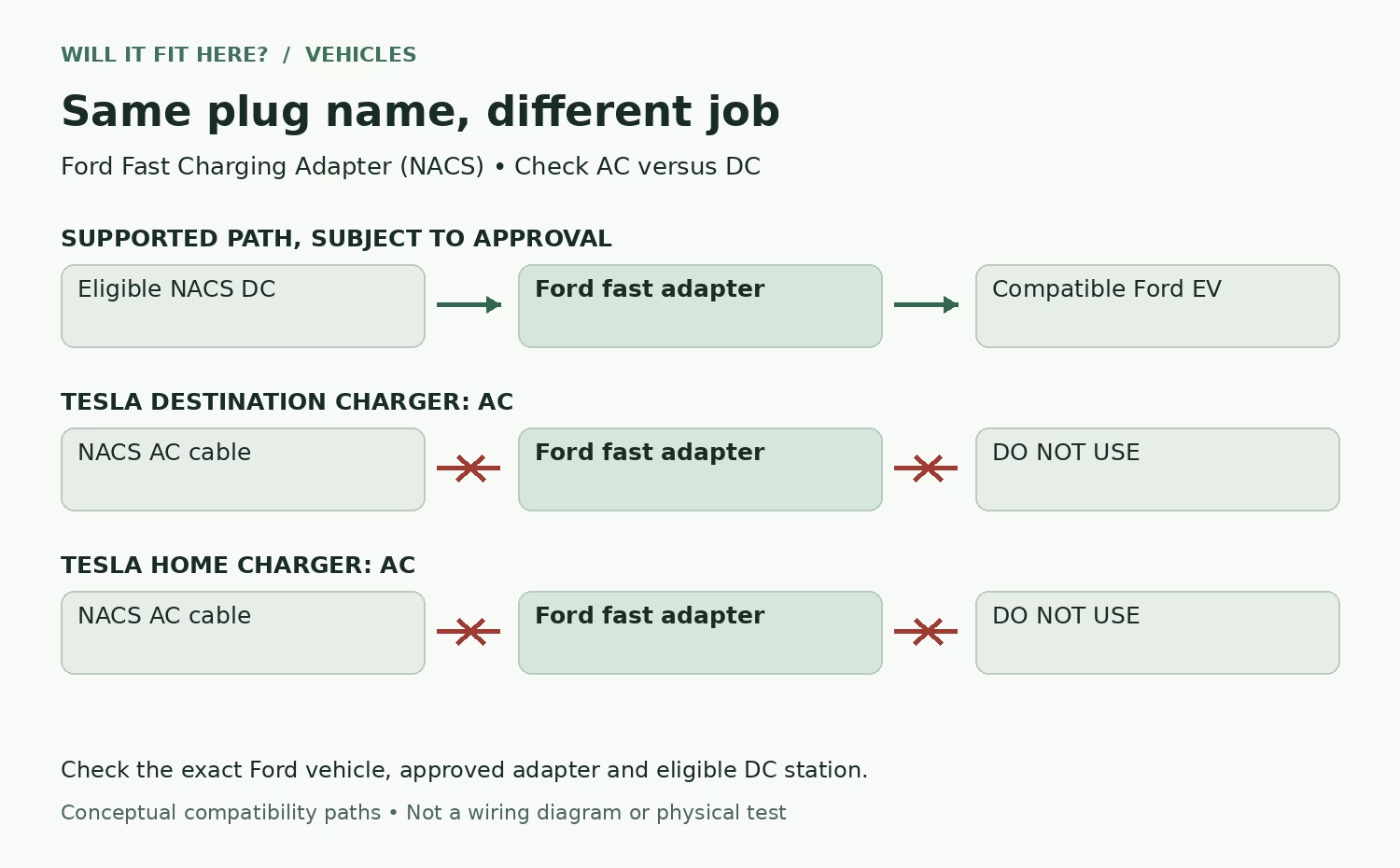
Make the Ford fast charging adapter AC/DC distinction
Treat “NACS” as only one field in the compatibility check. You also need the adapter’s intended charging mode, vehicle fitment and station eligibility. An accessory name that contains the right connector standard is insufficient purchasing evidence.
For this Ford product, the useful question is not whether you can persuade two pieces to mate. It is whether Ford authorizes this exact charging combination. An adapter is not a general-purpose promise to convert any station into the kind of supply your car expects.
- Read the adapter’s full name and part identification before comparing it with an online photograph.
- Read the charging unit’s label or official equipment description to establish AC or DC.
- Match the exact Ford model year and vehicle configuration to the adapter instructions.
- If any item is unclear, stop and ask Ford or the charging-equipment maker to identify the supported setup.
Ask the hotel the useful charging questions
“We have Tesla charging” is not enough information to plan an overnight stop. Ask which equipment is installed and how guests gain access. A hotel’s answer can help you select a location, but it does not replace Ford’s compatibility approval.
Here is a concise message to adapt for a hotel: “What is the exact manufacturer and model of your EV charging equipment, and what vehicle connector does its cable use? Is it AC destination charging or a DC fast charger? Can non-Tesla guests use it, and are there reservations, parking restrictions or charging fees?”
If possible, ask for a current photo of the equipment label and cable connector. Record the answer with the booking details. Do not turn a vague “yes, EV charging” response into an assumption that your Ford fast-charging adapter will work.
Before depending on that stop, identify a second charging option with equipment approved for your car. This is especially useful when the charging spaces cannot be reserved. Do not infer an overnight charging rate from an equipment name or a hotel’s estimated refill time.
Check a Mach-E and Tesla Wall Connector separately
A Mach-E/Tesla Wall Connector question is an AC equipment compatibility question for the exact vehicle and charger. The Ford accessory discussed here does not answer it. Record the Wall Connector’s model and connector version, then check Ford’s and the equipment manufacturer’s current instructions for that combination.
If you cannot establish an approved AC setup, use a charging station with a native connection supported by your car or get model-specific advice from Ford. This guide does not endorse a third-party AC adapter or propose changing the charger cable, household wiring or vehicle inlet.
Avoid spending money on a second product until the missing compatibility detail is resolved. A successful anecdote about a different model year, adapter brand or charger generation is not approval for your equipment.
The DC path still needs an eligible station
For a supported DC charging trip, verify the station with Tesla’s current vehicle-specific compatibility tools. Tesla permits its own or manufacturer-provided NACS DC adapters for this use and prohibits third-party adapters. Check access for the car you will actually drive.
Keep station availability, access and charging performance separate in your plan. A listed compatible site may be occupied or out of service, and a supported connection does not guarantee a particular charging rate. Follow the equipment’s instructions rather than improvising around a fault.
Keep a two-line charging plan
Use one line for the DC stop and a separate line for overnight AC charging. That small separation helps prevent packing the right accessory for the wrong kind of station.
| Planning field | DC fast-charging stop | Home or overnight AC |
|---|---|---|
| Exact site / equipment model | ___ | ___ |
| Cable connector identified | ___ | ___ |
| Vehicle and equipment approval checked | ___ | ___ |
| Required approved accessory | ___ | Not this Ford fast adapter |
| Access restrictions / alternative | ___ | ___ |
If equipment is damaged, a connector will not seat normally or the documentation conflicts, stop and contact the relevant support provider. Do not stack adapters, use extensions, defeat a latch or modify equipment to make a connection.
Sources and scope
References: Ford’s current Fast Charging Adapter product page, Ford’s December 5, 2024 adapter guide and Tesla’s current other-EV Supercharging guidance. Checked October 4, 2026. This is an enduring AC/DC compatibility issue, not a new model-year announcement. The hotel questions and planning worksheet are original decision aids; no physical charging test was conducted.