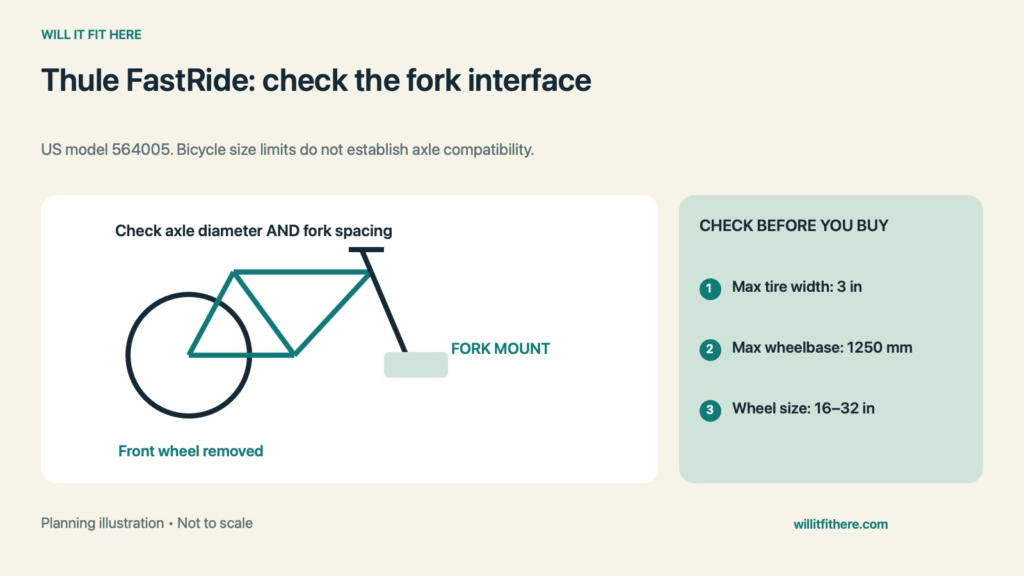
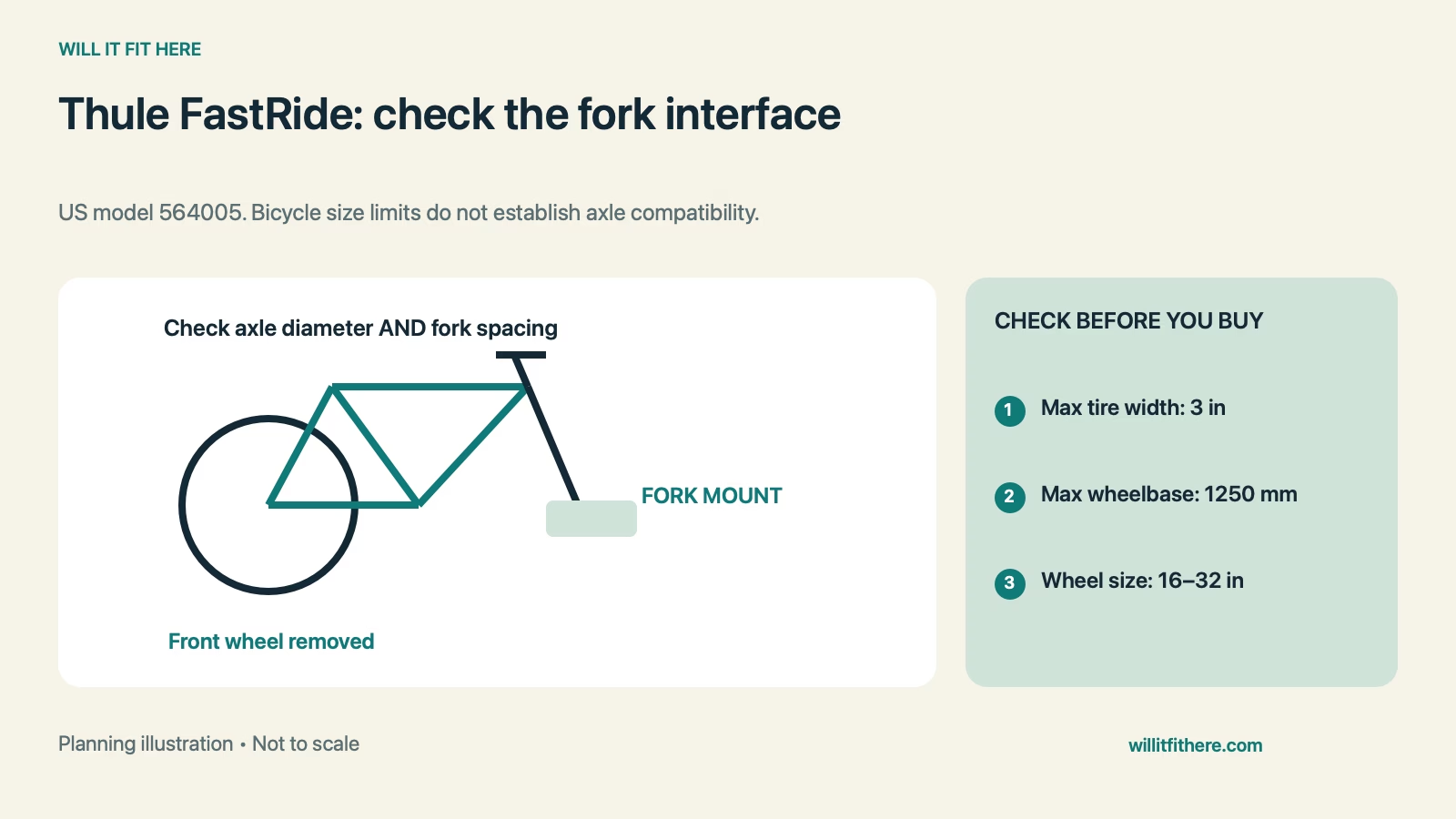
Fit verdict: Thule FastRide Fit starts at the fork, because this roof carrier requires the front wheel to come off. The US 564005 model accepts standard 9 mm quick-release bikes; specified thru-axle configurations require additional adapters. A bike that meets the tire and wheelbase limits can still fail at the fork interface, so check the connection before planning roof space.
This guide uses published specifications and planning calculations, not a firsthand product test. Examples are hypothetical.
Dimensions and conditions
| Measurement | Published specification |
|---|---|
| US model | 564005 |
| Carrier dimensions, length × width × height | 53 × 9 × 4 in |
| Maximum tire width | 3 in |
| Wheel size range | 16–32 in |
| Maximum wheelbase | 1250 mm |
| Published load capacity | 40 lb |
1. Identify the fork connection precisely
Begin the Thule FastRide Fit check with the bicycle or fork manufacturer documentation. Record quick-release or thru-axle, axle diameter, and hub spacing. A front axle described simply as “15 mm” is not a complete compatibility description. Inspect the exact adapter documentation rather than assuming a similarly sized part will engage correctly. This is especially important for unusual fork ends or accessories near the dropout. Do not modify a fork or adapter to make a near match work.
2. Match the required adapter to the bike
Thule lists the FastRide 9–15 mm axle adapter kit and a separate FastRide/TopRide 20 × 110 mm adapter among the supported accessories. Those product names are not permission to skip the kit instructions. Check that the specific bicycle interface appears in the adapter documentation and that every required part is present. Thule FastRide Fit is not established by tightening the carrier around an incompatible or incomplete adapter. Follow the prescribed assembly and confirmation steps.
3. Check the rear tire and wheelbase
The rear wheel remains on the bicycle and must fit the tray and strap. Compare the actual tire width with the published 3-inch maximum, and measure wheelbase between the wheel axle centers. Thule lists a 1250 mm maximum wheelbase and a 16–32-inch wheel-size range. Do not substitute the overall bicycle length for wheelbase. If the tire has been changed from the original specification, use the current tire and wheel combination in the check.
4. Confirm the carrier-to-roof connection
Thule FastRide Fit also depends on the vehicle rack system and installation instructions. The carrier page describes compatibility with Thule rack systems, round bars, and most factory racks, but “most” is not a vehicle-specific approval. Identify your crossbars and any required mounting hardware through the fit information. Check the vehicle roof limit, rack limit, carrier limit, and combined installed load. A carrier footprint that fits between other accessories does not settle clamp or track compatibility.
5. Plan front-wheel storage and loaded height
Removing the front wheel creates a second item to secure inside the vehicle or on a compatible wheel holder. Include that item in your travel plan before filling the cargo area. Measure the final vehicle height with the actual bicycle mounted correctly, then compare it with any garage or parking restriction. Do not estimate the loaded height from bicycle wheel diameter alone. Recheck the route when changing bicycles, roof bars, or carrier position.
Thule FastRide Fit: a worked example
Imagine a bicycle with a documented 15 × 110 mm front thru-axle, 2.6-inch tires, a 1210 mm wheelbase, and a transport weight below 40 lb. Its tire width is 0.4 inch below the published maximum, and its wheelbase is 40 mm below the maximum. Those numerical passes do not prove the fork fit. The next step is checking the applicable adapter instructions for that exact axle configuration, followed by the vehicle rack installation requirements. This Thule FastRide Fit example shows why a dimensional pass can remain conditional rather than becoming an automatic yes.
Before you decide
- Record the front-fork interface from reliable bicycle documentation.
- Confirm the exact adapter and all required components.
- Measure the current tire width and axle-to-axle wheelbase.
- Verify the crossbar installation and every applicable load limit.
- Secure the removed wheel and measure loaded vehicle height.
FAQ
Does the bike stay fully assembled?
No. This is a fork-mounted carrier, so the front wheel is removed. Thule FastRide Fit planning should include where that wheel will travel and how it will be restrained.
Will any 15 mm thru-axle bike fit?
Do not decide from diameter alone. Match the complete axle and fork configuration to the official adapter instructions. The available accessory must be appropriate for the exact interface.
Does the 40 lb limit override my roof limit?
No. The bicycle, carrier, roof rack, and vehicle must satisfy their applicable instructions and limits together. A lower limit elsewhere in the system can rule out an otherwise suitable bicycle.
Related fit guides
Thule ProRide 598 bike checks and Thru-axle dimensions and thread checks.
Official sources
Specifications checked November 5, 2026. Confirm the exact model and current instructions before purchase or installation.