Quick answer: Yes. The 2026 Toyota bZ J1772 adapter lets its NACS port use a compatible J1772 AC charger, so a new car does not automatically mean replacing your home charging station. Toyota includes a separate adapter for CCS1 DC fast charging. Confirm that both supplied accessories are actually with the vehicle. Toyota’s 2026 announcement confirms the standard adapter equipment.
The practical question is whether your existing charging cable can stay in service. Start with its connector and equipment label, then check the car’s adapter kit. This guide covers the US bZ with a factory NACS inlet; an older bZ4X needs its own model-specific check.
US-market vehicles. Sources checked October 4, 2026. This is a document-based compatibility guide, not a hands-on test.
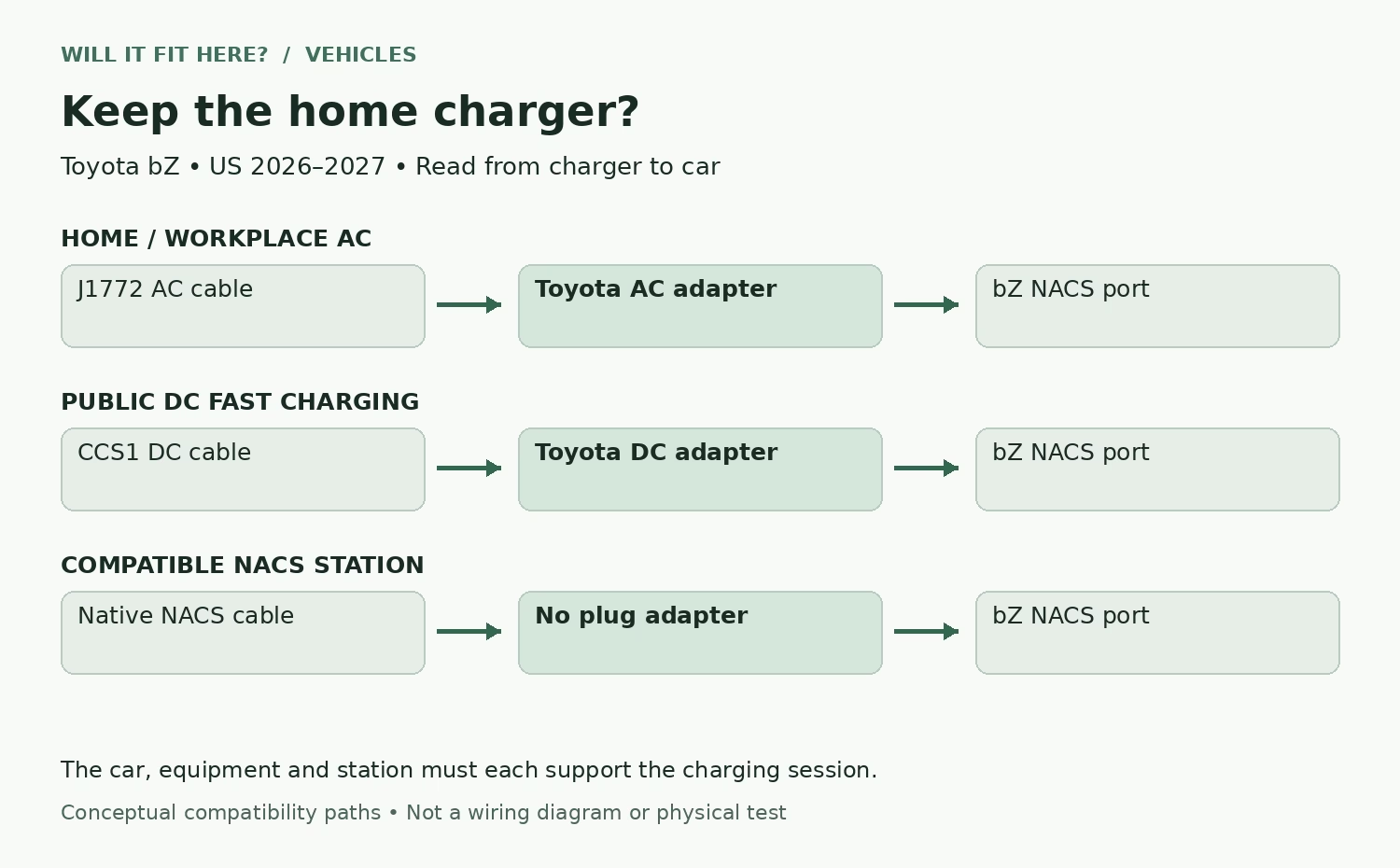
Choose the 2026 Toyota bZ J1772 adapter for AC charging
Toyota’s US bZ charging FAQ distinguishes two supplied charge-port adapters: one supports J1772 Level 1/2 AC equipment; the other supports CCS1 DC fast charging. Use the corresponding Toyota instructions rather than treating the kit as interchangeable plug converters.
| Cable at the station | Charging type | Connection to a NACS-port bZ |
|---|---|---|
| J1772 | AC, Level 1 or 2 | Toyota J1772-to-NACS adapter |
| CCS1 | DC fast charging | Toyota CCS1-to-NACS adapter |
| NACS | Supported AC or DC session | Direct connection; verify equipment and access |
Decide whether to keep your existing home charger
Do the identification work before shopping for a replacement. Photograph the label on the charging unit and the connector at the end of its vehicle cable. A photo of the household outlet alone does not identify the vehicle-side connection.
- Record the equipment model. Copy its manufacturer and exact model from the label. Keep the instructions beside the bZ manual.
- Confirm that the vehicle cable is J1772. Use the equipment documentation, not a marketplace photo or a seller’s broad “EV compatible” label.
- Check the approved combination. Match that equipment, your exact bZ and the supplied AC adapter against their instructions. Resolve an unclear rating or restriction with Toyota and the equipment maker.
- Inspect without altering anything. If a cable, connector or adapter appears damaged, stop using it and arrange service. Don’t force a connector or modify a latch.
- Separate the replacement decisions. A connector mismatch, damaged equipment, an unsuitable installation and a desire for different charging performance are separate reasons to seek advice. Buy only after identifying which problem you actually have.
Your bZ can use an old home charger when the J1772 equipment and the correct Toyota AC adapter are confirmed compatible. This guide does not assess your electrical circuit or prescribe an installation. Ask a qualified electrician about the supply and equipment installation if either is uncertain.
What changes for the 2027 bZ CCS adapter?
Toyota’s August 4, 2026 announcement for the 2027 bZ says the new model year retains native NACS and a standard kit for J1772 and CCS stations. That supports the same connector-selection decision for a US 2027 bZ. It does not prove that a particular used car or dealer delivery contains every original accessory.
Keep the model names straight on paperwork. Write “bZ,” the model year, trim and VIN when asking the dealer to identify an adapter. A parts listing for an older bZ4X, an overseas-market vehicle or another Toyota model is insufficient evidence for this car.
Check the kit before accepting delivery or buying used
Treat the adapters as individual inventory items. “Charging accessories included” is too vague to settle which one is present. Ask the seller to show the actual items and identify them from the Toyota documentation.
- J1772 AC adapter: present, identified and accompanied by its instructions.
- CCS1 DC adapter: separately present and identified.
- Portable charging cable: inventoried separately from the charge-port adapters.
- Any missing item: recorded on the sale or delivery paperwork with the agreed next step.
- Used-car accessories: checked directly; original standard equipment does not establish current possession.
If one is missing, ask a Toyota dealer to confirm the correct part for the VIN before paying for an alternative. Avoid buying a reverse-direction adapter simply because its listing includes both “NACS” and “CCS.”
Save this home-charger compatibility worksheet
- Vehicle: model year ___; trim ___; US-market VIN confirmed ___
- Charging unit: manufacturer ___; exact model ___
- Vehicle-side cable connector: ___; AC/DC designation: ___
- Toyota adapter identification: ___; matching instructions located ___
- Open question for Toyota or equipment maker: ___
- Outcome: retain equipment / seek clarification / arrange service ___
This worksheet is an original buying aid, not a certification. Keep it with your equipment records so someone helping with the car can see what was checked.
Know what an adapter cannot promise
At Tesla sites, check vehicle-specific access using Tesla’s current compatibility guidance. A matching plug alone does not authorize a session. Successful charging and its speed still depend on the supported vehicle-and-station combination and operating conditions.
A familiar NACS shape also does not establish AC/DC compatibility for a different product. The Ford Fast Charging Adapter’s home-charger limitation is a useful example of why an adapter’s stated purpose matters. Follow the exact Toyota instructions here; do not stack adapters, add a charging extension or improvise a connection.
Sources and scope
Primary references: Toyota 2026 equipment announcement, Toyota 2027 model announcement, Toyota bZ FAQ and Tesla network eligibility guidance. The checklist and worksheet are editorial decision aids. No vehicle, charger or adapter was physically tested for this article.