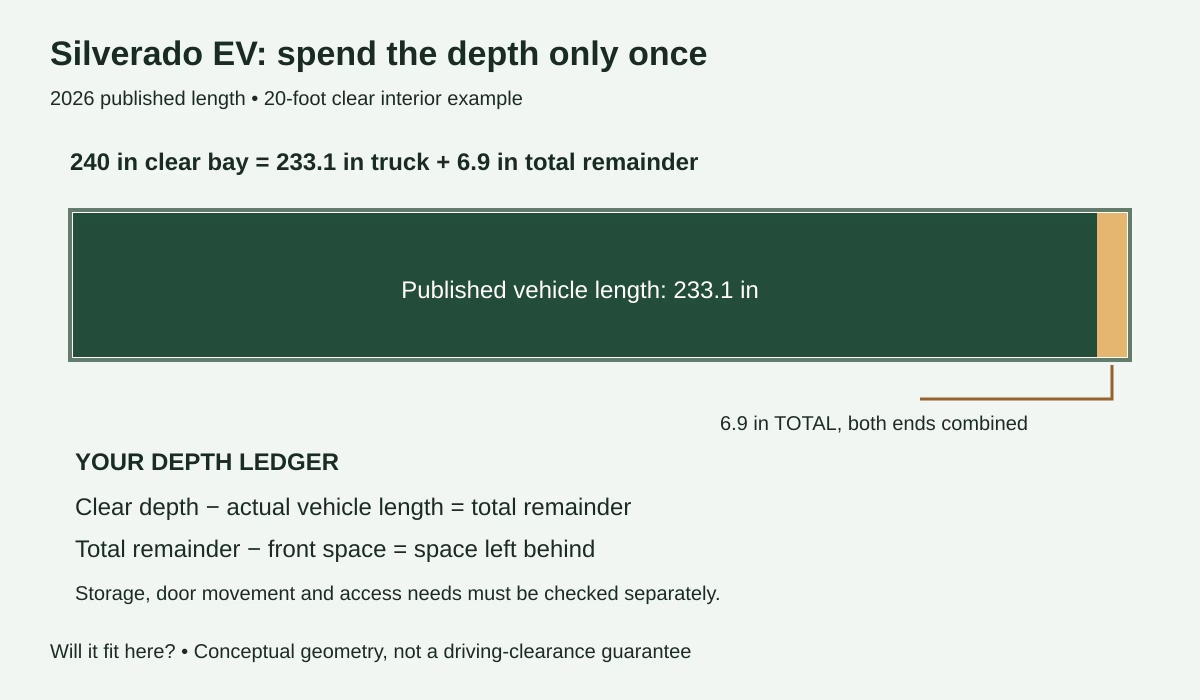
Quick answer: A 2026 Chevrolet Silverado EV is 233.1 inches long. A genuinely clear 20-foot (240-inch) interior leaves only 6.9 inches total for both ends combined. That is a bare length subtraction, not a comfortable-fit verdict. Measure the usable closed-door depth, then check the exact trim’s width and height separately.
Checked October 4, 2026 · US specifications · Documentation and measurement guide; no hands-on fit test.
This 2026 Silverado EV garage check treats truck length, usable depth and access as separate decisions. Keep the 6.9-inch result as one total remainder, then assign space to the front and rear before calling the bay usable.
Start with the 2026 Silverado EV and trim
The Chevrolet 2026 Silverado EV specification table lists the same 233.1-inch overall length for the lineup. Trail Boss has a different mirror span and height. These are Silverado EV figures; do not substitute measurements from a gasoline Silverado.
| 2026 trim | Length | Width with mirrors | Height |
|---|---|---|---|
| WT | 233.1 in | 94.3 in | 78.0 in |
| LT | 233.1 in | 94.3 in | 78.1 in |
| Trail Boss | 233.1 in | 95.6 in | 79.9 in |
Using the published inch figures, the calculated equivalents are 5,921 mm long; 2,395 or 2,428 mm across the mirrors; and 1,981, 1,984 or 2,029 mm high. These nearest-millimeter conversions can differ slightly from Chevrolet’s separately rounded metric specifications. Do not mix units mid-calculation.
Build a depth budget before calling it a fit
A listing that says “20-foot garage” may describe an outside dimension or a plan dimension. Start with the actual interior, measured with the garage door closed. You need the distance to the nearest obstruction at every height the vehicle occupies.
| Hypothetical measured clear depth | Subtract truck length | Total remainder |
|---|---|---|
| 240 in (20 ft) | 233.1 in | 6.9 in (175 mm) |
| 238 in | 233.1 in | 4.9 in (124 mm) |
| 234 in | 233.1 in | 0.9 in (23 mm) |
| 232 in | 233.1 in | −1.1 in (−28 mm) |
The negative result means the published truck length exceeds that straight clear bay. A positive result only means the length is smaller. It does not reserve space for people, charging, a tailgate or the garage door’s movement.
Imagine a wall-to-door dimension of 240 inches with an 8-inch-deep stored item projecting into the truck’s space. Usable depth becomes 232 inches, shorter than the published truck. Record the tightest actual distance directly; do not subtract a shelf twice if your first measurement already started at its front edge.
The front-and-rear space ledger
| Measure or choose | Your number |
|---|---|
| Actual clear parked depth, door closed | ___ in |
| Vehicle length, including any projecting installed item | ___ in |
| Total remainder: depth minus vehicle length | ___ in |
| Space planned ahead of the front bumper | ___ in |
| Space left behind: total minus front space | ___ in |
For the unmodified published length and a clear 240-inch bay, allocating 4 inches ahead would leave 2.9 inches behind. That example explains where the 6.9-inch remainder goes; it does not recommend either clearance.
Mark the front and rear vehicle limits on a plan before visiting a dealer. Note the closed garage door, the path it sweeps while moving, the charge connection and the access you need. A bumper fitting between two lines does not demonstrate that the garage door can close around it.
Width and Trail Boss height can stop the plan
| True 96-inch opening | Mirror-open width | Total width difference |
|---|---|---|
| WT / LT | 94.3 in | 1.7 in (43 mm) |
| Trail Boss | 95.6 in | 0.4 in (10 mm) |
Those are extremely small static differences, especially the Trail Boss result. Do not use them as permission to drive through an 8-foot opening. Any turn, misalignment or narrower actual opening can change the result. The cited table does not provide a folded-mirror width, so a body-only width must not be used as a substitute.
For reference, Chevrolet lists widths without mirrors of 81.6 inches for WT/2LT and 83.8 inches for 3LT/Trail Boss. Mirrors remain physical parts of the truck even when folded; measure the relevant configuration.
At a hypothetical true 84-inch overhead opening, the 79.9-inch Trail Boss height leaves 4.1 inches (104 mm) by subtraction. Check the lowest raised-door edge, hardware and the approach slope, as well as installed accessories. The nominal height of the garage door is not the usable height along the route.
Keep the depth ledger with a simple sketch of the actual bay. Mark the closed door’s innermost obstruction, the rear wall and any permanent storage that occupies the truck’s path. Label the measuring points so a second person can repeat the measurement. Write down the exact trim and the truck configuration you checked; a seller’s generic Silverado description is insufficient for this EV comparison.
Next, assign each planned use to a location on the sketch: where the driver exits, where charging equipment is reached, and where any unloading happens. Record the space those actions require in your actual setup rather than adding an invented universal clearance allowance. If two uses need the same remaining strip, show that conflict in the ledger. The 6.9-inch length remainder cannot be spent twice.
A number that barely clears the truck’s published length is a reason to gather better measurements. Resolve an uncertain obstruction or door position before making the buying decision. Keep usable depth, mirror width and overhead clearance as separate results, and repeat the check if shelving, a charger position or the truck’s configuration changes.
What to resolve before buying
Ask the dealer to measure the exact trim and configuration while stationary if your available space is close to the published dimensions. Compare that measurement with your garage survey before trying an uncertain entry.
- Can the closed garage door clear the whole vehicle and any fitted accessories?
- Can occupants enter and leave at the intended parking position?
- Can the charging connection be used without pinching its cable?
- Will you need to open the tailgate or front storage indoors?
- Is there a verified alternative parking place if the bay fails the check?
Do not make the plan depend on suspension lowering, sensors or angled parking recovering a shortfall. Those involve configuration or path questions that a straight-line length table cannot answer. The useful conclusion is specific: a true 20-foot bay leaves just 6.9 inches around the published truck length, and that alone does not establish workable daily parking.