Quick answer
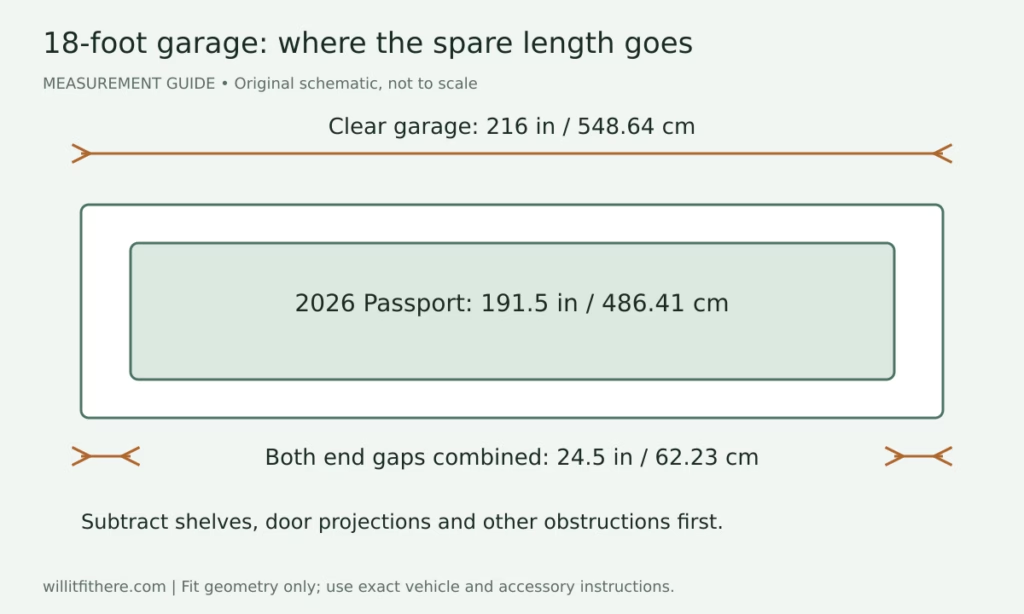
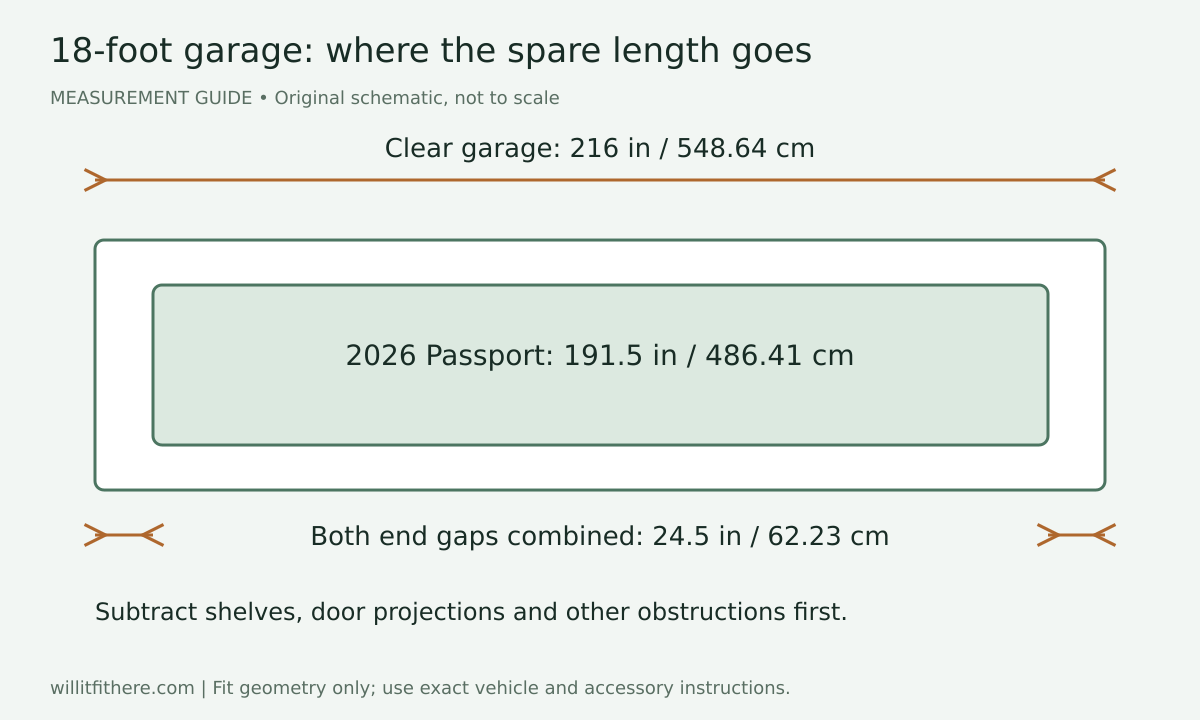
By length alone, the 2026 Honda Passport fits inside a genuinely clear 18-foot space: 216 minus 191.5 leaves 24.5 inches total. That is combined front-and-rear space, before shelves, door hardware and access needs. Width, mirrors, roof accessories and the garage door’s travel still require separate checks.
Use the year-specific 2026 dimensions
The Honda Information Center’s 2026 Passport specification table lists 191.5 inches of length, 79.4 inches of width and 73.1 inches of height across the listed trims. Those correspond to approximately 486.4, 201.7 and 185.7 cm. Use that year-specific production table for this calculation.
Generic vehicle pages can roll over to the next model year. Early launch material can also differ from later production specifications. Keep the year visible in your saved source rather than mixing a preview dimension with a current trim table. If a few tenths of an inch decide your purchase, measure the actual vehicle and its accessories.
| Published dimension | 2026 Passport | What it does not establish |
|---|---|---|
| Length | 191.5 in / 486.4 cm | Clearance with added rear accessories |
| Width | 79.4 in / 201.7 cm | Width across the mirrors |
| Height | 73.1 in / 185.7 cm | Height with a rack or cargo box |
Do not treat the published width as a mirror-to-mirror measurement. The table’s width value cannot substitute for the operating mirror envelope at your doorway.
Find the usable depth with the garage door shut
An “18-foot garage” may refer to a building plan, exterior dimension or approximate listing measurement. Your usable length runs from the nearest fixed obstruction at the front to the closed door or its projecting hardware at the rear. Measure inside, along the actual parking position.
Look for a shelf, workbench, cabinet handle, stair or low foundation ledge. An obstruction only matters when it overlaps the vehicle’s envelope, but do not assume a bumper will tuck neatly beneath a shelf without checking both heights. Mark every relevant projection on a simple plan.
Measure with the garage door fully closed and the space empty. Keep clear of moving mechanisms and never disable door sensors for a fit test. If the door has unusual hinges, a tilt-up path or an inward sweep, its operating envelope can be more restrictive than its final resting position.
Calculate the combined front-and-rear space
Eighteen feet equals 216 inches, or 548.64 cm. Subtract the published vehicle length: 216 − 191.5 = 24.5 inches, or 62.23 cm. This is the entire remaining depth, not the clearance at each bumper.
If centered in a perfectly unobstructed rectangle, the arithmetic gives 12.25 inches at each end. Real parking may deliberately leave more at one end and less at the other. Choose that distribution for your actual use; the calculation is not a recommended minimum walkway or parking margin.
Now add a hypothetical 10-inch-deep cabinet projecting into that vehicle envelope. Clear depth becomes 206 inches, leaving 14.5 inches total. Reserve 6 inches at the front and only 8.5 inches remain behind. This worked example shows how quickly storage consumes the headline surplus. It is not a measurement of your garage.
Treat the doorway and getting out as separate tests
Measure the narrowest clear doorway width, including weather seals, jamb trim and projecting handles. Then measure the actual Passport across its mirrors in the position you intend to use. A body-width calculation cannot establish whether the mirrors clear.
For perspective, an 8-foot opening is 96 inches. Subtracting the 79.4-inch published width produces 16.6 inches total, but that is only a body-envelope comparison. It would be misleading to divide it into a claimed driving margin while ignoring the mirrors. Use the measured mirror envelope instead.
Inside the garage, open the driver’s door to the position you need for normal entry and exit. Test with neighboring cars, storage and wall projections in place. The doorway may be wide enough while the parked position leaves too little room to get out comfortably. Door-opening space is not captured by overall vehicle width.
Check roof height and hatch travel
The 73.1-inch factory height is a starting value. Measure the highest point on your actual vehicle if it has crossbars, a roof box, aftermarket equipment or other changes. Compare that with the lowest point on the route, not simply the height printed on a garage-door brochure.
A door that does not retract completely can hang below the header. Tracks, an opener rail, lights and overhead storage may create a lower point farther inside. A sloping driveway can also change the vehicle’s relationship to the doorway during entry, so a close static comparison needs a vehicle-side assessment.
The closed vehicle height does not establish raised-tailgate clearance. Decide whether you need to open the tailgate inside, and check the complete movement using the vehicle’s instructions. If the garage only accommodates parking with the hatch shut, that may still meet your needs, but record it as a limitation.
Make a parking plan before a vehicle trial
- Draw the measured clear garage rectangle and each fixed obstruction.
- Mark a 191.5-inch length as the initial vehicle outline, then allow for actual accessories.
- Choose where the front and rear boundaries need to sit.
- Check the measured mirror envelope against the narrowest doorway.
- Check driver-door access and any required passenger access.
- Check the highest point and any overhead travel restrictions.
If the paper check is close, arrange a controlled trial with the exact vehicle rather than relying on a different showroom SUV. A helper can observe from a safe position outside the travel path. Stop before a questionable clearance and measure again; contact with the door or wall is not a measuring method.
After a successful trial, record the parked position and relevant clearances. A visual parking reference may make repetition easier, but it does not replace keeping the space clear or observing the garage-door instructions.
Questions that change the answer
Does 24.5 inches mean plenty of space? It means only that much combined unused length in an ideal clear rectangle. Your required walkway, storage access and door travel determine whether it is enough for everyday use.
Will folding the mirrors solve the garage? It may alter the entry width, but you still need the actual folded width and a practical entry procedure. It cannot solve insufficient depth, roof height or driver-door space.
Can I use this for another model year? Recheck that year’s specifications. Similar styling is not evidence of identical length or accessory dimensions. This article deliberately uses the 2026 production table.
The final garage-fit decision
Call the result a confirmed fit only after depth, entry width, parked access and height have all been checked for the intended setup. “Fits by length” is a useful intermediate result, but it is not the whole garage decision.
Sources checked October 5, 2026. Metric figures are converted from the published US inch values and rounded where shown. Garage dimensions and cabinet examples are illustrative, not property measurements or minimum-clearance standards.