Quick Answer
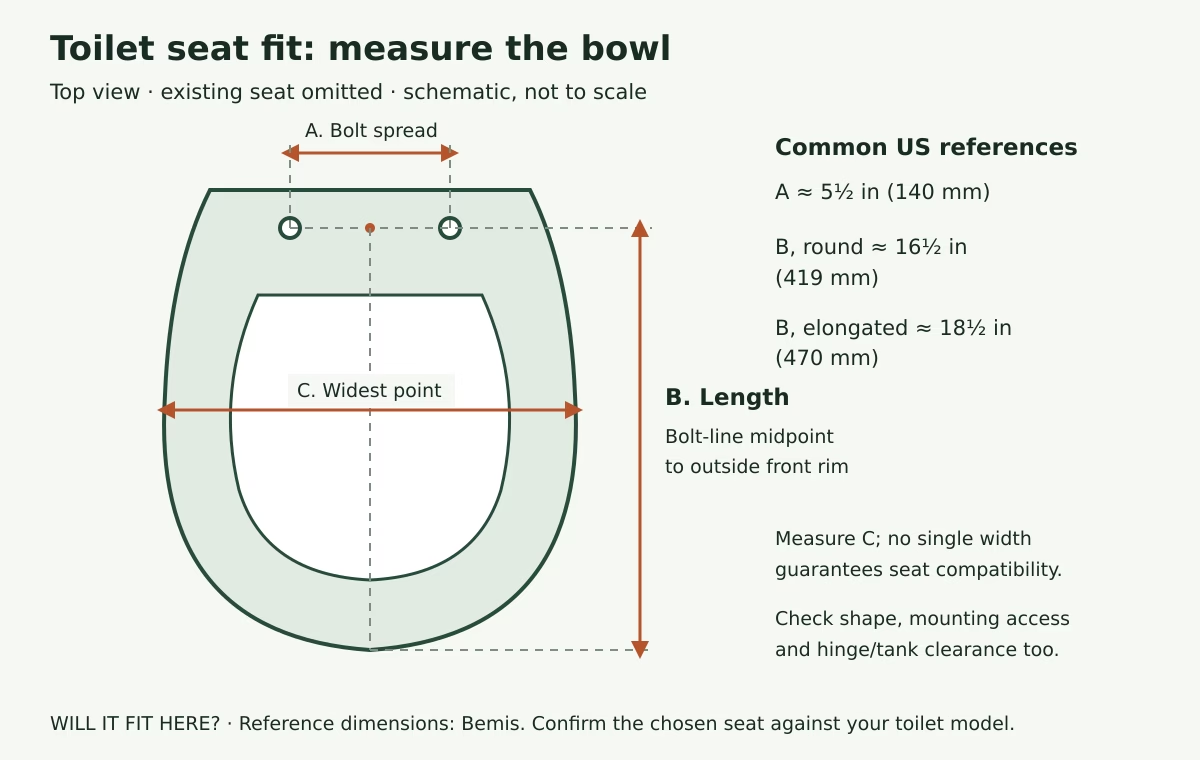
Toilet seat sizes start with the bowl, not the old lid. For many US residential toilets, a bowl measuring about 16½ inches (419 mm) from the mounting-hole midpoint to the outside front rim points to a round seat; about 18½ inches (470 mm) points to elongated. A common bolt-hole spread is 5½ inches (140 mm), center to center. Confirm shape, width, mounting hardware and clearance before buying.
This guide is for regular, non-powered replacement seats. Specialty bowls and unusual mounting arrangements need a toilet-model or manufacturer compatibility check.
Toilet seat sizes at a glance
The common reference measurements below follow Bemis’s bowl-measuring guide. They help identify a likely category; they are not universal pass/fail limits for every toilet.
| Check | Common US reference | Measurement endpoints |
|---|---|---|
| Round-front bowl length | About 16½ in / 419 mm | Mounting-hole line midpoint to outside front rim |
| Elongated bowl length | About 18½ in / 470 mm | Same endpoints as round |
| Bolt-hole spread | About 5½ in / 140 mm | Center of one hole to center of the other |
| Bowl width | Measure your bowl | Outside edge to outside edge at its widest point |
The common length difference is 2 inches (50.8 mm). A rounded-looking front alone will not reliably distinguish the categories: measure before selecting the package label.
Do not mix measurement types. A retailer’s overall seat length may use different endpoints from your bowl measurement. Kohler’s buying guide, for example, describes round-front seat lengths of 16¾ inches (about 425 mm) or less and elongated seats of 18⅝ inches (about 473 mm) or more. Those seat descriptions are not substitute thresholds for the bowl measurements above. Use the dimensioned drawing for the specific product.
Measure the bowl in three places
Use a clean tape measure and record inches or millimeters consistently. Raise the lid and seat so you can identify the ceramic bowl edges. Do not assume the existing seat is the right size: a previous replacement may already overhang or fall short.
A. Bolt spread: center to center
Locate the two mounting-hole centers and measure the straight-line distance between them. Do not measure the outer edges of hinge covers or bolt heads. If covers hide the location and you cannot identify it without dismantling unfamiliar hardware, use the existing instructions or obtain the toilet’s model information.
B. Bowl length: bolt line to front rim
Find the midpoint between the two mounting-hole centers. Measure from that point straight forward along the bowl centerline to the outside front rim. A straightedge across the hole centers can help establish the starting line.
Do not begin at the tank, the back edge of the lid or the rear of the entire toilet. Do not end at the inner opening. Those measurements describe different distances and can send you to the wrong seat category.
C. Bowl width: the widest outside point
Measure side to side across the bowl’s widest outside edges, perpendicular to the centerline. Record the bowl’s outline as well as the number: a photo taken from directly above helps show a squared, D-shaped or otherwise unusual profile. Avoid relying on an angled photo alone for dimensions.
Check shape, hardware and clearance
Length and bolt spread narrow the search. The remaining checks help prevent buying a seat that attaches but sits poorly on the bowl.
- Outline: compare the bowl with the product’s intended shape and its dimensioned drawing. An elongated label alone does not establish a specialty bowl match.
- Mounting access: inspect how the current fasteners are reached. If you cannot reach nuts below the bowl, confirm that the replacement has a mounting method approved for that toilet. A skirted or one-piece design may call for a specific fixing arrangement.
- Hinge and tank clearance: compare the chosen seat’s hinge area and opening path with the space behind the holes. Check whether the seat and lid can open as intended without hitting the tank or another obstruction.
- Support: use the maker’s fit instructions to confirm the seat and its bumpers sit on the intended bowl surfaces. Matching bolt holes alone is not enough.
- Model-specific requirements: use the toilet model and manufacturer guidance when dimensions, shape or supplied hardware leave a question unanswered.
This is a selection check, not an installation procedure. Do not drill the ceramic or improvise mounting hardware to make a questionable match work. Follow the seat and toilet instructions for installation.
Choose your next step
| Your measurement or observation | Next step |
|---|---|
| Near 16½ in (419 mm), ordinary round outline | Compare round seats; verify width, spread, mounting and clearance. |
| Near 18½ in (470 mm), elongated outline | Compare elongated seats; verify the same remaining checks. |
| Length between the reference values or outside them | Recheck the endpoints, then identify the toilet model. Do not round into whichever category is on sale. |
| Bolt spread differs from about 5½ in (140 mm) | Use the actual measurement and model; check the specified adjustment range or dedicated seat. |
| Square, D-shaped or other specialty outline | Search the toilet maker’s compatible-seat list or ask the manufacturer with your model and photos. |
| Bolts are inaccessible or mounting method is unclear | Resolve the fixing arrangement before ordering or removing the old seat. |
Example: if the bowl measures about 18½ inches long but the old seat stops short of the rim, the old lid’s length is a poor shopping reference. Use the bowl measurements to investigate elongated replacements, then verify the exact candidate’s fit.
Toilet seat shopping worksheet
Save these details alongside a top-view photo and a photo of the hinge area. Keep an unanswered item visible rather than treating it as a match.
| Item to record | Your toilet | Candidate seat / result |
|---|---|---|
| Toilet brand and model, if available | ________ | ________ |
| A: mounting-hole center spread | ________ | ________ |
| B: bolt-line midpoint to front rim | ________ | ________ |
| C: widest outside bowl width | ________ | ________ |
| Bowl shape / outline | ________ | ________ |
| Fastener access and mounting method | ________ | ________ |
| Hinge / tank opening clearance | ________ | ________ |
Read the product drawing’s arrows before copying a dimension into this card. An overall product length, a bolt-to-front dimension and an opening length may all appear on one drawing. Compare like endpoints with like endpoints.
Before-you-buy checklist
- Measure the ceramic bowl rather than copying the old seat.
- Record length, maximum width and center-to-center bolt spread.
- Match the outline and check the exact product drawing.
- Confirm the fasteners can be installed using the approved method.
- Check hinge and lid clearance behind the mounting holes.
- Resolve specialty-model or uncertain-fit questions before ordering.
Toilet seat sizing questions
Are toilet seats universal?
No. Common round and elongated categories simplify shopping, but shape, mounting arrangement and clearance can still differ. “Fits most” should prompt a compatibility check for your bowl.
Can an elongated seat fit on a round bowl?
Even when mounting holes line up, the length and support may be wrong. Buy the shape and dimensions specified for the bowl rather than judging fit only by whether the bolts go through.
Does a compact toilet always need a round seat?
No. The toilet’s overall footprint is not the seat measurement. Check the bowl endpoints and model; Kohler’s guide explicitly includes compact elongated toilets among elongated-seat applications.
What if my measurement is slightly different from the chart?
First repeat it using the mounting-hole midpoint and outside front rim. Then consult the toilet model and chosen seat’s drawing. The rounded references are category clues, not a universal tolerance rule.
Should I measure the inside opening?
Not to identify the round-versus-elongated reference length in this guide. That length ends at the outside front rim; the opening is a separate dimension.