Quick answer: Faucet aerator sizes must match the part type, thread gender, diameter and pitch. Common U.S. housing examples include male 15/16-27 and female 55/64-27, but hidden aerators and other designs need their own specifications. A close diameter does not establish compatibility: 15/16-27 is not M24 × 1.
Identify the part you are replacing
Look at the outlet with the water off. A visible metal ring often holds an insert and washer. A recessed part may have its own threads and need a matching removal key. A pull-out spray head can use a model-specific assembly, so start with the faucet’s parts diagram rather than assuming it accepts a standard ring.
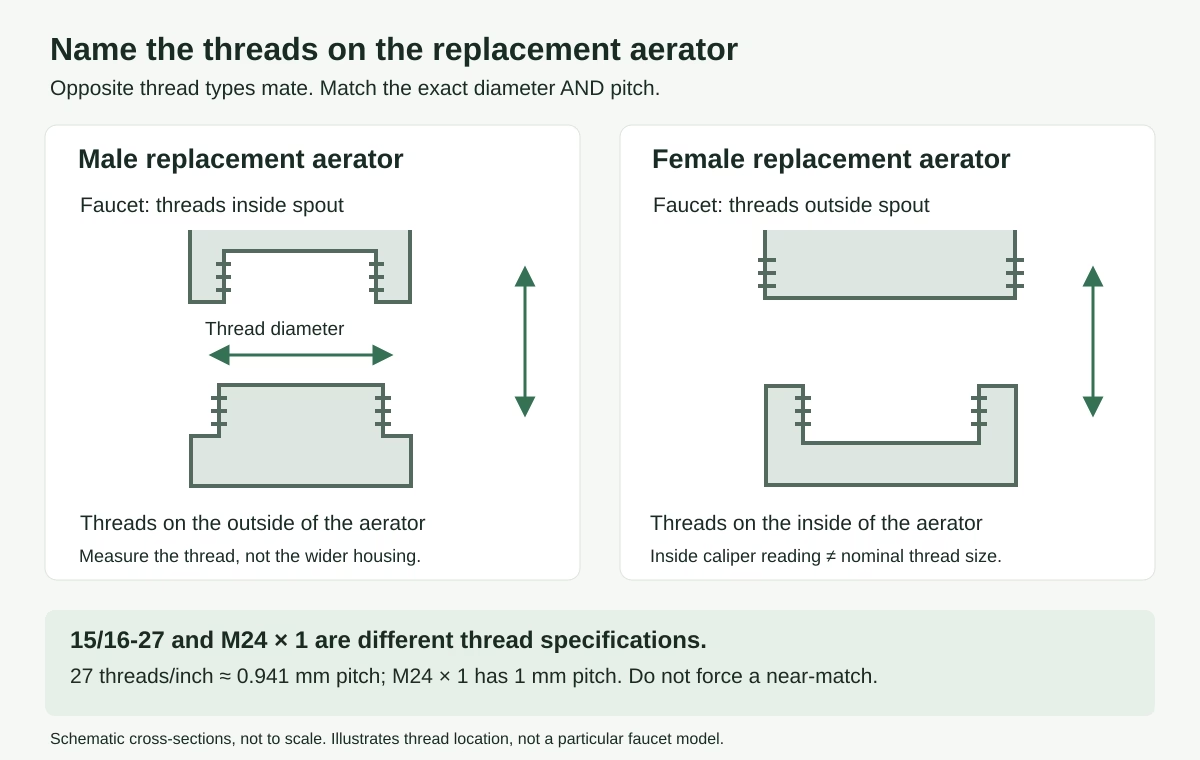
When a listing says male aerator, the replacement part has outside threads and screws into a faucet with inside threads. A female aerator has inside threads and goes over outside threads on the faucet. Always say which part you mean when asking a store for help.
Decide whether you need the complete housing assembly or only the insert. An insert has its own size and height requirements; the faucet’s thread label alone does not identify it. Neoperl distinguishes housing, insert and washer as separate components.
Faucet aerator sizes and thread labels
These are examples from Neoperl’s housing range, not a complete list of faucet connections. The gender below always describes the replacement aerator housing.
| Housing label | Thread on replacement | Nominal diameter, for reference |
|---|---|---|
| Regular U.S. male | 15/16-27 | 15/16 in ≈ 23.81 mm |
| Regular U.S. female | 55/64-27 | 55/64 in ≈ 21.83 mm |
| Junior U.S. male | 13/16-27 | 13/16 in ≈ 20.64 mm |
| Junior U.S. female | 3/4-27 | 3/4 in = 19.05 mm |
| Metric male example | M24 × 1 | 24 mm ≈ 0.945 in |
| Metric female example | M22 × 1 | 22 mm ≈ 0.866 in |
Source: Neoperl housing specifications. Inch-to-millimeter values above are calculated conversions of the nominal labels, not caliper acceptance limits.
The second number matters. In 15/16-27, 27 means 27 threads per inch. That works out to a pitch of about 0.941 mm. In M24 × 1, the pitch is 1 mm. Although their diameters look close, these are different threads. Neither rounding a measurement nor getting the first turn started proves a match.
A dual-thread product offers the two connections stated in its specification. Check both labels; “dual-thread” does not cover every faucet.
How to measure without guessing
- Find the faucet model first. Check purchase records, a model label or the manufacturer’s parts page. Record the aerator part number and flow specification if available.
- Photograph the outlet before removal. Close or cover the drain so a washer or small component cannot disappear. Follow the faucet’s removal instructions and use its specified key. If the part is stuck or the tool does not engage, stop rather than gripping and crushing it.
- Keep the pieces together. Photograph the old assembly and its orientation. A washer can remain in the spout; inspect for it before adding another. Neoperl’s replacement instructions explain this common trap.
- Measure the correct feature. On an external male thread, use calipers across the thread crests, avoiding the wider decorative ring. Record the reading in inches and millimeters. On an internal female thread, an inside-jaw measurement is only an identification aid: it does not directly give the nominal mating thread diameter.
- Confirm the thread specification. Use the model’s documentation, a correctly fitting original part or a supplier’s thread gauge to establish both diameter and pitch. Do not choose a near match from diameter alone.
A ruler or coin can narrow a search, but cannot resolve close diameters or pitch. Bring the old assembly to the supplier if you cannot establish an exact specification.
Hidden aerators: identify the product family, complete thread designation, body height, seal and compatible tool. Neoperl’s integrated-thread range includes multiple metric and U.S. sizes. A key’s color or a “standard” label is not enough to identify an unknown faucet across brands.
Choose the next step
| What you find | What to do |
|---|---|
| Exact faucet model and part number | Use the specified replacement and installation instructions. |
| Visible housing with known thread; intact matching insert identified | Choose either the specified full assembly or that exact insert and seal combination. |
| Only an approximate diameter | Confirm the pitch and part format before ordering. |
| Recessed, rectangular or unusual outlet | Use the model-specific parts drawing and tool. |
| Replacement catches, tilts or stops early | Stop. Recheck specification and inspect for damaged threads. |
| Correct thread but persistent leak | Recheck the specified seal and assembly. Do not solve it by forcing tighter. |
Replacement shopping worksheet
Copy this card into your phone before shopping. “Unknown” is a useful answer if it tells the supplier what still needs checking.
| Record | Your faucet / proposed replacement |
|---|---|
| Faucet brand, model and aerator part number | ________________ / ________________ |
| Part format: housing, insert only or integrated thread | ________________ / ________________ |
| Gender of replacement aerator | ________________ / ________________ |
| Complete thread label, including pitch | ________________ / ________________ |
| Measured diameter and where measured | ________________ / ________________ |
| Insert height or body depth, seal type and tool | ________________ / ________________ |
| Specified flow rate and stream type | ________________ / ________________ |
Keep the manufacturer-approved flow specification and any applicable local requirements. For comparing labels, 1 U.S. gallon per minute is about 3.785 liters per minute. Do not remove a flow-control component to make a replacement work or to increase the flow.
Check the fit before using the faucet
- The part number or complete thread specification is confirmed.
- The housing, insert and seal belong together; no old washer is doubled underneath.
- The replacement engages squarely without force and is installed to its own instructions.
- The permitted flow specification and intended stream type match the faucet’s requirements.
- After installation, a brief water-on check shows no leak around the connection.
If it leaks, turn the water off and revisit the seal and specification. If the faucet threads are damaged, buying progressively tighter-fitting aerators is not a repair. Ask the faucet maker for the correct service option.