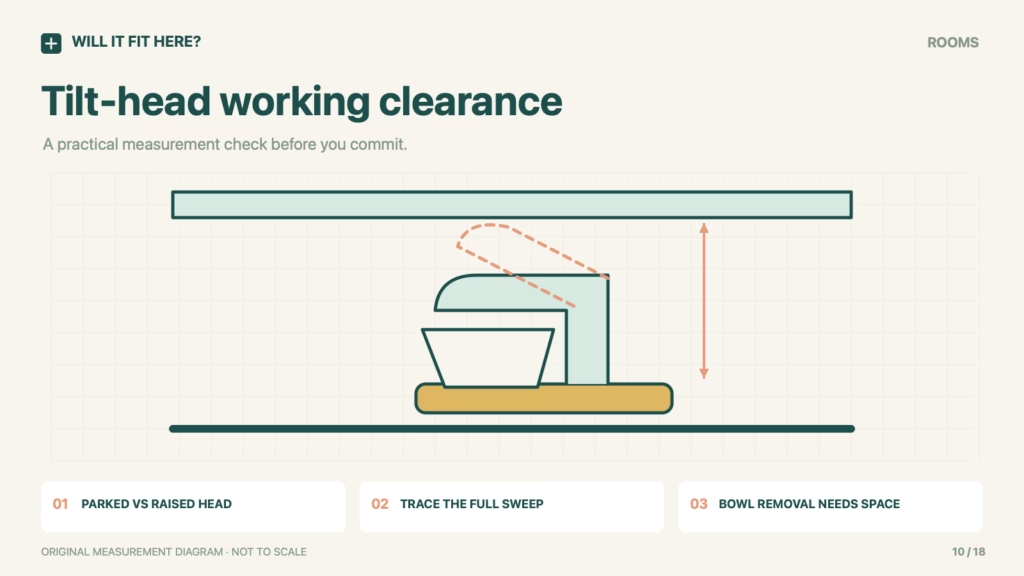
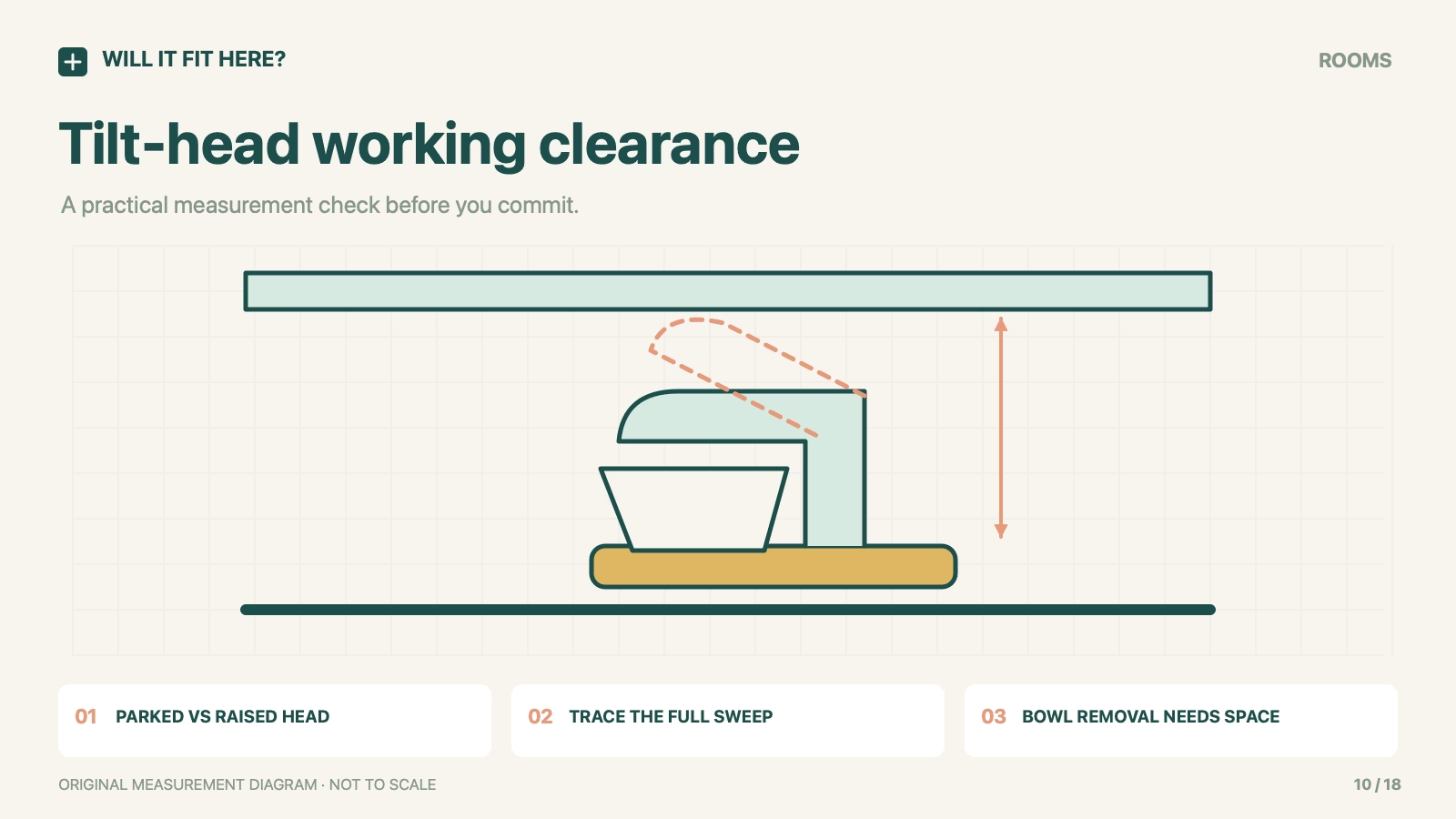
Fit verdict — Conditional. KitchenAid tilt-head fit beneath an upper cabinet must be checked with the head raised and the bowl handled normally, as well as with the mixer parked. KitchenAid describes full-size tilt-head models as about 14 inches high and the Mini as about 12½ inches. Those broad descriptions are not raised-head clearance specifications. Measure the exact model and the complete tilt movement before calling the counter position usable.
KitchenAid tilt-head fit: scope
KitchenAid tilt-head stand mixers. Model-specific dimensions and instructions control; bowl-lift and Mini models must not inherit a full-size model’s envelope.
Dimensions and conditions
| Check | Reference or condition | What it means |
|---|---|---|
| Full-size reference | About 14 in parked height | Approximate family description in KitchenAid’s comparison. |
| Mini comparison | About 12½ in parked height | Not interchangeable with a full-size model. |
| Raised-head height | Measure the exact mixer through its movement | No universal raised-head number is asserted. |
| Overhead obstruction | Lowest cabinet edge, light or rail | Measure the actual intrusion. |
| Bowl and accessory handling | Observe removal and insertion paths | Storage fit does not establish working access. |
1. Mark parked and working positions for your KitchenAid tilt-head mixer
Draw one outline for the mixer as stored and another for the area where it will be used. If the plan is to move it forward, check that the full base remains supported and that the lead is not pulled tight. Do not assume a narrow strip of clear counter supports every model. The useful question is whether the normal setup can be reached without tilting the mixer or trapping its cord.
2. Trace the entire head movement
With the appliance disconnected and handled according to its instructions, observe the head’s permitted upward movement. Check the sweep, not only the final raised point. A low cabinet rail can meet the head partway through the motion. Include room to change the beater and remove the bowl. Record the exact model and any pouring shield or attached accessory so later comparisons describe the same assembly.
3. Include ingredients and cleanup
Plan where the removed bowl will go and where ingredients can be added without meeting the cabinet underside. Check access to the speed control and head lock from the normal standing position. A mixer parked deep in a corner can fit vertically yet be awkward to load and clean. Use a full operating-position outline rather than making the heaviest part of the decision from a single catalogue height.
Before you decide: 5 checks
- Identify the exact tilt-head model and matching manual.
- Measure the lowest obstruction above the real support surface.
- Separate storage from a fully supported operating position.
- Check the head sweep and bowl/accessory removal route.
- Check cord movement, controls, ingredients and cleanup access.
FAQ
Will an opening slightly above 14 inches work?
That compares only with an approximate parked family height. The actual model, raised head and bowl access still need checking.
Can I use bowl-lift dimensions for a tilt-head mixer?
No. The mechanisms have different operating movements and access needs.
Is there one extra gap I should add?
No universal extra gap is asserted here. Measure the exact working envelope and follow the model’s instructions.
Official sources and scope
Checked on 26 October 2026. The cited product, variant and region control. Follow the matching current instructions. The measurement workflow is editorial guidance; no firsthand installation or universal fit is claimed.